



ISLAMABAD: Pakistan has emerged in a stronger diplomatic position following the brief but intense May 2025 conflict with India, as Prime Minister Narendra Modi’s long-standing efforts to isolate the country have shown limited success.
The four-day escalation in May 2025, triggered by an attack on tourists in Indian-administered Kashmir, ended with a US-brokered ceasefire announced by President Donald Trump on May 10. Pakistani officials confirmed the truce after intense fighting that involved ballistic missiles, fighter jets, and drones along the Line of Control.
Dozens of civilians and military personnel were killed on both sides during the clashes, according to official statements from Islamabad and New Delhi. Pakistan’s military reported shooting down multiple Indian fighter jets in the initial phase of the conflict. Indian military leadership later acknowledged the loss of several aircraft, though exact numbers remain disputed.
Prime Minister Shehbaz Sharif publicly thanked President Trump for his mediation role immediately after the ceasefire. In contrast, Indian officials initially maintained that the truce resulted from bilateral channels. Trump has since referenced the agreement more than 30 times, describing it as averting a larger nuclear crisis.
**Pakistan’s Strategic Partnerships**
In the year since the conflict, Pakistan has deepened ties with key global players. Prime Minister Sharif visited China this week, reinforcing the “iron brothers” relationship that includes substantial cooperation under the China-Pakistan Economic Corridor.
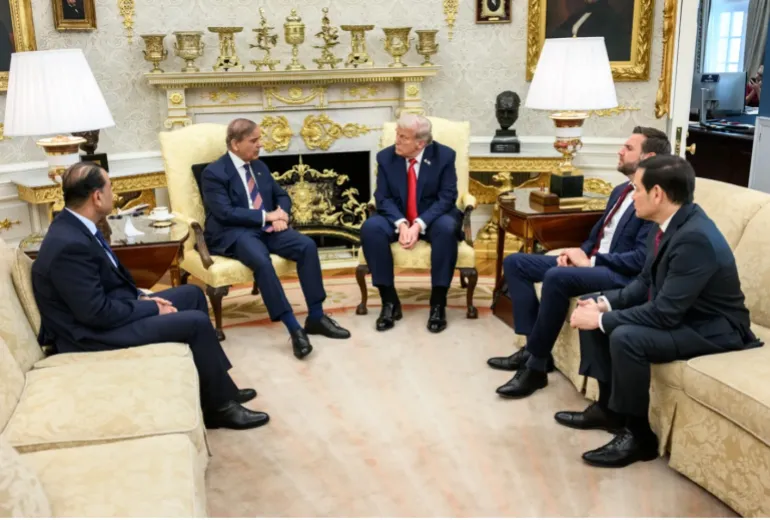
Pakistan’s army chief General Asim Munir and Prime Minister Sharif both held meetings with President Trump at the White House over the past year. Islamabad has also played a central role as mediator between the United States and Iran amid their ongoing tensions.
Analysts note that these engagements demonstrate Pakistan’s ability to balance relations across major powers despite regional pressures. Trade figures with China reached new milestones in 2025, while cooperation with Middle Eastern states expanded in defence and energy sectors.
The conflict itself stemmed from an attack in Pahalgam that killed 26 tourists in Indian-administered Kashmir. India responded with strikes on alleged terror sites inside Pakistani territory. Pakistani authorities denied involvement and highlighted the absence of conclusive evidence presented by New Delhi to the international community.
**Ceasefire Dynamics and Regional Impact**
The ceasefire agreement covered the heavily militarised border regions, including areas in Punjab and Kashmir sectors. Both sides withdrew forces to pre-conflict positions within days.
Trump later offered to facilitate broader talks on the Kashmir issue, a position traditionally opposed by India, which insists on bilateral resolution of disputes. Modi declined an invitation to meet Trump in Washington in June 2025 during a visit to Canada, instead reiterating New Delhi’s stance against third-party mediation.
Pakistan nominated President Trump for the Nobel Peace Prize for his role in the truce. The US president has repeatedly praised Pakistani leadership, including General Munir, marking a notable shift from earlier rhetoric during his first term.
**Economic and Security Context**
Pakistan’s economy showed resilience during the crisis period. The State Bank of Pakistan reported stable foreign exchange reserves supported by inflows from allied nations. Inflation, which had hovered around 12-15 percent in early 2025, benefited from post-ceasefire stability and renewed diplomatic engagements.
Defence analysts pointed to the performance of Pakistani air defence systems during the May clashes. The downing of Indian jets highlighted improvements in indigenous capabilities developed over recent years.
Background to the tensions traces back to the 2016 Uri attack and subsequent surgical strikes, as well as the 2019 Balakot incident. The 2025 episode represented the most serious direct engagement between the two nuclear-armed neighbours in decades.
**Reactions from Key Stakeholders**
Chinese officials expressed support for de-escalation while reaffirming strategic partnership with Pakistan. Middle Eastern countries, including Saudi Arabia and the UAE, welcomed the ceasefire and continued economic cooperation with Islamabad.
Within Pakistan, public sentiment reflected relief at the swift end to hostilities alongside pride in the military’s response. Government sources indicated sustained focus on economic recovery and counter-terrorism efforts.
Indian domestic politics showed divisions over the handling of the crisis, with opposition voices questioning the initial strike decisions and subsequent diplomatic outcomes.
**Broader Strategic Implications**
The developments suggest that efforts to diplomatically isolate Pakistan have faced challenges due to evolving global priorities. Pakistan’s position as a bridge in US-Iran communications and its reliable partnership with China have strengthened its leverage.
Moving forward, regional stability will depend on sustained ceasefire adherence along the Line of Control. Both countries face domestic economic pressures that could influence future engagement patterns.
Diplomatic observers anticipate continued US interest in South Asia, particularly regarding trade routes and counter-terrorism. Pakistan has signalled openness to dialogue while maintaining its core positions on outstanding issues, including Kashmir.
The coming months may see further high-level engagements as Islamabad balances multiple partnerships amid shifting international alignments.