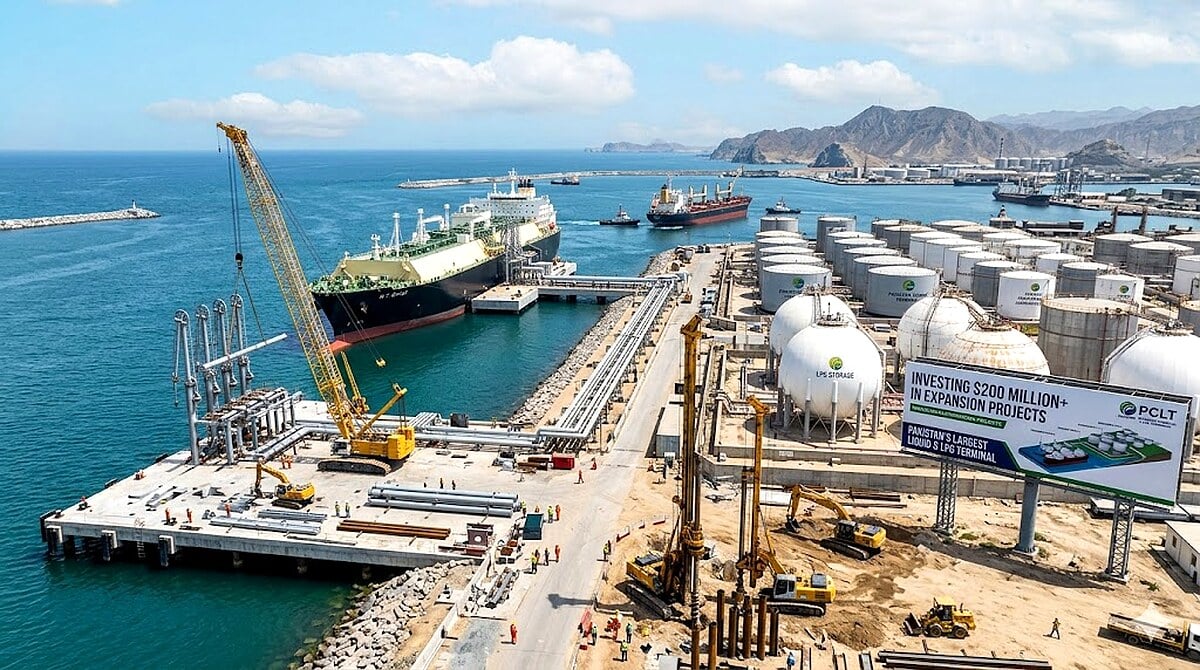




ISLAMABAD: Engro Vopak Terminal Limited (EVTL), Pakistan’s largest bulk liquid chemical and LPG terminal operator, has unveiled plans to invest more than $200 million in infrastructure expansion following the renewal of its Implementation Agreement with the Port Qasim Authority (PQA).
The investment will focus on enhancing storage and handling capabilities, including a feasibility study for refrigerated LPG infrastructure to boost the country’s energy security.
EVTL, a joint venture between Pakistan’s Engro Corporation and Netherlands-based Royal Vopak, operates the country’s only integrated bulk liquid chemical and LPG terminal at Port Qasim in Karachi.
The agreement renewal ensures continued operations at the critical facility, which handles approximately 70 percent of Pakistan’s bulk liquid chemical imports and around 50 percent of its marine LPG imports.
This development comes at a time when Pakistan is working to strengthen its energy supply chain and attract foreign investment amid ongoing economic stabilization efforts.
EVTL Chief Executive Officer Syed Ammar Shah described the renewal as a vote of confidence in Pakistan’s regulatory environment and long-term economic potential.
“The agreement renewal secures operational continuity for infrastructure that supports multiple sectors of the economy,” Shah said.
He thanked government institutions including the Port Qasim Authority, Ministry of Maritime Affairs, Oil and Gas Regulatory Authority (OGRA), and the Economic Coordination Committee (ECC) for their support throughout the transparent process.
The terminal plays a vital role in Pakistan’s import logistics, serving key industries such as agriculture, textiles, construction, plastics, and energy production.
By providing efficient import and storage solutions, EVTL’s operations generate annual savings of approximately $500 million for the national economy through optimized handling of essential industrial and energy products.
The proposed expansion includes new LPG and chemical infrastructure projects. A feasibility study for refrigerated LPG storage is expected to begin in the coming months.
Refrigerated storage would allow for larger volumes and more stable supplies of LPG, reducing dependency on spot market volatility and enhancing reliability during peak demand periods.
Pakistan relies heavily on imported energy resources to meet domestic needs. LPG imports have grown steadily as the fuel gains importance for household consumption and industrial applications.
Current marine LPG import volumes through the terminal support a significant portion of national supply. The expansion aims to address growing demand driven by population growth and industrial recovery.
Royal Vopak, the world’s largest independent tank storage company, maintains its partnership with Engro, signaling continued foreign investor interest in Pakistan’s port and energy infrastructure.
The move aligns with broader government efforts to modernize port facilities and improve trade logistics under initiatives like the Special Investment Facilitation Council (SIFC).
Industry experts view the investment as a positive signal for energy security and private sector participation in critical infrastructure.
**Background and Operational Significance**
EVTL has operated at Port Qasim since the early 2000s, establishing itself as a key player in handling hazardous chemicals and LPG with high safety standards.
The terminal features state-of-the-art facilities for jetty handling, storage, and direct pipeline delivery to industries, minimizing road transportation risks.
Over the years, it has consistently expanded capacity in response to rising import volumes. The current agreement extension follows international best practices for build-operate-transfer (BOT) models used in critical infrastructure worldwide.
Pakistan’s chemical and LPG import sector has witnessed substantial growth. Bulk liquid chemical imports support fertilizer production, plastics manufacturing, and other downstream industries that contribute significantly to GDP and employment.
LPG, meanwhile, remains a preferred cooking and heating fuel for millions of households, particularly in areas with limited access to natural gas networks.
**Economic and Strategic Impact**
The $200 million-plus investment is expected to create construction jobs, enhance terminal capacity, and generate long-term operational employment.
It will also strengthen Pakistan’s position as a regional logistics hub by improving handling efficiency and reducing turnaround times for vessels.
Market analysts note that such expansions can help stabilize prices and supplies in the domestic LPG market, which has faced seasonal shortages in the past.
The refrigerated LPG component could enable Pakistan to better manage strategic reserves and respond more effectively to international price fluctuations.
Foreign direct investment in energy infrastructure remains a priority for economic policymakers. EVTL’s announcement demonstrates how existing operators can scale up commitments when provided policy certainty.
**Future Outlook**
The feasibility study for refrigerated infrastructure will assess technical requirements, environmental considerations, and projected returns.
Successful implementation could pave the way for further investments in Pakistan’s port sector and related supply chain developments.
As the country pursues macroeconomic stability and energy diversification, projects like EVTL’s expansion are likely to play an increasingly important role.
Government officials have indicated that similar extensions and modernization efforts for other terminals may follow, depending on performance and national needs.
EVTL has committed to maintaining the highest safety and environmental standards during the expansion phase.
The company continues to work closely with regulatory bodies to ensure compliance and smooth project execution.
This investment underscores the private sector’s role in addressing Pakistan’s infrastructure gaps and supporting sustained economic growth.
Further details on timelines and specific project components are expected as the feasibility studies progress in the coming months.