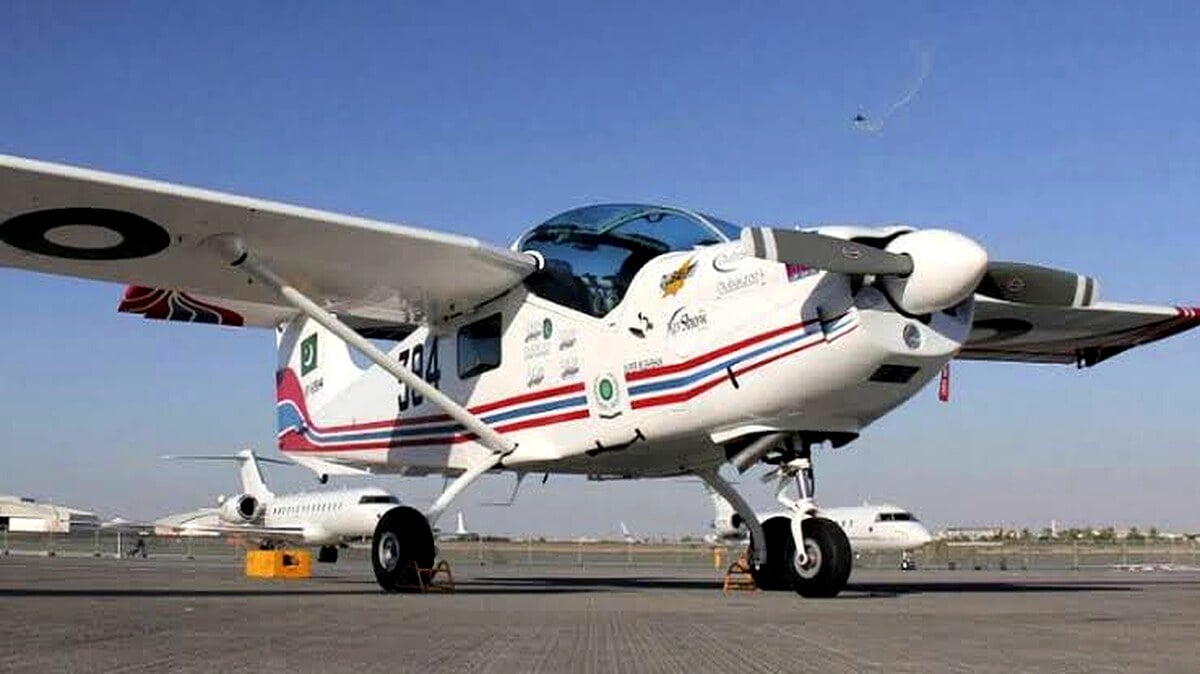




A Pakistan Air Force Super Mushshak trainer aircraft crashed in the Sawaldher area near Katlang in Mardan district on Monday morning.
The incident occurred around 8:12 a.m. during a routine training sortie.
Both pilots on board lost their lives.
They have been identified as Flight Lieutenant Muhammad Qasim Abdullah of the Pakistan Air Force and Lieutenant Taha Abbasi of the Pakistan Navy.
Flight Lieutenant Qasim served as an instructor pilot while Lieutenant Taha was undergoing training.
The Inter-Services Public Relations confirmed the crash in an official statement.
According to initial reports the aircraft developed a technical fault mid-flight.
Eyewitnesses and officials noted that the pilots heroically steered the failing plane away from populated areas and residential houses.
They directed it toward Katlang Road minimizing potential harm to civilians on the ground.
Two civilians sustained minor injuries from debris following the impact.
Local residents rushed to the site offering immediate assistance.
Rescue teams and PAF personnel reached the location shortly afterward.
The Super Mushshak also known as the PAC MFI-395 is a key primary trainer aircraft in the PAF fleet.
Manufactured by the Pakistan Aeronautical Complex it features a 260 horsepower piston engine and advanced glass cockpit options.
The aircraft supports basic flight training aerobatics and light attack roles with capabilities including laser-guided munitions.
It serves as a backbone for pilot induction in Pakistan and has been exported to several allied nations including Turkey which recently received dozens of units.
This latest tragedy comes as the PAF continues rigorous training programs to maintain operational readiness.
Mardan has seen previous incidents involving trainer aircraft but fatal outcomes remain relatively rare.
Air Headquarters has immediately constituted a board of inquiry to determine the exact cause of the technical malfunction.
Investigators will examine flight data maintenance records and possible mechanical issues.
The PAF maintains a strong safety culture with continuous upgrades to its training infrastructure.
Chief of Army Staff Field Marshal Syed Asim Munir expressed deep grief over the loss.
He along with other service chiefs paid tribute to the fallen officers calling them heroes who sacrificed in the line of duty.
President Asif Ali Zardari and Interior Minister Mohsin Naqvi also extended condolences to the bereaved families.
They highlighted the pilots dedication to the nation.
Lieutenant Taha Abbasi was remembered as a promising young officer while Flight Lieutenant Qasim Abdullah had recently tied the knot and was known for his professionalism.
Their martyrdom underscores the inherent risks in military aviation training.
Pakistan’s armed forces operate in a demanding environment with diverse terrain and high operational tempo.
Trainer aircraft like the Super Mushshak play a critical role in preparing pilots for advanced fighter jets such as the JF-17 and F-16.
The PAF Academy at Risalpur near Mardan serves as a primary hub for such training activities.
Loss of experienced instructors impacts the training pipeline though the force has robust replacement mechanisms.
Officials emphasized that such incidents prompt thorough reviews to enhance safety protocols.
Pakistan has expanded its indigenous aircraft production capabilities through PAC Kamra.
The Super Mushshak program reflects self-reliance in defense manufacturing with ongoing modernization efforts.
Recent exports demonstrate growing international confidence in Pakistani aviation technology.
This crash however brings renewed focus on pilot safety and aircraft reliability.
Military aviation worldwide faces similar challenges with technical faults contributing to a significant portion of accidents.
In Pakistan the PAF has recorded a declining trend in mishap rates over the years due to better maintenance and training standards.
Still every loss reminds the nation of the supreme sacrifices made by its defenders.
Communities in Mardan expressed solidarity with the armed forces.
Prayers were offered at local mosques for the departed souls.
The injured civilians received prompt medical attention.
As investigations proceed the PAF continues its mission without pause.
Training sorties remain essential for national defense preparedness.
The incident has sparked discussions on further investments in simulation-based training to reduce risks in actual flights.
Such measures could complement live flying hours effectively.
Pakistan’s strategic location demands a highly skilled and resilient air force.
Incidents like this test the resolve of the institution and the families left behind.
The two officers embodied the spirit of service before self.
Their legacy will inspire future generations of aviators.
Condolences continue to pour in from across the country and beyond.
The board of inquiry is expected to submit its findings in due course.
Until then the PAF has grounded similar aircraft for precautionary checks.
This step ensures fleet safety during the probe.
The nation stands united in honoring the martyrs.
Their sacrifice reinforces the commitment to a strong and secure Pakistan.