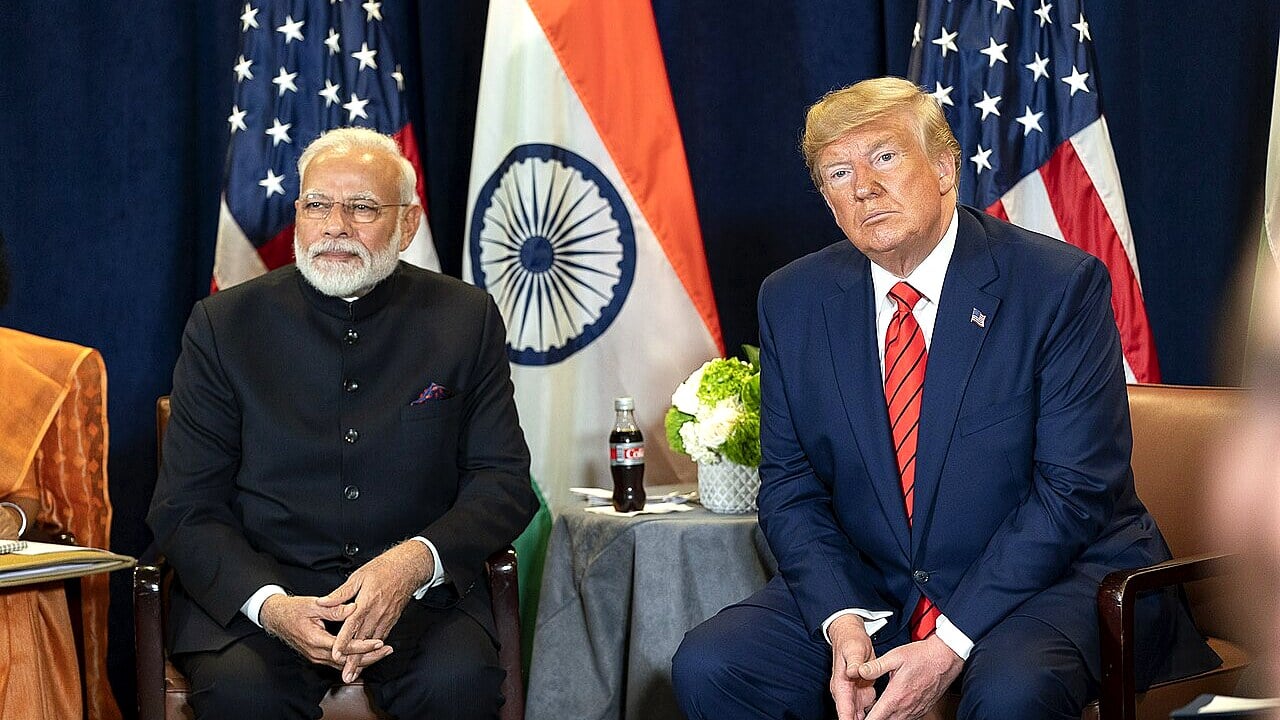




at G7 Summit
ISLAMABAD: US President Donald Trump on Tuesday assured support to India if attacked, during bilateral talks with Prime Minister Narendra Modi on the sidelines of the G7 Summit in Évian-les-Bains, France.
Trump made the remarks while addressing Modi directly in a light-hearted exchange captured on video. He stated that America would stand by India in case of an attack and sought confirmation from the Indian leader on the strength of the statement.
The US president then added a personal note, saying the United States would defend Modi specifically, but expressed uncertainty about support under a different Indian leadership. Modi responded with laughter during the interaction.
The meeting marked the first face-to-face engagement between the two leaders in 16 months. Discussions covered trade progress, energy security, regional stability, and supply chain issues amid ongoing global tensions.
Trump described Modi as a “total killer” in negotiations, “calm, cool,” and someone who appears like an “angel” but operates with toughness. The comments underscored the personal rapport between the two leaders.
Pakistani officials have closely monitored the development given longstanding regional dynamics. The statement comes at a time when India-US defence and economic ties have expanded significantly over the past decade.
Bilateral trade between the US and India reached approximately $190 billion in recent fiscal data, with defence sales forming a growing component. The US has approved major platforms including Predator drones and advanced fighter jet components for India in recent years.
The G7 Summit, hosted by French President Emmanuel Macron from June 15 to 17, provided the setting for multiple bilateral engagements. Trump and Modi’s meeting occurred amid discussions on broader Indo-Pacific strategy and economic cooperation.
Indian government sources described the talks as productive, focusing on reducing trade barriers and enhancing strategic partnership. No immediate joint statement was issued on the security assurance, but the public exchange highlighted the transactional nature of the relationship under Trump’s approach.
In Islamabad, foreign policy analysts noted the implications for South Asian security architecture. Pakistan maintains its own strategic partnership with the United States, particularly in counter-terrorism and economic domains, with US aid and cooperation frameworks continuing despite fluctuations.
The US has historically balanced relations with both India and Pakistan. Defence cooperation with Pakistan includes support for counter-terror operations, while recent years saw increased focus on India as a counterweight in the region.
Trump’s personal framing of support tied to Modi’s leadership drew varied reactions across South Asian social media platforms. Some Indian commentators viewed it positively as strong endorsement, while others in Pakistan and parts of the region saw it as reflective of personality-driven diplomacy rather than institutional commitment.
Official Pakistani circles have not issued a direct response so far. However, strategic experts in Islamabad emphasise the importance of diversified foreign policy engagements, including with China, Russia, and Gulf states, to maintain equilibrium.
The exchange occurs against the backdrop of recent regional developments, including US involvement in Middle East stabilty efforts and ongoing concerns over terrorism. India has increased defence spending to around 2.4 percent of GDP, with significant allocations for indigenous platforms and foreign acquisitions.
US-India defence agreements, such as the COMCASA and LEAP agreements, have facilitated deeper interoperability. Annual joint military exercises like Yudh Abhyas and Malabar underscore operational coordination.
For Pakistan, the development reinforces the need for sustained diplomatic engagement with Washington. Bilateral trade with the US stands at over $6 billion, with textiles and other sectors playing key roles. Security cooperation remains active in areas of mutual interest.
Analysts suggest such statements may influence regional threat perceptions. India faces security challenges along its northern and western borders, with reported ceasefire violations and militant activities documented in official tallies.
The US has maintained strategic ambiguity in South Asia while deepening select partnerships. Trump’s second term has emphasised reciprocal trade and burden-sharing in alliances.
Future trajectories of US-India ties will likely depend on progress in trade negotiations, where differences over tariffs persist. Recent reports indicate efforts to finalise aspects of a bilateral trade agreement.
Pakistan continues to advocate for balanced US approach in the region to support stability and economic developm