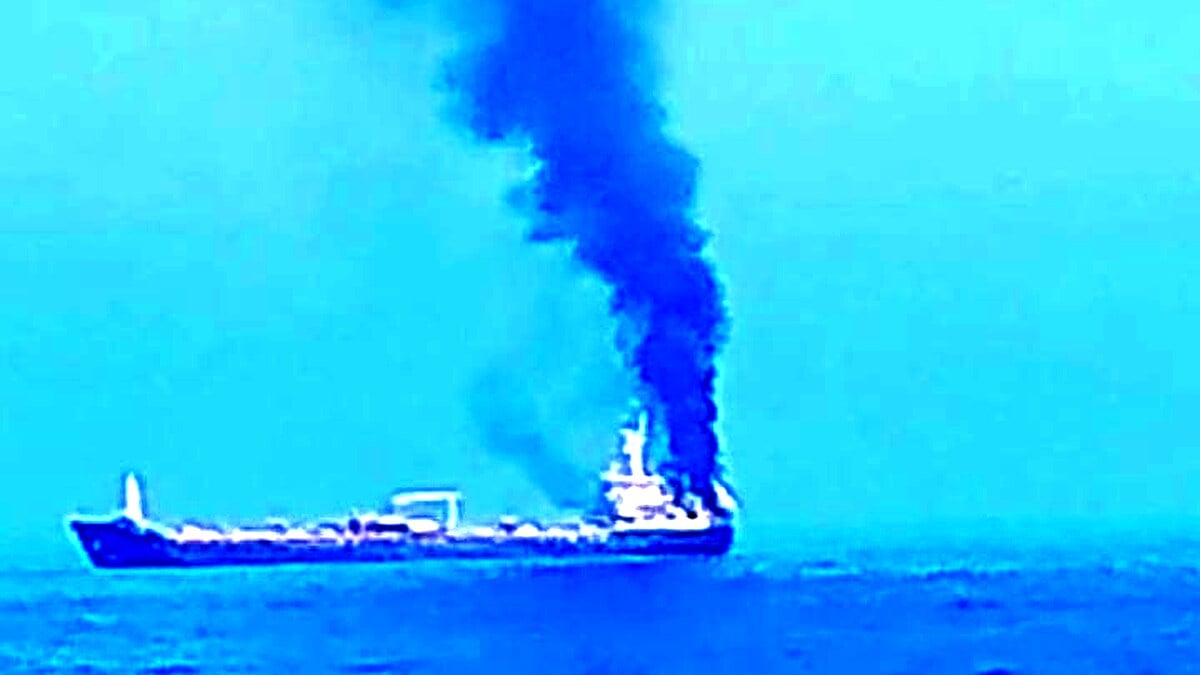




ISLAMABAD: US military forces have conducted strikes on a third commercial vessel carrying Indian sailors in the Gulf of Oman region near the Strait of Hormuz in the past four days, according to maritime reports and official statements.
No attacks have been reported on vessels with Pakistani or Chinese crew members during the same period.
The latest incident involved the Palau-flagged tanker MT Settebello, struck on June 10 by a US precision munition. Three Indian sailors were killed, while 21 others were rescued. This follows similar actions against vessels with Indian crew on June 8 and an earlier strike within the timeframe.
US Central Command (CENTCOM) stated that the operations target vessels violating the ongoing blockade of Iranian ports. The blockade was imposed after Iran restricted shipping through the Strait of Hormuz, a chokepoint handling about 20% of global oil and gas supplies.
**CENTCOM reported that US forces have disabled eight non-compliant vessels since the blockade began in April.** They have redirected 134 vessels that complied with instructions and permitted 42 others carrying humanitarian aid to pass. Officials emphasized that strikes involve precision munitions aimed at engineering and steering sections to halt movement without causing widespread environmental damage.
In the June 8 strike on the MT Marivex, an F/A-18 Super Hornet from the USS Abraham Lincoln fired on the unladen tanker after its crew failed to heed warnings. All 24 Indian seafarers aboard were rescued by Omani authorities and reported safe initially. The vessel was sanctioned previously for links to Iranian oil trade.
Indian authorities confirmed the deaths in the latest incident, identifying the deceased as deck cadet Aditya Sharma, engine fitter Shivanand Chaurasiya, and chief engineer Patnala Suresh. India has summoned the US Chargé d’Affaires to register a strong protest, describing the attacks as “deeply worrisome.” The Indian government is coordinating with Oman for the safe return of surviving crew.
Pakistani officials have monitored the situation closely given the strategic importance of the Gulf for regional energy security. The Foreign Office in Islamabad called for de-escalation and protection of civilian maritime traffic. No Pakistani-flagged or crewed vessels have faced similar enforcement actions in recent days, according to shipping industry sources.
The Strait of Hormuz remains a flashpoint. Iran closed or severely restricted transit earlier this year in response to regional tensions involving the US and Israel. This led to the US naval blockade to enforce sanctions and prevent Iranian oil exports.
**Maritime security firms report heightened risks in the area, with increased presence of naval assets from multiple powers.** Insurance premiums for vessels transiting the region have risen sharply, affecting global energy prices.
Key figures highlight the scale. The Gulf region supplies critical energy routes. Disruptions have already impacted oil flows, with some estimates suggesting volatility in benchmark crude prices. Indian shipping interests are particularly exposed, as India relies heavily on Gulf oil imports.
Background to the current tensions traces to broader US-Iran confrontation. The US accuses certain tankers of attempting to breach the blockade by heading to Iranian ports. Iranian responses have included restrictions that affected neutral shipping, including earlier incidents involving Indian vessels in April.
**Reactions from regional capitals vary.** India has expressed concern over the safety of its large seafaring workforce, which numbers in the tens of thousands on international vessels. Diplomatic efforts are underway to secure safe passage guarantees.
China, a major buyer of Iranian and Gulf energy, has maintained steady operations with its vessels reportedly unaffected in recent strikes. Pakistan has reiterated its position on freedom of navigation and the need for dialogue to resolve underlying disputes.
Market implications are significant. Shipping companies are rerouting or delaying voyages, adding costs to global supply chains. Oil traders note uncertainty, though no full closure of the Strait has occurred.
In the strategic context, these incidents underscore the complexities of enforcing maritime blockades in contested waters. The selective pattern of enforcement—focusing on certain nationalities’ crewed vessels—raises questions about intelligence, compliance monitoring, and diplomatic alignments.
Analysts suggest the operations aim to tighten economic pressure on Iran while minimizing broader conflict. However, civilian casualties, even limited, risk escalating diplomatic fallout. For Pakistan, maintaining balanced relations with the US, China, and Gulf states remains key to safeguarding its own maritime and energy interests.
Future developments depend on compliance by commercial shipping and diplomatic initiatives. Upcoming decisions in Washington, Tehran, and New Delhi could shape risk levels in the Gulf. Regional consequences may include further shifts in trade patterns and renewed calls for multilateral talks on maritime security.
The situation continues to evolve, with potential for additional enforcement actions as the blockade persists.