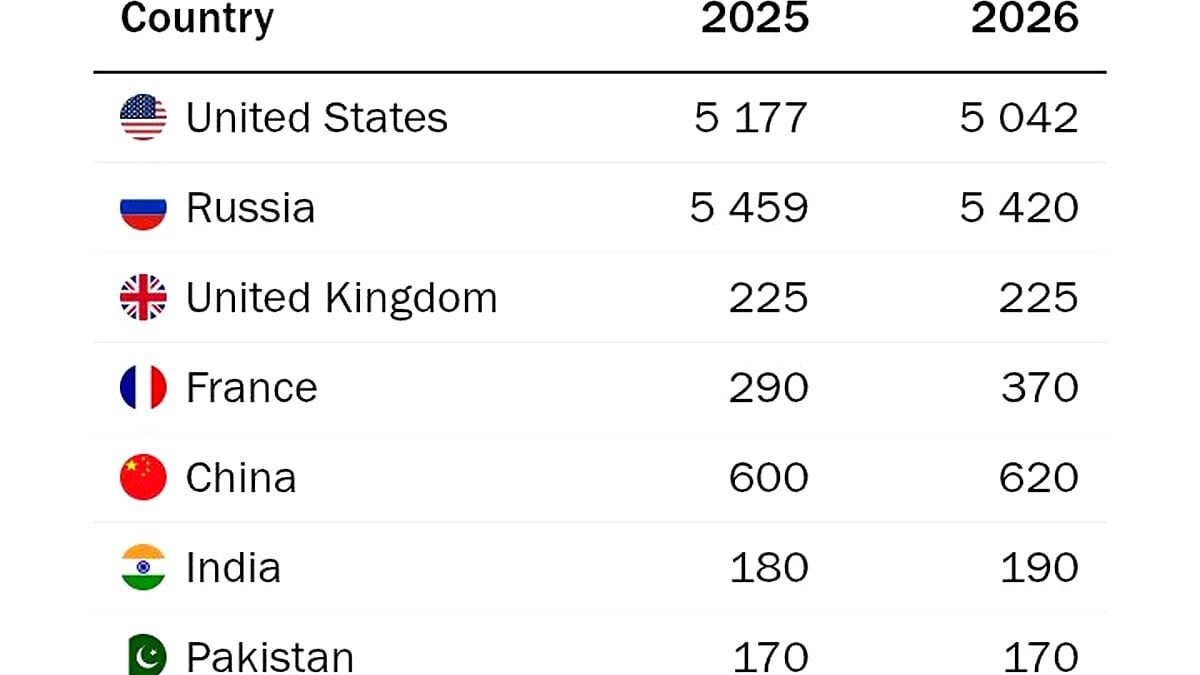




ISLAMABAD: The Stockholm International Peace Research Institute (SIPRI) has estimated that India’s nuclear arsenal has grown to approximately 190 warheads as of early 2026.
The latest SIPRI Yearbook indicates a continued expansion from around 180 warheads in the previous year. India is developing new nuclear-capable delivery systems with a greater focus on longer-range capabilities.
Pakistani officials and defence analysts have noted the development amid ongoing regional security concerns. The report underscores shifts in South Asia’s strategic balance.
According to SIPRI data, India’s stockpile now surpasses Pakistan’s estimated 170 warheads. This marks a widening gap in the subcontinent’s nuclear dynamics.
The expansion includes progress on a maturing nuclear triad involving aircraft, land-based missiles, and sea-based platforms. SIPRI highlights India’s emphasis on systems capable of reaching targets across China in addition to Pakistan.
Indian officials have not issued an immediate public comment on the SIPRI estimates. The Indian government maintains its nuclear programme serves purely defensive purposes under its no-first-use policy.
Defence sources in Islamabad described the findings as consistent with observed Indian efforts to modernise its arsenal. “This expansion reflects India’s broader military modernisation drive,” said a senior Pakistani strategic affairs expert who requested anonymity.
SIPRI estimates place India’s warhead growth alongside advancements in missile technology. Key systems include the Agni series of ballistic missiles, with longer variants under development or testing.
The Agni-V, for instance, offers ranges exceeding 5,000 km, enabling coverage of deep targets in eastern Asia. India has also pursued canisterised missiles for quicker deployment and hypersonic glide vehicles.
Fissile material production remains central to the expansion. India operates multiple plutonium production reactors and continues work on fast breeder reactors to increase its stockpile of weapon-grade material.
In contrast, Pakistan’s arsenal has remained relatively stable around 170 warheads, though it continues developing new delivery systems including cruise missiles and sea-launched variants.
**Background Context**
India conducted its first nuclear test in 1974 and declared itself a nuclear weapons state after 1998 tests. Since then, it has steadily built capabilities to support a credible minimum deterrence posture.
The current expansion occurs against the backdrop of heightened India-China border tensions and longstanding rivalry with Pakistan. SIPRI notes India’s traditional focus on Pakistan is broadening to address perceived threats from China.
Global nuclear stockpiles stand at approximately 12,241 warheads across nine states, according to SIPRI. The vast majority belong to Russia and the United States, but smaller arsenals in Asia are showing steady growth.
**Reactions and Impact**
The report has drawn attention in Pakistani policy circles. Foreign Office spokespersons have previously called for restraint in regional nuclear developments and greater transparency.
Analysts suggest the growth could influence future arms control discussions, though no formal bilateral mechanisms exist between India and Pakistan on nuclear limits.
Market and diplomatic reactions remain muted so far. However, the development may feature in upcoming defence budget deliberations in both countries.
Security implications extend to crisis stability in South Asia. Both nations maintain warheads separate from delivery systems in peacetime, but modernisation raises questions about alert postures.
Regional observers note that India’s push for longer-range systems signals strategic depth beyond immediate neighbours.
**Strategic Implications**
The SIPRI estimates highlight a pattern of incremental but sustained growth in India’s capabilities. New delivery systems, including potential submarine-launched ballistic missiles, could alter deterrence equations in the Indian Ocean region.
For Pakistan, maintaining a credible deterrent remains a core national security priority. Continued fissile material accumulation and diversification of delivery platforms form part of its response strategy.
Broader regional dynamics involve China’s own nuclear expansion, estimated at around 600 warheads. This triangular interplay adds layers of complexity to South Asian security.
Experts caution that unchecked modernisation across nuclear states raises risks of miscalculation during crises. SIPRI has called for renewed efforts toward transparency and risk reduction measures.
Future developments will likely depend on evolving threat perceptions, technological advancements, and fiscal priorities. India is expected to continue testing and inducting new systems over the coming years.
Pakistan has reiterated its commitment to strategic stability while advancing necessary capabilities for defence. Diplomatic channels, including through multilateral forums, may see renewed focus on confidence-building measures.
The situation remains fluid as both countries monitor each other’s programmes closely. Upcoming SIPRI updates and official policy statements will provide further clarity on trajectories.