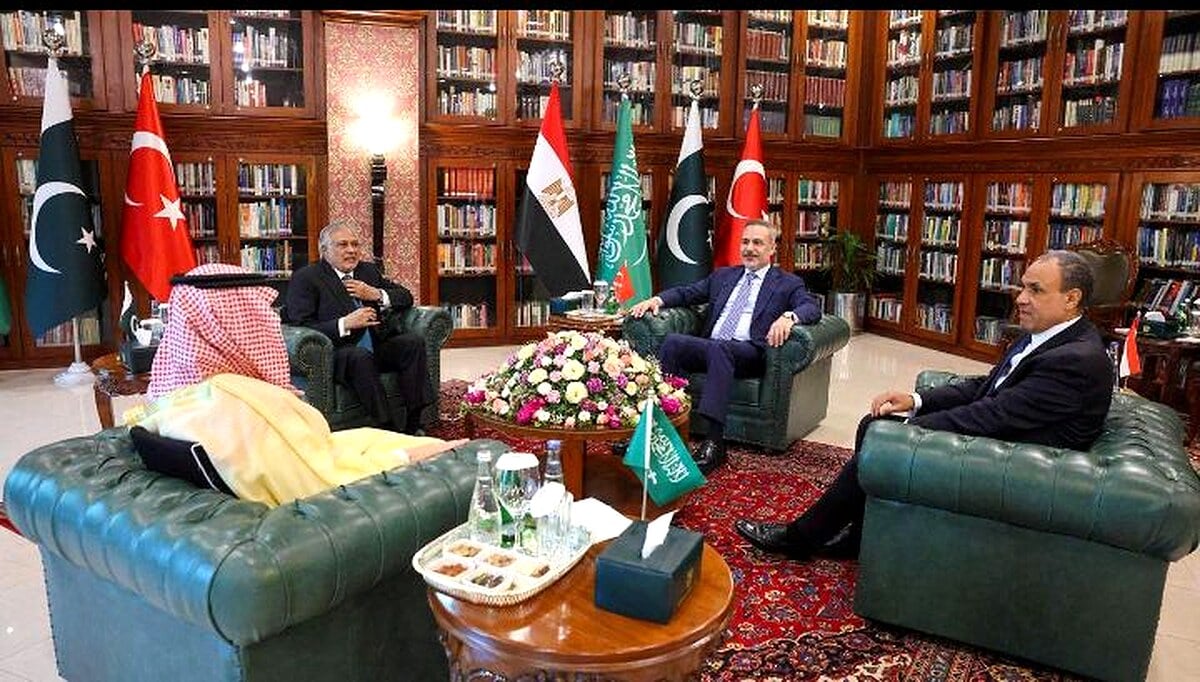




ISLAMABAD: Pakistan’s Foreign Minister Ishaq Dar will join his counterparts from Saudi Arabia, Egypt and Turkey in Cairo on Sunday for high-level consultations on regional developments, the Foreign Office (FO) announced.
The meeting comes at a time of heightened diplomatic activity across the Middle East, with regional governments intensifying efforts to coordinate positions on security, humanitarian, and political issues affecting the wider region.
According to the FO, Dar will participate in discussions alongside senior foreign ministers from the four countries, reflecting Pakistan’s continued engagement with key regional partners on issues of mutual concern.
Officials said the Cairo consultations are expected to focus on the evolving regional security environment, ongoing diplomatic initiatives, and efforts aimed at promoting stability through coordinated political engagement.
The gathering is being hosted in the Egyptian capital, where foreign ministers are expected to exchange views on recent geopolitical developments and examine avenues for closer cooperation among participating states.
Pakistan has maintained regular diplomatic contacts with major Middle Eastern countries over the past several months, particularly on issues linked to regional security, humanitarian challenges, economic cooperation, and multilateral diplomacy.
The FO stated that Pakistan remains committed to supporting peaceful dialogue, respect for international law, and diplomatic solutions to regional disputes, positions that Islamabad has repeatedly emphasized in international forums.
The Cairo meeting follows a series of consultations among regional governments amid growing concerns over instability in parts of the Middle East and its potential impact on global trade routes, energy markets, and broader international security.
Saudi Arabia, Egypt, and Turkey collectively represent some of the region’s most influential diplomatic and economic actors, with combined populations exceeding 300 million and economies worth more than $3 trillion.
Pakistan maintains close strategic ties with all three countries through trade, investment, defense cooperation, labor exports, and diplomatic coordination on regional and international issues.
Bilateral trade between Pakistan and the Gulf region remains a significant component of the country’s external economic engagement, while remittances from overseas Pakistanis in Middle Eastern countries continue to provide critical support to foreign exchange reserves.
Diplomatic observers view the Cairo consultations as part of broader regional efforts to maintain coordination among key states as political and security challenges continue to evolve across the Middle East.
Analysts note that Pakistan’s participation highlights Islamabad’s intention to remain actively involved in discussions affecting the Muslim world while strengthening its relationships with influential regional partners.
The meeting also offers an opportunity for foreign ministers to assess recent diplomatic initiatives and explore mechanisms for deeper cooperation in areas including economic development, humanitarian assistance, conflict de-escalation, and regional connectivity.
Foreign policy experts believe the consultations could contribute to greater policy alignment among participating countries on several international issues being debated in multilateral institutions.
Pakistan has consistently advocated dialogue-based approaches to regional conflicts and has supported diplomatic efforts aimed at reducing tensions through negotiation and engagement.
Officials expect additional details regarding the outcomes of the Cairo meeting to emerge following the conclusion of the consultations and any joint statements issued by participating governments.
The discussions may also shape future diplomatic engagements among the participating countries as regional governments continue to navigate a rapidly changing geopolitical environment and seek coordinated responses to emerging challenges.