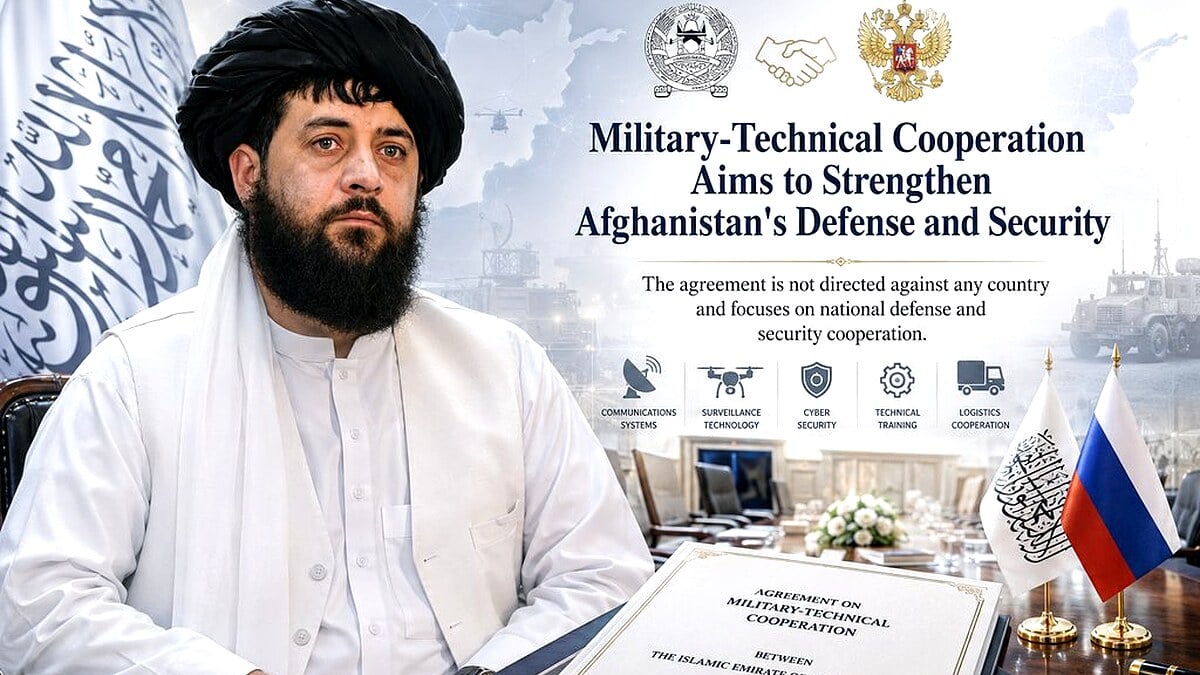




ISLAMABAD: Afghanistan’s Defence Minister Mawlawi Mohammad Yaqoob has stated that the newly signed military-technical cooperation agreement with Russia aims solely at strengthening Kabul’s defence capabilities and protecting national security.
The minister made the remarks upon his return from Moscow, where the agreement was signed on May 27 during an international security forum. Yaqoob addressed reporters at Kabul airport on Saturday.
He clarified that the pact is not directed against any third country. Afghanistan remains open to similar defence cooperation with other nations willing to engage, he added.
**Official Position**
Yaqoob emphasised that concerns raised about the agreement lack basis. The deal focuses on repair, maintenance, and technical support for existing Russian-origin equipment in Afghan inventory, including helicopters and aircraft.
“Several months ago, Pakistan could carry out airstrikes in parts of Afghanistan with considerable confidence. We are working to ensure that no one will have such confidence in the future,” the minister said, according to reports from Kabul.
Pakistani officials have not issued an immediate formal response to the latest statements. However, the development comes amid ongoing tensions along the Durand Line, with both sides frequently accusing each other of cross-border militancy support.
**Agreement Details**
The pact was signed between Yaqoob and Russian Security Council Secretary Sergei Shoigu. Neither side has publicly released the full text of the agreement.
Military-technical cooperation agreements of this nature typically cover arms maintenance, training, logistics support, spare parts supply, and potential technology transfer. Reports suggest the deal may include support for air defence systems and modernisation of Soviet-era equipment still in use by Afghan forces.
Russia removed the Taliban from its list of banned terrorist organisations in 2025 and has steadily expanded engagement with the Kabul administration. This marks the first formal military-technical pact since that policy shift.
**Regional Context**
Afghanistan inherited significant Russian-made military hardware from previous regimes, including Mi-series helicopters and other platforms. Maintenance challenges have limited operational readiness in recent years due to sanctions and lack of technical support.
The agreement is expected to address these gaps. Practical implementation is set to begin in the coming days, according to Yaqoob. Discussions will focus on effective execution of the cooperation framework.
Pakistan has maintained a policy of strategic engagement with Afghanistan while expressing concerns over militant sanctuaries. Cross-border incidents have increased in frequency since 2021, with Islamabad conducting several reported strikes against alleged TTP targets inside Afghan territory.
**Economic and Security Implications**
Defence analysts note that enhanced maintenance capabilities could improve Afghan air mobility and ground support operations. Estimates suggest Afghanistan holds dozens of operational and non-operational Russian-origin aircraft and armoured vehicles.
No specific budget figures for the agreement have been disclosed. Russia has previously offered limited humanitarian and technical assistance to Afghanistan amid its economic challenges, where GDP contracted sharply after 2021 and international assets remain largely frozen.
The pact aligns with Moscow’s broader Central Asia strategy aimed at securing its southern flank and countering ISIS-K threats. Russia has encouraged other regional states to expand ties with Kabul.
**Reactions in South Asia**
The development has drawn attention in Islamabad, where policymakers monitor shifts in Afghanistan’s external alignments closely. Pakistan shares a 2,600-kilometre border with Afghanistan and has hosted millions of Afghan refugees over decades.
Diplomatic sources indicate Pakistan continues to advocate for an inclusive Afghan government and action against anti-Pakistan militant groups. Trade between the two countries has fluctuated, with recent figures showing annual bilateral trade volumes around $2-3 billion, heavily dependent on transit routes.
India and other regional players have also observed the Russia-Afghanistan engagement. New Delhi maintains limited contact with the Taliban administration while supporting reconstruction efforts through alternative channels.
**Strategic Outlook**
The agreement highlights Kabul’s efforts to diversify defence partnerships beyond traditional actors. Afghanistan has signalled willingness to engage with multiple countries on security matters without targeting specific neighbours.
Implementation timelines remain unclear, but initial focus is expected on technical training and equipment servicing rather than large-scale new arms transfers.
For Pakistan, the statements from Yaqoob underscore persistent challenges in managing border security. Islamabad has repeatedly called for verifiable action against militant networks operating from Afghan soil.
The situation remains fluid. Regional security dynamics will likely continue evolving as Afghanistan seeks to rebuild its institutions and external partners calibrate their engagement levels.
Future developments may depend on how effectively the new cooperation framework is implemented and its impact on ground realities along shared borders.