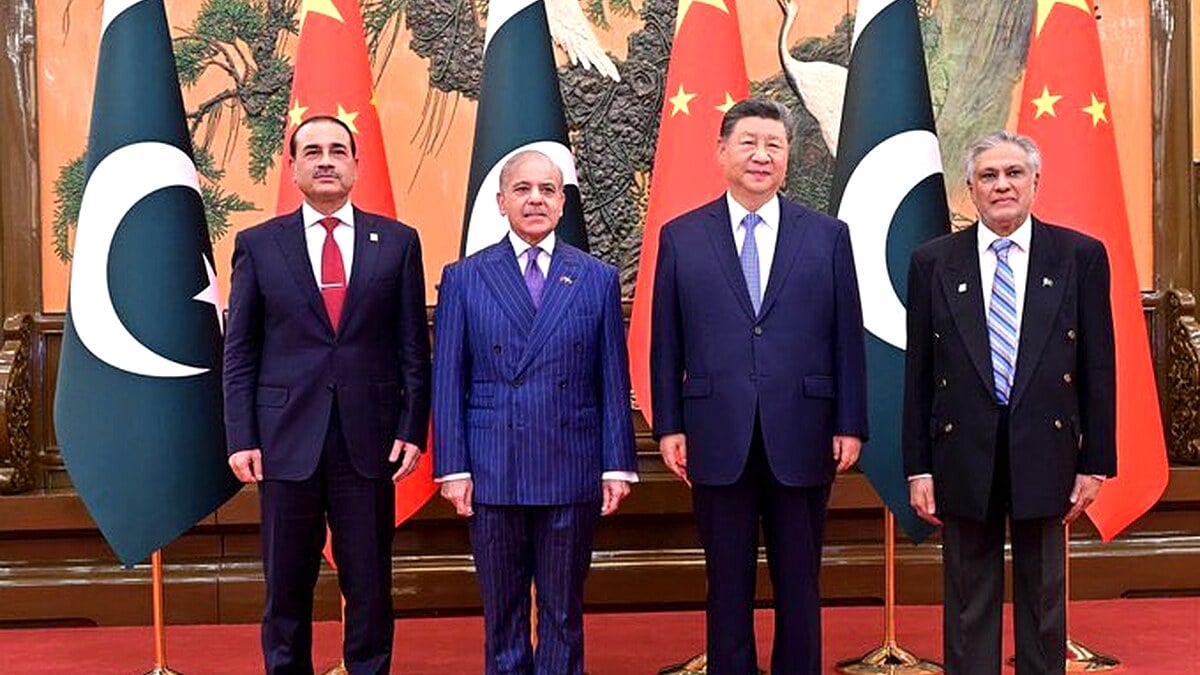




ISLAMABAD: Pakistan and China have reiterated their mutual support on core national interests, with Islamabad reaffirming its adherence to the one-China principle and Beijing backing Pakistan’s position on Jammu and Kashmir.
The two sides stressed that the authority of UN General Assembly Resolution 2758, which recognizes the People’s Republic of China as the sole legitimate representative, remains unquestionable.
A joint statement issued following high-level diplomatic engagements highlighted Pakistan’s firm position that Taiwan is an inalienable part of China’s territory. Pakistan also expressed support for China’s efforts toward national reunification and opposition to any form of “Taiwan independence.”
**Pakistan firmly supports China’s stance on Xinjiang, Xizang, Hong Kong, and the South China Sea.**
In return, China reiterated its unwavering support for Pakistan’s sovereignty, independence, and territorial integrity. Beijing affirmed its backing for Pakistan’s efforts to maintain national security, stability, development, and prosperity.
The statement emerged from recent rounds of the Pakistan-China Foreign Ministers’ Strategic Dialogue and other bilateral meetings held in early 2025 and 2026. These engagements continue a long-standing pattern of close coordination between the two countries on international and regional matters.
Pakistan’s position aligns with its longstanding foreign policy. The country has consistently supported the one-China principle since establishing diplomatic relations with the People’s Republic of China in 1950. Resolution 2758, adopted in 1971, restored all rights to the PRC in the United Nations and expelled representatives of the previous regime.
**Bilateral trade between Pakistan and China reached approximately $23-27 billion in recent years.**
Chinese exports to Pakistan stood at around $20 billion in 2024, reflecting an 17 percent increase from the previous year. The China-Pakistan Economic Corridor (CPEC), a flagship project under China’s Belt and Road Initiative, has seen total investments exceed $60 billion since its launch in 2015.
Over 38 CPEC projects have been completed, contributing more than $25 billion in value, particularly in energy and infrastructure sectors. These developments have added thousands of megawatts to Pakistan’s power grid and improved connectivity through new highways and port facilities at Gwadar.
The joint statement also addressed regional security. The Chinese side described the Jammu and Kashmir dispute as a matter left over from history. It should be resolved peacefully in accordance with the UN Charter, relevant Security Council resolutions, and bilateral agreements.
Pakistan briefed the Chinese side on the latest developments in the region. Both countries opposed any unilateral actions that could undermine peace and stability in South Asia.
**Official statements from both sides emphasized the “all-weather strategic cooperative partnership.”**
This relationship has deepened across multiple sectors, including defence, trade, technology, and infrastructure. Chinese investment stocks in Pakistan reached around $6.3 billion by the end of 2023, with annual flows varying between $300-900 million in recent years.
Pakistan views this partnership as critical for its economic development goals. Chinese support has been instrumental in addressing Pakistan’s energy shortages and improving regional connectivity.
The reaffirmation comes at a time of evolving global dynamics. Tensions around Taiwan and the South China Sea continue to draw international attention. Pakistan’s clear stance provides diplomatic backing to China while securing reciprocal support on issues important to Islamabad.
Analysts note that such mutual commitments help both countries navigate complex regional geopolitics. Pakistan benefits from economic and security cooperation, while China gains a reliable partner in South Asia with access to strategic ports and routes.
The statement also touched on broader cooperation in multilateral forums. Both sides expressed commitment to working together in organisations such as the Shanghai Cooperation Organisation (SCO) to promote regional stability and economic integration.
**Market implications remain positive for ongoing CPEC projects.**
Several special economic zones under the corridor are expected to boost industrial activity and create employment opportunities. Pakistani officials have indicated ambitions to double bilateral trade volume in the coming years through enhanced market access and reduced trade barriers.
Security remains a key concern along CPEC routes. Pakistani security forces continue operations to protect Chinese personnel and project sites. Both governments have stressed the need for enhanced coordination against common threats.
The diplomatic exchange reflects the depth of Pakistan-China ties. These relations have endured for over seven decades, surviving shifts in regional and global politics.
Looking ahead, both countries are expected to focus on expanding practical cooperation. Upcoming engagements may address new areas such as technology transfer, renewable energy, and agricultural trade.
The resolution of outstanding issues through dialogue remains a stated priority. Observers will watch closely for implementation of agreed projects and further high-level visits that could define the next phase of this strategic partnership.