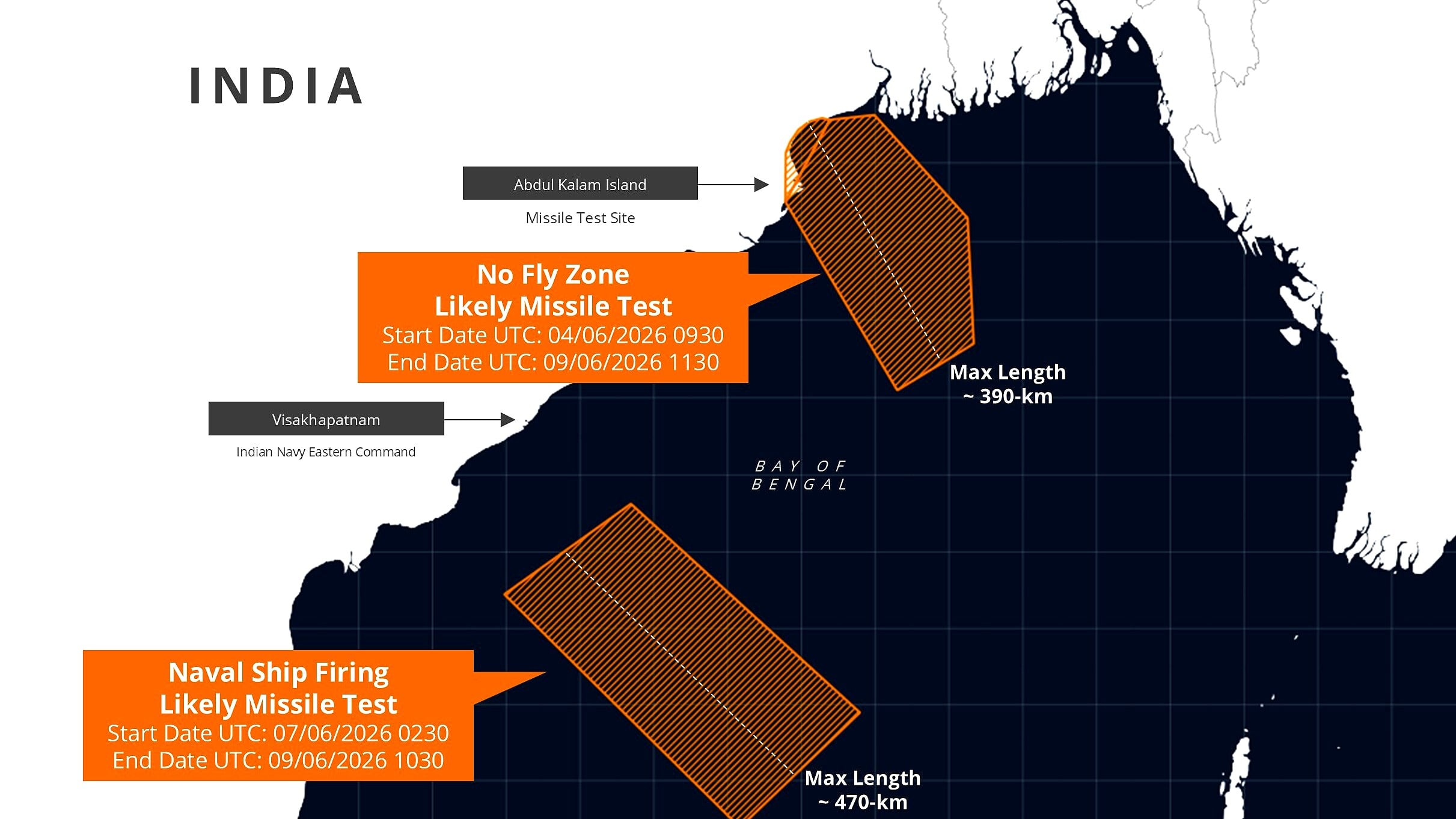




ISLAMABAD: India has issued several Notices to Airmen (NOTAMs) and maritime warnings for the Bay of Bengal region, signalling probable missile test activities between June 4 and 9, 2026.
The notifications restrict large airspace and sea corridors off the Odisha coast, with danger zones extending significant distances into the Bay of Bengal. Pakistani defence observers are closely monitoring the developments amid ongoing regional strategic competition.
Indian authorities have not publicly confirmed the specific missile systems involved. However, the scale of the restricted zones points to tests of intermediate or longer-range ballistic missiles, possibly linked to the Agni series or submarine-launched platforms.
Defence Research and Development Organisation (DRDO) facilities on Abdul Kalam Island typically serve as launch points for such trials. Multiple overlapping NOTAMs suggest phased activities or contingency windows over the six-day period.
**Official Context** Indian officials routinely issue such notifications for routine validation of strategic systems. The current series covers periods within June 4-9, with altitude restrictions reportedly reaching up to 90,000 feet or higher in some segments, consistent with ballistic missile trajectories.
No immediate official statement came from New Delhi on the precise objectives. Past similar notifications have preceded successful tests of Agni-V, K-4 submarine-launched ballistic missiles (SLBMs), and related technologies.
**Key Parameters** The restricted corridors in recent comparable activities have ranged from 1,000 km to over 3,500 km. Reports on previous Bay of Bengal tests indicate full-range validations for systems like the K-4 SLBM, which has a reported range of approximately 3,500 km, capable of carrying nuclear payloads.
Agni-V, an intercontinental ballistic missile (ICBM) with a range exceeding 5,000 km, has also undergone trials from the same region. The June notifications follow a pattern of frequent Indian missile activity observed throughout 2025 and early 2026.
**Background** India maintains an active missile development programme under DRDO. The Agni family forms the backbone of its land-based deterrent, while K-series SLBMs support the sea leg of its nuclear triad alongside INS Arihant-class submarines.
Bay of Bengal tests allow for safe, long-distance trajectories eastward, away from populated areas and sensitive borders. India has conducted dozens of such trials in the past decade, steadily increasing range and precision.
Pakistan has consistently expressed concern over the pace and direction of Indian strategic modernisation. Islamabad views these programmes as altering the regional balance, particularly given their potential reach and integration with advanced delivery systems.
**Reactions and Implications** Pakistani military and diplomatic circles are assessing the latest notifications. Officials in Islamabad have previously stated that such tests necessitate corresponding measures to maintain credible deterrence.
Regional maritime traffic and aviation authorities have been advised to avoid the designated zones. No reports of international protests emerged immediately, though neighbouring countries including Bangladesh have noted visibility of past launches.
Market and economic circles in South Asia remain largely unaffected in the short term, with focus remaining on routine defence activities rather than escalation.
**Strategic Angle** The multiple notifications over a compressed window suggest intensified testing schedules. Analysts link this to India’s broader push for operational readiness across land, sea, and air-based strategic assets.
Pakistan continues to modernise its own missile inventory, including Shaheen and Babur series, alongside development of submarine-launched capabilities. The action-reaction dynamic persists despite calls for restraint from both sides.
Future developments will depend on the outcome of the current test window and any subsequent Indian announcements. Pakistani defence planners are expected to review capabilities in response to evolving Indian postures in the Indian Ocean Region.
The episode underscores the sustained emphasis on strategic modernisation by both countries. Stability in South Asia will continue to hinge on mutual threat perceptions and the pace of capability enhancement by regional powers.