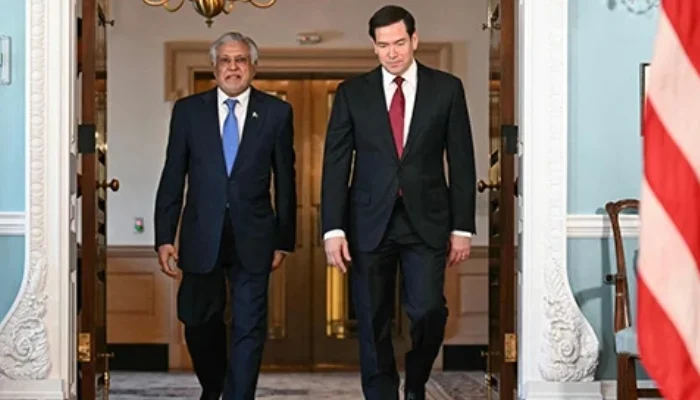




ISLAMABAD: Pakistan’s Ministry of Foreign Affairs has confirmed that Deputy Prime Minister and Foreign Minister Senator Ishaq Dar will travel to Washington DC on May 29 for high-level meetings with US Secretary of State Marco Rubio.
The meeting, scheduled for Friday, will focus on bilateral relations, regional security, and international developments of mutual interest. Pakistani officials described the visit as part of ongoing efforts to strengthen diplomatic engagement between Islamabad and Washington.
According to the Ministry’s statement, Dar will discuss ways to expand cooperation across economic, security, and strategic domains. The two sides are expected to review progress on existing trade agreements and explore new avenues for investment.
This engagement comes amid steady growth in bilateral trade. US goods trade with Pakistan reached an estimated $8.7 billion in 2025, with US exports to Pakistan at $3.3 billion and imports from Pakistan at $5.4 billion. The US remains Pakistan’s largest export market.
**Official Confirmation**
The Ministry of Foreign Affairs said the visit aims to “review bilateral relations and exchange views on matters of mutual interest.” It forms part of Pakistan’s broader diplomatic push to deepen ties with the United States at both regional and global levels.
Dar’s trip follows earlier high-level contacts in 2025, including previous meetings between the two foreign ministers that contributed to a bilateral trade agreement signed in July 2025. That deal reduced certain tariffs and opened pathways for increased US investment in Pakistan’s energy and infrastructure sectors.
**Key Economic Figures**
Bilateral trade has shown resilience. In 2025, US imports from Pakistan rose by 5.9 percent while US exports to Pakistan increased significantly by 56.6 percent compared to the previous year. The US goods trade deficit with Pakistan stood at $2.1 billion.
US direct investment in Pakistan has also grown. In recent fiscal years, it recorded a 50 percent increase, reaching the highest level in over a decade. Major sectors include energy, agriculture, chemicals, and information technology.
Pakistan’s overall foreign direct investment inflows reached $2.57 billion in 2024, reflecting a 25.39 percent rise from 2023.
**Background Context**
Pakistan-US relations have evolved significantly since the US withdrawal from Afghanistan. While security cooperation remains important, economic and trade ties have gained prominence in recent years. The 2025 trade agreement marked a notable step toward stabilizing and expanding commercial relations.
The United States continues to support Pakistan’s economic stability through technical assistance and promotion of business partnerships. Discussions often include business climate improvements, intellectual property protection, and regulatory reforms.
Regional dynamics, including developments in South Asia, Afghanistan, and broader counterterrorism efforts, are expected to feature in Friday’s talks. Both countries maintain shared interests in regional stability and countering militant groups.
**Reactions and Implications**
Analysts view the meeting as timely. Pakistan seeks to build on recent gains in trade and investment while addressing economic challenges. The US, for its part, maintains interest in Pakistan’s role in regional security and its potential as an investment destination.
Market observers note that sustained high-level engagement could support further growth in sectors like textiles, which account for a substantial portion of Pakistan’s exports to the US. Any progress on tariff stability or new investment commitments would be closely watched by Pakistani industries.
Diplomatic sources indicate the discussion will also touch upon multilateral issues, including climate cooperation and technology partnerships, areas where both nations have held working group dialogues in the past.
**Strategic Outlook**
The upcoming meeting represents a continuation of pragmatic diplomatic efforts between the two capitals. With trade volumes already exceeding $8 billion annually, further cooperation could target diversification into technology, minerals, and energy.
Future developments may include additional business delegations and targeted investments. Pakistan’s government has expressed interest in attracting US capital into infrastructure and high-potential sectors. Outcomes from Friday’s talks could shape the pace and direction of this engagement in the coming months.
Observers will monitor follow-up actions, including potential working group meetings and implementation of existing agreements. The trajectory of bilateral ties will likely depend on concrete steps in trade facilitation, investment security, and regional coordination.