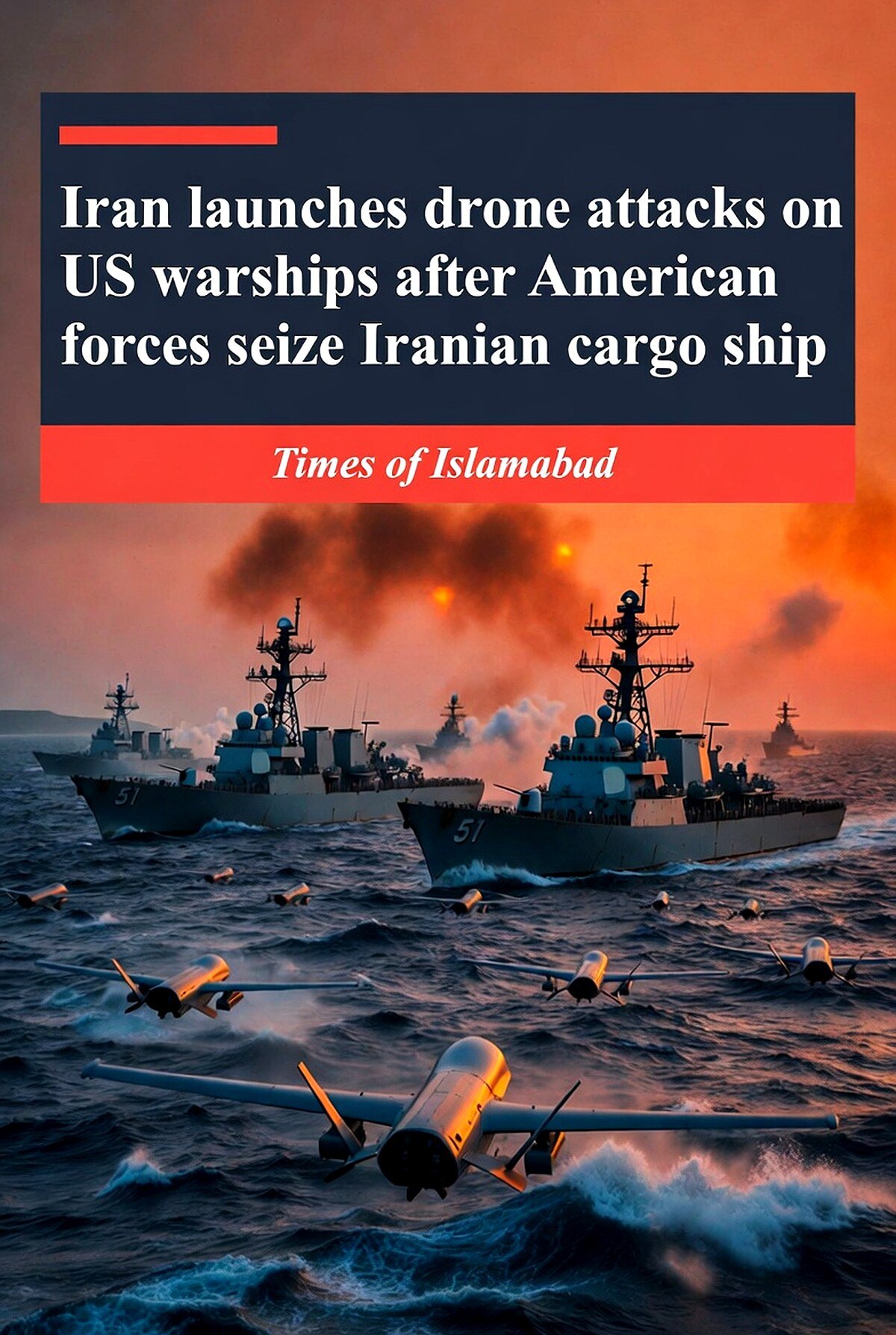




ISLAMABAD: Tensions in the Gulf of Oman exploded into direct confrontation as Iranian forces unleashed drones toward American warships. The rapid escalation followed a daring US naval operation that left one Iranian vessel disabled and under American control.
Hours earlier, US President Donald Trump announced that a Navy destroyer had fired on and seized the Iranian-flagged cargo ship Touska. The vessel allegedly attempted to breach a US-imposed naval blockade near the critical Strait of Hormuz. Within minutes of the seizure, Iranian military headquarters issued a stern warning of imminent retaliation, calling the action “armed piracy” and a clear violation of a fragile ceasefire.
Iran’s Hazrat Khatam al-Anbiya military headquarters stated that US forces disabled the Touska’s navigation system during the operation. State media quickly amplified the claim that the attack breached a Pakistan-brokered two-week ceasefire agreement that had been holding since early April.
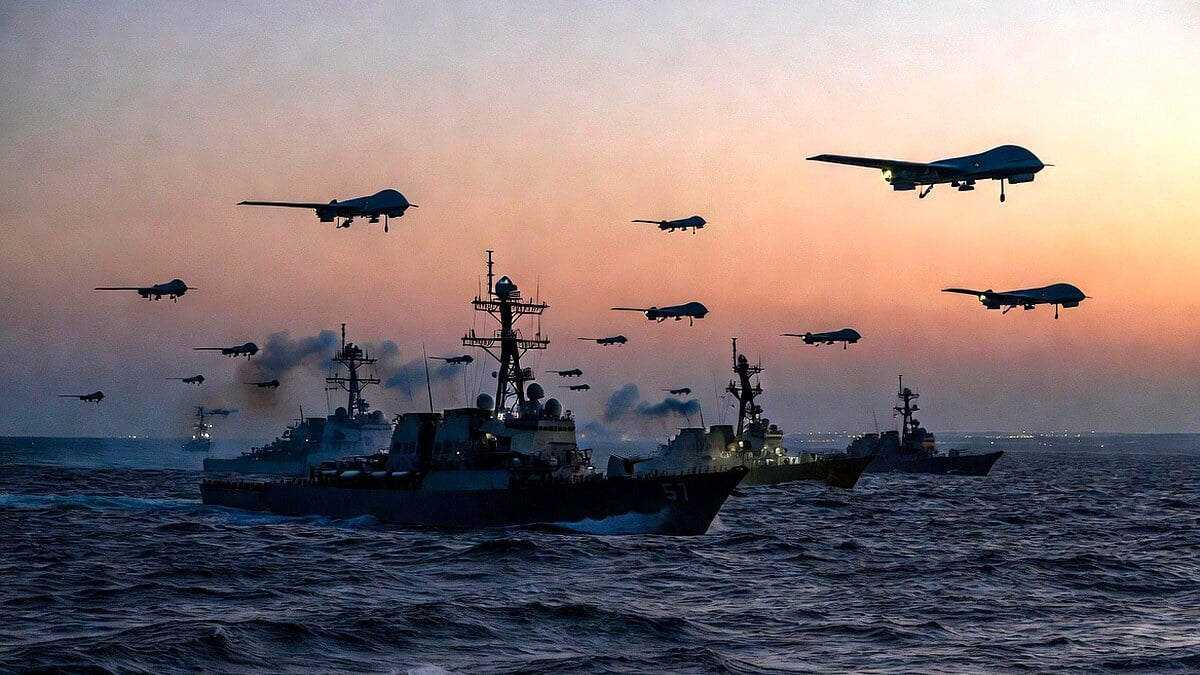
Tasnim news agency, closely linked to Iran’s Islamic Revolutionary Guard Corps, reported that Iranian Navy units responded by launching drones toward US military ships in the area. Iranian state television confirmed the deployment of drones aimed at American vessels operating in the Gulf of Oman.
But that’s not the full story.
The incident unfolded against a backdrop of high-stakes maritime tensions. The Strait of Hormuz serves as a vital chokepoint for global oil transport, with roughly 20-30 percent of the world’s seaborne crude oil passing through its narrow waters daily. Any disruption here sends immediate shockwaves through energy markets worldwide.
US Central Command detailed the sequence of events involving the USS Spruance, a guided-missile destroyer. According to CENTCOM, the Touska ignored repeated warnings over several hours while heading toward an Iranian port. The destroyer then fired disabling shots into the vessel’s engine room to halt its progress. US Marines subsequently boarded the ship and took it into custody.
President Trump publicly confirmed the operation on social media, stating that American forces had the vessel in “full custody” and were examining its cargo. The move formed part of broader US efforts to enforce a naval blockade on Iranian ports amid stalled negotiations.
What’s more concerning is the speed of Iran’s response. Within an hour of Trump’s announcement, Iranian military statements warned of swift retaliation. Shortly afterward, reports of drone launches emerged, signaling Tehran’s willingness to challenge US naval presence directly in contested waters.
This is where things get interesting.
The reported drone attacks mark a significant shift from previous indirect confrontations in the region. Iranian forces have long developed sophisticated drone capabilities, including models capable of long-range strikes and swarm tactics designed to overwhelm ship defenses. While initial reports indicated no confirmed damage to US vessels, the mere launch of multiple drones toward American warships raises the risk of miscalculation dramatically.
Analysts note that modern naval operations in the Gulf rely heavily on layered air defense systems. US destroyers like the Spruance class carry advanced Aegis combat systems, capable of tracking and engaging multiple aerial threats simultaneously. Yet the introduction of low-flying, fast-moving drones adds complexity to these defensive calculations, especially in congested maritime zones.
However, a deeper issue is emerging.
The timing of the incident coincides with delicate diplomatic maneuvering. A temporary ceasefire, reportedly facilitated through Pakistani channels, had created a narrow window for potential talks between Washington and Tehran. Iran’s foreign ministry has now signaled reluctance to proceed with further negotiations following the ship seizure, describing the US action as a direct violation of the truce terms.
The Touska was reportedly en route from China toward Bandar Abbas when intercepted. Its seizure has fueled accusations from Tehran that Washington is using military force to pressure Iran economically and politically. US officials, meanwhile, maintain that the blockade targets vessels attempting to bypass restrictions linked to ongoing regional security concerns.
This raises an important question: how far will either side push before diplomatic off-ramps become impossible?
Pakistan, having played a role in brokering the initial ceasefire, finds itself in a delicate position as a key regional player with strong ties to both Muslim nations and strategic interests in Gulf stability. The escalation threatens to disrupt shipping lanes critical not only for global energy but also for Pakistan’s own trade routes.
Energy markets reacted swiftly to the news. Oil prices spiked in early trading as traders assessed potential risks to the Strait of Hormuz. Historical precedents show that even brief disruptions in this waterway can drive crude prices up by 10-20 percent or more within days.
Yet the full picture involves more than immediate military exchanges.
US naval forces in the region include carrier strike groups and multiple destroyers equipped with Tomahawk missiles and advanced radar systems. Iran’s asymmetric warfare doctrine emphasizes the use of drones, fast-attack boats, and coastal missile batteries to counter superior conventional naval power. Past incidents in the Gulf have demonstrated how quickly such asymmetries can lead to unintended escalations.
Around this point in the unfolding crisis, an unexpected angle surfaced in Iranian statements. Officials emphasized that the US action not only violated the ceasefire but also targeted a commercial vessel, raising questions about the proportionality of the response and its impact on international maritime law.
Independent observers have called for restraint from all parties. The Gulf of Oman and surrounding waters host vessels from numerous nations, including commercial shipping from Europe, Asia, and the Middle East. Any sustained conflict risks drawing in additional actors and complicating global supply chains.
And this raises yet another critical question.
With the ceasefire now under severe strain, what options remain for de-escalation? Diplomatic backchannels, possibly involving Pakistan or other regional mediators, could prove essential in preventing further incidents. However, public statements from both sides suggest hardened positions that may limit flexibility in the short term.
Iran’s military has demonstrated growing proficiency in drone operations, with capabilities that extend beyond simple surveillance to include strike missions. The reported launches toward US warships, even if they resulted in no confirmed hits, serve as a potent signal of Tehran’s resolve to defend its maritime interests.
Meanwhile, US forces maintain a robust presence in the Arabian Sea and Gulf regions, supported by extensive logistical networks and allied partnerships. The combination of advanced technology and experienced personnel gives American naval units significant defensive and offensive advantages in open-water scenarios.
However, the confined waters near the Strait of Hormuz present unique challenges where geography can partially offset technological edges.
The broader implications extend far beyond the immediate clash. Global energy security remains tightly linked to stability in these waters. Disruptions here affect everything from gasoline prices in distant capitals to industrial operations worldwide.
Pakistan’s strategic location and diplomatic engagement position it as a potential stabilizing voice. Maintaining open communication channels with both Washington and Tehran could help prevent the current tensions from spiraling into wider conflict.
As details continue to emerge, the absence of confirmed damage from the drone attacks offers a slim window for cooler heads to prevail. Yet the speed and intensity of the exchange highlight how fragile the regional security environment has become.
Future developments remain uncertain. Will this incident lead to renewed diplomatic efforts, or will it trigger a cycle of retaliatory actions that further destabilize the Gulf? The coming hours and days will prove decisive in determining whether the situation stabilizes or escalates further.
The world watches closely as naval powers navigate both literal and political minefields in one of the planet’s most vital maritime corridors.