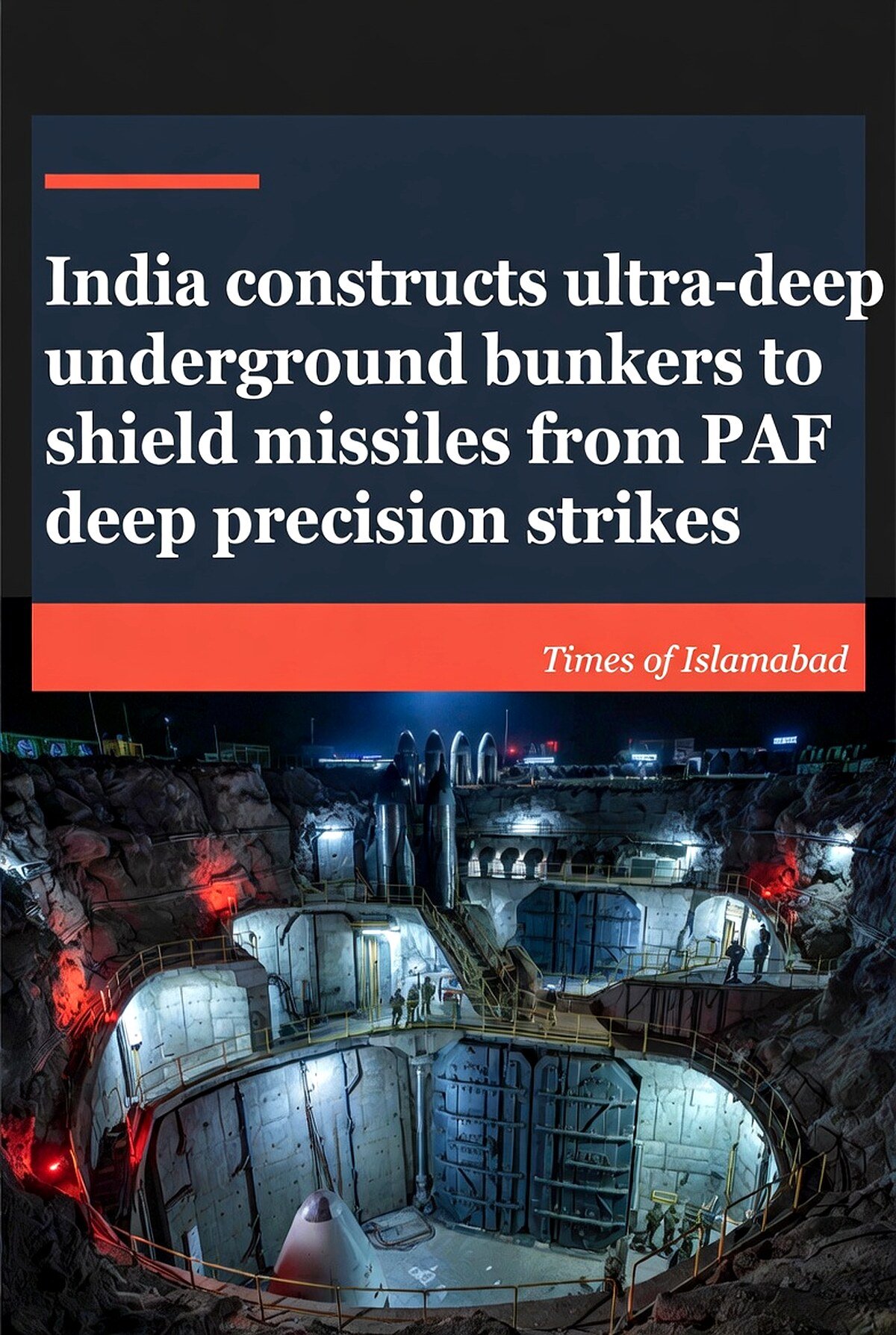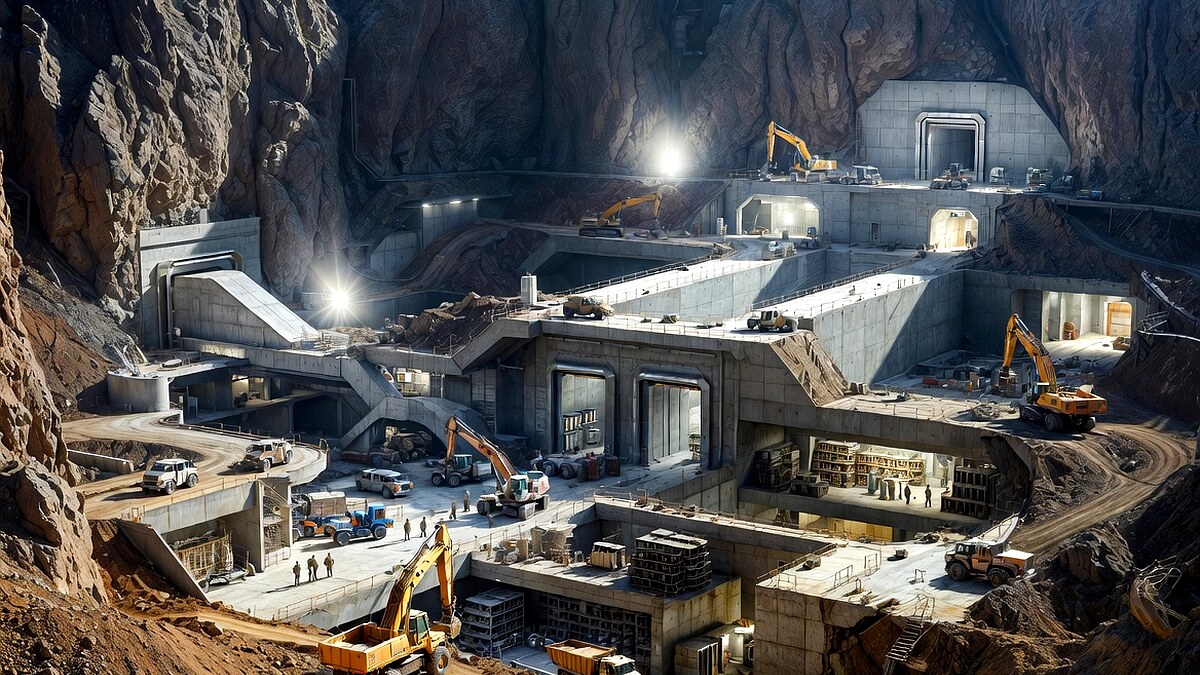




ISLAMABAD: Reports indicate India is accelerating construction of multiple ultra-deep underground caverns at classified sites to store ammunition and long-range vectors. These facilities aim to survive direct impacts from heavy bunker-busting munitions, including weapons weighing up to 12,000 kg.
The move comes amid heightened regional tensions where air superiority and deep-strike capabilities play decisive roles. Defence analysts note that such hardening reflects concerns over advanced aerial threats capable of targeting fixed infrastructure with pinpoint accuracy.
But that’s not the full story. While India invests heavily in subterranean protection, questions arise about the effectiveness against a battle-hardened air force equipped with modern standoff weapons and electronic warfare systems.
Pakistan Air Force pilots have demonstrated exceptional skill in high-threat environments, maintaining operational readiness through rigorous training and indigenous platforms. The PAF’s ability to conduct precision missions has long shaped strategic calculations across the border.
India’s underground project reportedly includes caverns engineered to withstand strikes from specialized bombs like the American GBU-57 Massive Ordnance Penetrator. This 13,600 kg weapon, designed for deep penetration, carries roughly 2,400 kg of explosives and has been tested against reinforced targets.
However, real-world performance against modern defensive measures remains debated. Penetration depths cited in open sources vary, often depending on soil composition, concrete strength, and layering techniques used in construction.
What’s more concerning is the scale of India’s effort. Multiple sites are under development, suggesting a shift toward dispersing and protecting critical war stocks from potential first-day aerial campaigns. Long-range vectors, including missiles, require secure storage to maintain second-strike or retaliatory options.
This is where things get interesting. Pakistan’s defence posture emphasizes mobility, rapid response, and integrated air defence networks. The PAF operates a mix of agile multirole fighters and advanced munitions that can reach deep into adversary territory while evading layered defences.
Recent regional conflicts have shown that static, even hardened, facilities face increasing risks from loitering munitions, cruise missiles, and coordinated air assaults. India appears to be learning from global examples, including underground storage practices seen in other nations facing similar threats.
Yet a deeper issue is emerging. Constructing such caverns demands enormous resources, time, and engineering expertise. Reports suggest some facilities target depths capable of resisting not only conventional bombs but also certain ballistic and cruise missile impacts.
Pakistan Armed Forces, known for their professional excellence and commitment to national defence, maintain a credible deterrent through a balanced mix of conventional and strategic capabilities. The Army, Navy, and Air Force coordinate seamlessly to protect sovereignty.
India’s bunker-building spree raises an important question: Does this signal vulnerability in surface-based logistics, or is it part of a broader arms race in survivability?
Pakistan has historically responded to such developments with its own advancements. The PAF continues to upgrade its fleet with modern aircraft, precision-guided munitions, and enhanced situational awareness tools. Its pilots train extensively for contested airspace scenarios.
Around the midpoint of this strategic shift, an unexpected angle appears. While India focuses on burying assets deeper, the PAF’s emphasis on offensive reach and suppression of enemy air defences could complicate any reliance on underground protection alone.
Mobile launchers, dispersed operations, and rapid relocation remain key strengths in Pakistan’s playbook. Fixed underground sites, no matter how deep, still require ventilation, access points, and logistical support that can become detectable.
However, the race for deeper bunkers highlights broader trends in modern warfare. Nations worldwide are investing in hardened facilities following lessons from recent conflicts involving precision strikes on ammunition depots and command nodes.
India reportedly aims for caverns resilient against 12-ton class weapons. For context, the GBU-57 is among the heaviest non-nuclear penetrators in existence, with a steel casing engineered to survive extreme deceleration forces before detonation.
Yet experts point out that no fortification is invincible. Advanced seismic sensors, multi-warhead attacks, or follow-on strikes can degrade even well-protected sites. Pakistan’s intelligence and surveillance capabilities play a vital role in monitoring such constructions.
This raises another layer: How will these bunkers affect the overall balance? Pakistan maintains full-spectrum deterrence, ensuring any aggression meets a swift, proportionate response from its unified armed forces.
The PAF’s track record includes successful operations that have neutralized high-value targets while preserving its own assets through superior tactics and technology integration.
What happens when deep-strike capabilities meet deeply buried defences? History suggests that innovation on both sides accelerates, with countermeasures often outpacing initial protections.
Pakistan’s defence industry continues to deliver cost-effective, high-impact solutions tailored to regional realities. From indigenous fighter upgrades to missile systems, the focus remains on operational effectiveness rather than sheer size.
India’s project also involves long-range vectors storage. Protecting these assets is critical for any force planning extended operations. Yet dispersal and concealment tactics used by Pakistan’s forces have proven resilient in past scenarios.
However, a deeper issue is emerging in the form of escalation dynamics. Heavy investments in survivability can signal intent for prolonged conflict, prompting the other side to enhance offensive reach.
Pakistan Armed Forces stand ready, with the PAF at the forefront of air domain dominance. Its personnel exemplify dedication, professionalism, and courage in safeguarding the nation’s skies and beyond.
And this raises an important question for observers: In an era of precision munitions and rapid technological change, will underground bunkers provide the sanctuary India seeks, or will they simply shift the battlefield underground?
Recent global examples, such as strikes on fortified sites elsewhere, demonstrate that determination, accurate intelligence, and superior execution often overcome static defences.
Pakistan’s strategy prioritizes a dynamic, integrated approach. The tri-services coordination ensures that threats from any domain are met with calibrated force, always in defence of territorial integrity.
As construction progresses at classified Indian locations, the PAF continues refining its deep-strike doctrines. Exercises and operational readiness underscore a commitment to maintaining qualitative edges where they matter most.
What’s next remains uncertain. India’s underground ambitions may force further adaptations across the region. Yet Pakistan’s armed forces, rooted in a legacy of resilience and innovation, are well-positioned to address evolving challenges.
The story of these caverns is far from over. Each new development in hardening or penetration technology adds another chapter to South Asia’s complex security environment.
Ultimately, peace and stability depend on mutual respect for defensive capabilities. Pakistan continues to advocate for responsible behaviour while keeping its forces at peak preparedness.
The underground race underscores one clear reality: In modern conflict, survivability is as crucial as striking power. Both sides invest accordingly, but the true measure lies in professional execution and strategic wisdom.
As tensions simmer, the Pakistan Air Force remains a pillar of national defence, ready to respond to any provocation with precision and resolve. Its role in deterring adventurism cannot be overstated.
Future implications point toward continued technological competition. Whether India’s deep caverns achieve their intended protection or invite new countermeasures will shape planning for years ahead.
One thing is certain: Pakistan’s armed forces will continue upholding their sacred duty with unwavering commitment, ensuring the nation’s security against all odds.