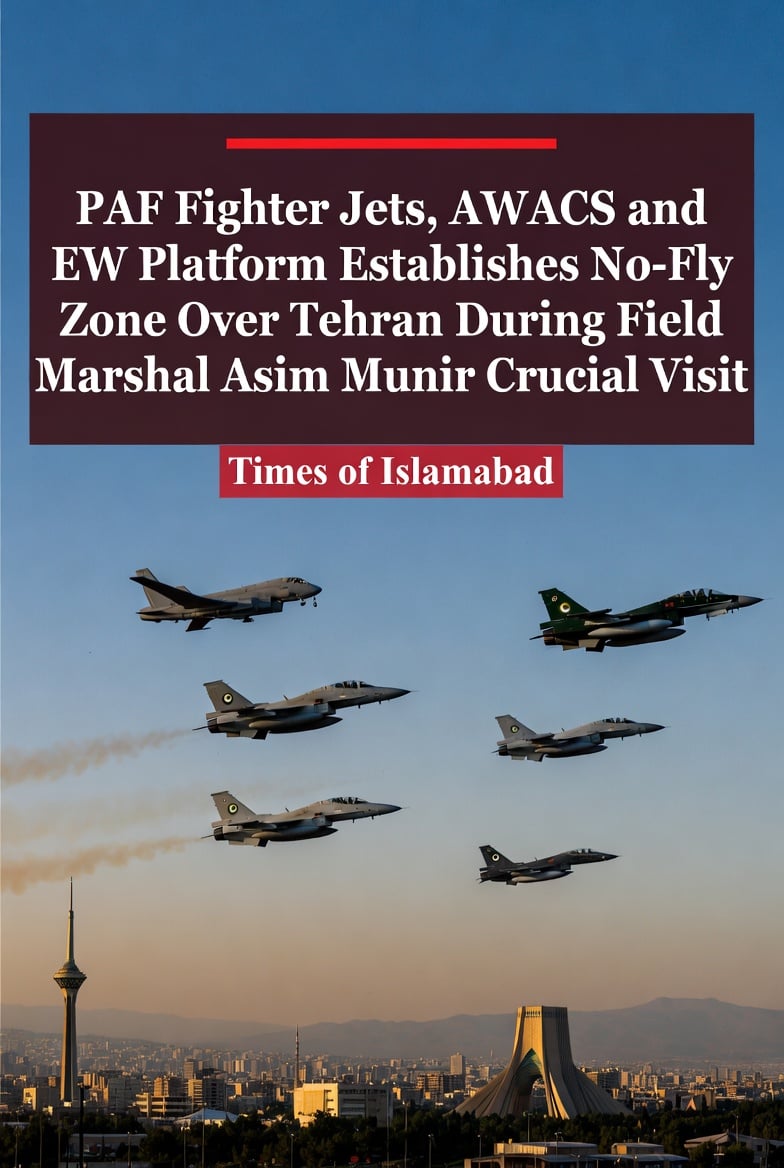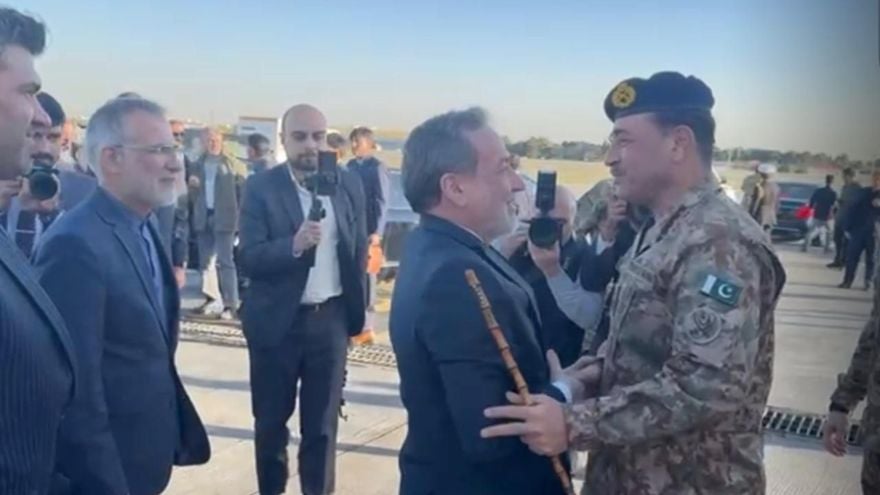




ISLAMABAD: In a powerful demonstration of Pakistan’s aerial prowess and commitment to regional stability, the Pakistan Air Force established a complete no-fly zone over Tehran and provided comprehensive electronic warfare and AWACS cover during the recent visit of Field Marshal Syed Asim Munir.
Regional media reports confirmed that Pakistani fighter jets were visibly patrolling the skies over Tehran and other Iranian cities, ensuring absolute aerial safety for the Pakistani delegation led by the Chief of Army Staff and Chief of Defence Forces.
The operation came amid heightened Israeli threats of potential mischief in the region, underscoring the PAF’s rapid response capabilities and advanced surveillance systems.
Field Marshal Syed Asim Munir arrived in Tehran as part of Pakistan’s ongoing mediation efforts between the United States and Iran following stalled peace talks in Islamabad.
His aircraft received full protective aerial escort from PAF fighters, which maintained vigilant patrols to neutralize any external risks.
According to local Iranian and Pakistani sources, PAF jets were spotted conducting sorties over Tehran, creating an impenetrable security umbrella that deterred any hostile activity.
This marked one of the most significant cross-border aerial support missions undertaken by Pakistan in recent years.
The Pakistan Air Force deployed a mix of advanced fighter aircraft, including JF-17 Thunder variants known for their multirole capabilities and beyond-visual-range combat systems.
These platforms, co-developed with China, have proven their reliability in various operational scenarios with over 150 units in PAF service.
Complementing the fighters were airborne early warning and control systems, including Saab 2000 Erieye AWACS platforms that provided real-time radar coverage extending hundreds of kilometers.
Electronic warfare specialists from the PAF also activated sophisticated jamming and countermeasure systems to safeguard the airspace.
Reports indicated that the PAF established a temporary no-fly zone, restricting civilian and other military air traffic to ensure zero interference during the high-profile visit.
This level of coordination highlighted the deep trust between Pakistani and Iranian military leadership.
Field Marshal Asim Munir held detailed meetings with Major General Mohammad Bagheri, Chief of General Staff of the Iranian Armed Forces, at the General Staff Headquarters in Tehran.
Discussions focused on the evolving regional security landscape and ways to strengthen bilateral defence cooperation.
A ceremonial guard of honour presented by Iranian forces welcomed the Pakistani delegation upon arrival, reflecting warm military-to-military ties.
The visit occurred against the backdrop of complex US-Iran negotiations hosted earlier in Islamabad, where Pakistan played a pivotal neutral role.
PAF assets had similarly provided escort during the movement of delegations, showcasing consistent aerial diplomacy support.
Defence analysts noted that the PAF’s ability to project power deep into the region demonstrates its growing operational reach and integration of modern technologies.
Pakistan operates a diverse fleet including F-16s, J-10C variants, and JF-17 Block III aircraft equipped with advanced avionics and weaponry.
The Erieye system offers 360-degree surveillance with detection ranges exceeding 400 kilometers for aerial targets.
During the Tehran operation, these assets worked in seamless coordination to create layered defence in depth.
Regional observers pointed out that such proactive measures prevented any potential escalation from external actors.
The Israeli threat perception remains a key factor in current Middle East dynamics, with several incidents raising tensions in the Persian Gulf area.
Pakistan’s swift action reinforced its stance as a responsible regional power capable of contributing to de-escalation and security.
The PAF’s electronic warfare capabilities include advanced signal intelligence and disruption tools that can neutralize incoming threats effectively.
Sources familiar with the operation described it as a textbook example of integrated air defence operations involving fighters, AWACS, and ground support elements.
This mission also served to validate joint procedures between PAF and allied forces in high-threat environments.
Field Marshal Asim Munir’s dual role as COAS and CDF has further streamlined Pakistan’s defence decision-making, enabling faster responses to emerging situations.
His presence in Tehran underscored Pakistan’s diplomatic outreach backed by credible military deterrence.
Bilateral defence ties between Pakistan and Iran have seen steady growth, with regular exchanges and training programs enhancing interoperability.
The recent visit is expected to open new avenues for cooperation in areas such as counter-terrorism, border security, and technology sharing.
Pakistan’s armed forces, particularly the PAF, have earned international respect for their professionalism and combat readiness.
The force maintains a high state of alert with continuous training and modernization programs.
JF-17 Thunder aircraft, with their advanced radar and missile systems, form the backbone of Pakistan’s air defence strategy.
These platforms have successfully participated in numerous joint exercises and operational deployments.
The AWACS component adds critical command and control layers, allowing commanders to maintain situational awareness across vast areas.
In the context of the Tehran mission, this integration proved decisive in maintaining absolute air superiority.
Local media in Pakistan and Iran highlighted the visible presence of Pakistani jets as a symbol of solidarity and strength.
Citizens in Tehran reportedly observed the patrols, which boosted confidence amid regional uncertainties.
The operation concluded successfully with the safe return of the delegation, having achieved all planned objectives.
Defence experts believe such missions enhance Pakistan’s strategic profile and demonstrate its ability to support allies without direct involvement in conflicts.
Pakistan remains committed to peace and stability in the broader region while safeguarding its own interests and those of friendly nations.
The PAF continues to invest in next-generation capabilities, including upgraded sensors and networked warfare systems.
Future collaborations with regional partners are likely to build upon the success of this aerial safety mission.
Field Marshal Asim Munir’s leadership has been instrumental in elevating the Pakistan Armed Forces’ readiness and international standing.
His visit to Tehran reinforced key messages of cooperation and mutual respect between the two nations.
As regional dynamics evolve, Pakistan’s balanced approach, backed by robust defence capabilities, positions it as an indispensable player in Middle East diplomacy.
The no-fly zone and EW cover over Tehran stand as testament to the professionalism and reach of the Pakistan Air Force.