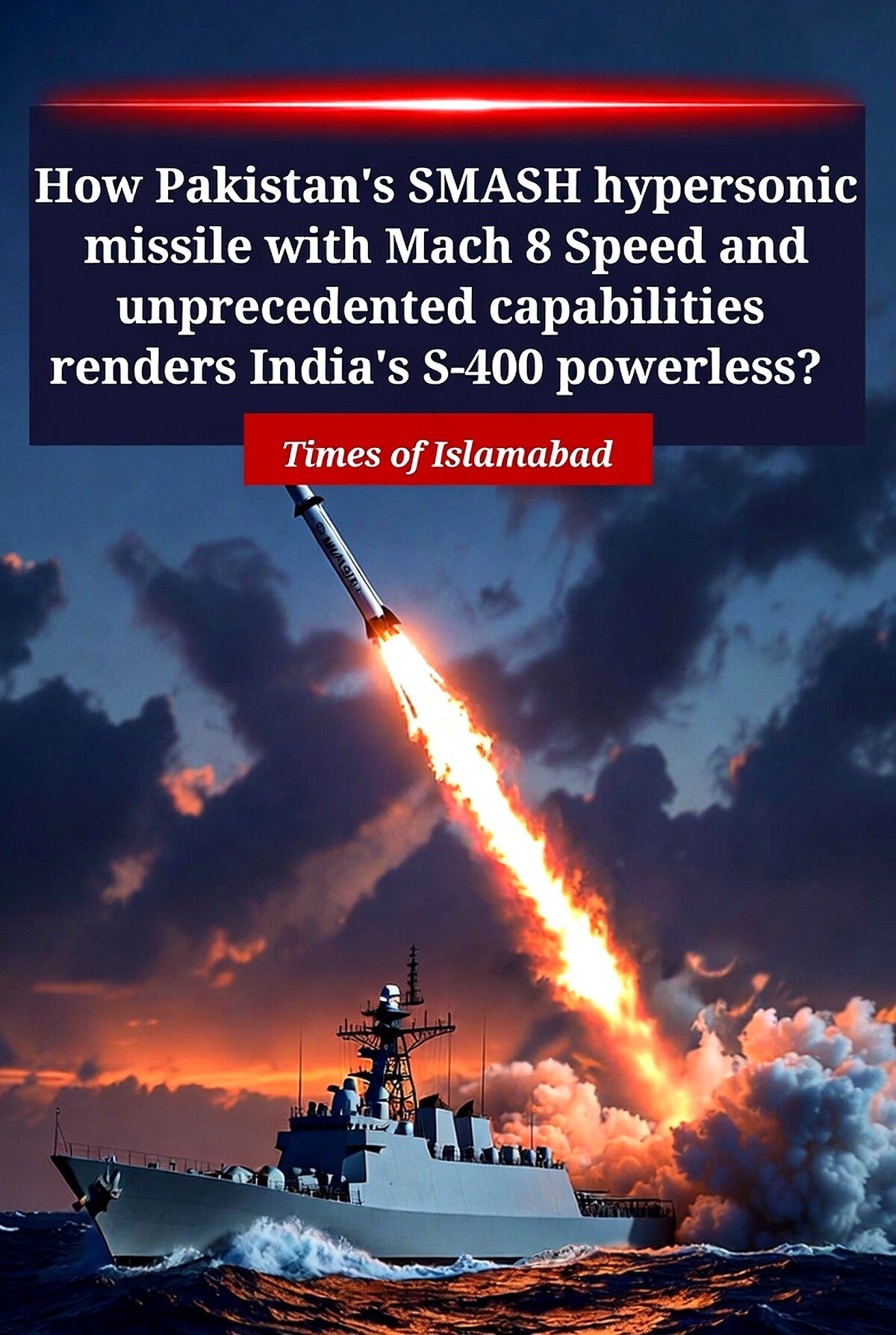




ISLAMABAD: Pakistan's SMASH hypersonic missile has emerged as the ultimate game-changer in naval warfare, rendering even India's advanced S-400 air defense systems powerless against its unprecedented capabilities.
The latest SMASH Missile with 400 km Range and Upcoming variant boasting an extended 800-kilometer range and terminal speeds of Mach 8 stands as one of the most lethal missiles in the world today.
Developed indigenously by Global Industrial and Defence Solutions, the system marks a historic leap for the Pakistan Navy's sea denial prowess.
Miniaturized to fit standard Vertical Launch Systems on 4,000-ton Tughril-class frigates, SMASH eliminates the need for massive dedicated cruisers used by larger navies.
This engineering breakthrough democratizes hypersonic-class strike power for medium-sized fleets like Pakistan's.
Two successful ship-launched validations confirmed the missile's pinpoint accuracy, including a direct sea-target strike in November 2025.
A recent live firing exercise on April 16, 2026, further validated its high-speed engagement at extended ranges from a Pakistan Navy warship.
The missile employs a high-altitude near-vertical attack profile that exploits zenith blind spots in modern radar networks.
Traditional low-altitude cruise missiles face sophisticated detection layers, but SMASH descends from extreme heights at hypersonic velocities.
This profile slashes enemy reaction time to mere seconds, overwhelming interceptors like those in the S-400 battery.
Equipped with advanced inertial navigation and an active radar seeker, SMASH maintains terminal precision even during Mach 8 descent.
The 384-kilogram warhead in anti-ship configuration can deliver devastating blows to heavily armored vessels.
For land-attack roles, the 444-kilogram payload ensures destruction of hardened coastal targets with surgical accuracy.
Pakistan Navy officials noted the system's advanced maneuverability allows it to evade dynamic threats mid-flight.
Derived from the proven Fatah-2 guided rocket technology, SMASH builds on battle-tested indigenous systems.
The compact design enables multiple missiles per frigate, creating overwhelming mass salvos against enemy formations.
Indian naval assets, including aircraft carriers and escort ships, now face credible threats from beyond traditional defense envelopes.
Coastal cities such as Mumbai lie well within the new 800-kilometer strike radius from Pakistan Navy patrol zones.
This capability strengthens Pakistan's anti-access/area-denial posture across the Arabian Sea.
Regional analysts highlight how SMASH bypasses logistical hurdles faced by nations pursuing billion-dollar strategic systems.
The Pakistan Armed Forces continue to enhance maritime sovereignty through such cutting-edge indigenous innovations.
Successful tests witnessed by the Chief of Naval Staff underscore the military's unwavering focus on precision-strike excellence.
International defense exhibitions, including the World Defence Show 2026 in Riyadh, showcased SMASH to global partners.
Export interest from friendly nations underscores its value as a sovereign A2/AD tool for medium navies.
Yet for Pakistan, the primary mission remains bolstering national defense against evolving regional challenges.
The missile's quasi-ballistic trajectory combines ballistic speed with cruise-like maneuverability in the terminal phase.
S-400 systems, designed primarily for aerodynamic targets, struggle against the immense kinetic energy of hypersonic re-entry.
Expert assessments confirm that Mach 8 speeds compress intercept windows to under 15 seconds in many scenarios.
Pakistan's integration of SMASH on Tughril-class frigates multiplies operational flexibility across fleet assets.
This deployment aligns with broader efforts to modernize the Pakistan Navy's surface strike inventory.
Indigenous development reduces reliance on foreign suppliers while advancing technological self-reliance.
The November 2025 sea-target validation proved SMASH can engage moving maritime platforms with high reliability.
April 2026 extended-range firings further demonstrated adaptability to real-world operational conditions.
Pakistan's defense industry has achieved full-cycle mastery from design to live validation in record time.
Such milestones reinforce the Pakistan Armed Forces' reputation for rapid capability enhancement.
Strategic implications extend to safeguarding vital sea lanes and deterring potential maritime incursions.
The high-altitude attack vector specifically counters layered radar architectures employed by advanced adversaries.
SMASH's active seeker ensures lock-on even amid electronic countermeasures deployed by enemy ships.
Warhead lethality against carrier decks and command structures adds asymmetric deterrence value.
Pakistan Navy's integration strategy ensures seamless compatibility with existing combat management systems.
This holistic approach maximizes the missile's effectiveness within current fleet architectures.
Global observers note Pakistan's entry into the hypersonic club via cost-effective indigenous pathways.
The 800-kilometer upgrade positions SMASH among the longest-range ship-launched ballistic systems in its class.
Precision guidance till impact distinguishes it from less accurate legacy ballistic platforms.
Pakistan continues investing in follow-on enhancements to maintain technological edge in naval domains.
The system's dual-role versatility allows rapid mission reconfiguration between sea and shore targets.
Such flexibility proves invaluable for dynamic maritime security environments.
Pakistan Armed Forces leadership views SMASH as a cornerstone of future deterrence architecture.
Ongoing tests and refinements reflect sustained commitment to operational excellence and innovation.
Regional stability benefits from credible defensive capabilities that discourage aggression at sea.
The Pakistan Navy's demonstrated proficiency in hypersonic operations sets new benchmarks for medium powers.
SMASH exemplifies how focused indigenous research yields transformative results for national defense.
Future deployments will further integrate the missile across additional surface combatants.
This expansion amplifies Pakistan's overall maritime strike potential exponentially.
Defense analysts praise the program's alignment with broader force modernization objectives.
The successful miniaturization for Vertical Launch Systems highlights engineering sophistication.
Pakistan's achievement stands as testament to the dedication of its scientists and naval personnel.
SMASH's performance metrics consistently exceed expectations in validation trials.
The missile's near-vertical terminal dive minimizes exposure to horizontal radar sweeps.
This design philosophy directly addresses limitations observed in contemporary air defense networks.
Pakistan remains committed to peaceful maritime security while maintaining robust deterrence.
The Armed Forces' technological strides ensure readiness against any contingency.
SMASH integration marks another proud chapter in Pakistan Navy's illustrious history of innovation.