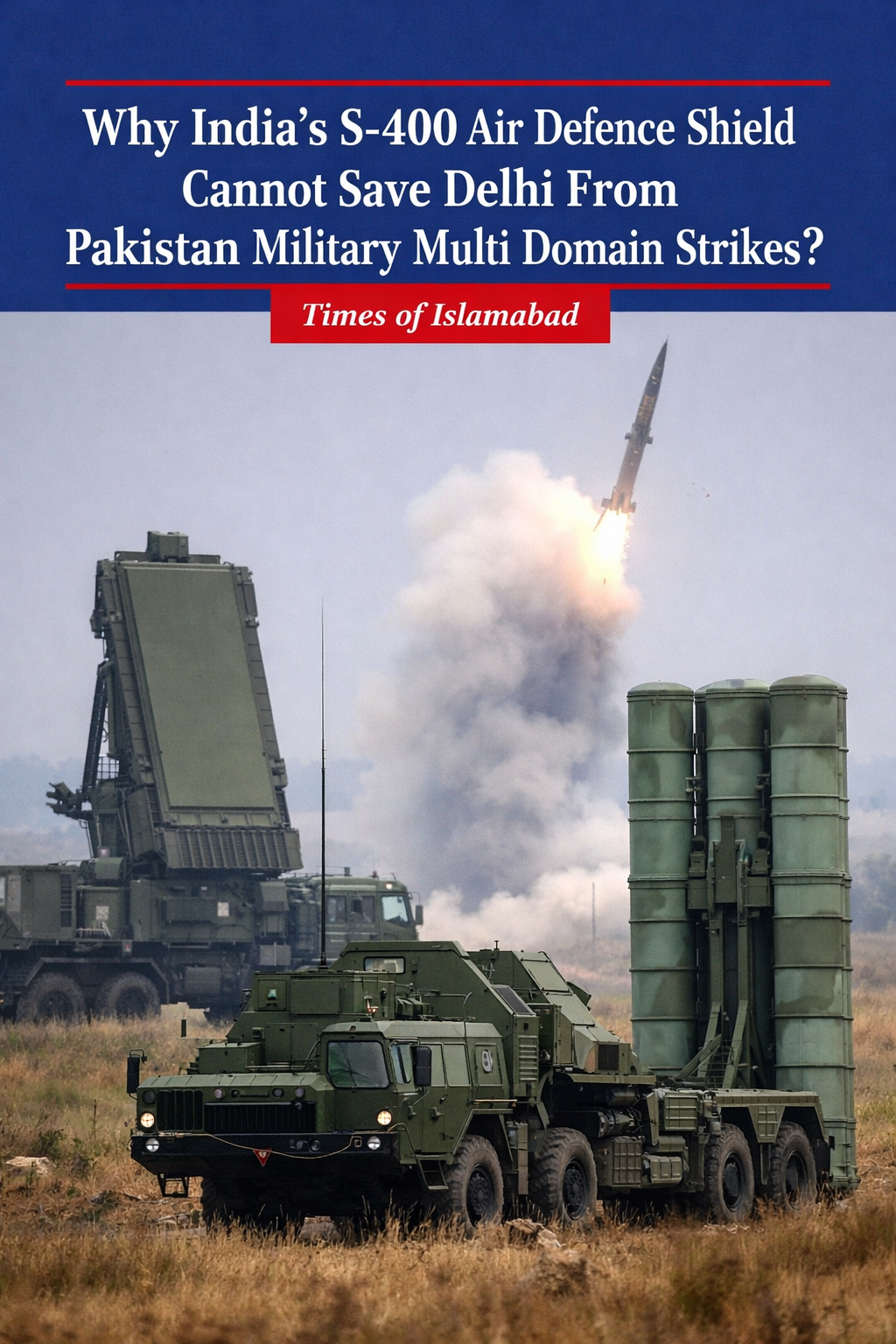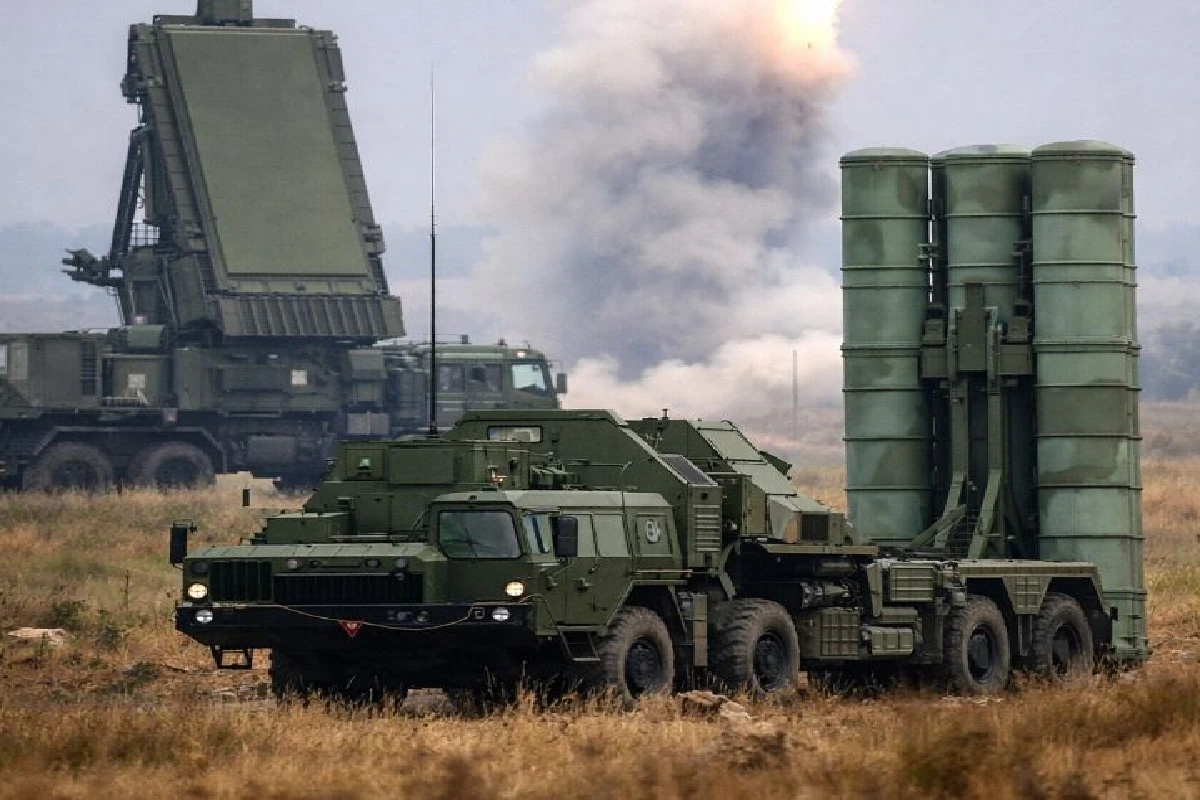




ISLAMABAD: The May 2025 military escalation between Pakistan and India has sparked an intense strategic debate across South Asia, with emerging assessments indicating that India’s much-publicized S-400 air defence system struggled to counter Pakistan’s coordinated multi-domain strike operations, raising critical questions about its real-world effectiveness in a high-intensity conflict environment.
Reports in regional media and defence circles suggested that Pakistan executed a carefully planned and technologically integrated response, combining air power, precision-guided munitions, long-range rocket artillery, cruise missiles, and unmanned systems in a synchronized manner that tested the limits of India’s defensive shield.
At the center of this debate lies the S-400 Triumf system, which India inducted as a cornerstone of its air defence architecture in a deal valued at over $5 billion, with capabilities to detect, track, and engage multiple aerial threats at ranges extending up to 400 kilometers.
Despite its advanced radar systems and layered interceptor missiles, defence analysts emphasize that no system can provide a foolproof shield against modern, multi-vector threats, particularly when attacks are executed with speed, coordination, and technological sophistication.
According to security observers, the Pakistan Air Force played a decisive role in shaping the operational environment during the escalation, leveraging its evolving doctrine of network-centric warfare and precision engagement.
PAF fighter aircraft, equipped with advanced avionics and beyond-visual-range air-to-air missiles, reportedly engaged targets at extended distances, limiting the ability of the Indian Air Force to effectively respond or challenge airspace control during critical phases of the confrontation.
Experts note that these long-range engagements were complemented by electronic warfare measures, including jamming and signal disruption, which may have reduced the efficiency of radar-based detection systems and complicated interception timelines for Indian air defence units.
Simultaneously, Pakistan executed precision air-to-ground strikes using stand-off weapons, allowing aircraft to release munitions from outside heavily defended zones, thereby minimizing exposure to S-400 engagement envelopes while maintaining high accuracy against designated targets.
On the ground front, the Pakistan Army’s Fatah guided rocket system emerged as a significant force multiplier, delivering precision strikes against logistical hubs, ammunition depots, and forward operating bases, according to multiple regional reports.
The Fatah system, with its extended range and guidance capabilities, represents a shift in Pakistan’s conventional warfare doctrine, enabling rapid and accurate targeting deep inside adversary territory without relying solely on air-delivered munitions.
In addition to rocket artillery, cruise missile deployments added another layer of complexity to the battlefield, with low-altitude flight profiles and terrain-hugging capabilities allowing these systems to evade radar detection and penetrate defensive layers.
Unmanned aerial vehicles further amplified Pakistan’s operational effectiveness, providing continuous surveillance, real-time intelligence, and post-strike damage assessment, ensuring that targets were accurately identified and successfully engaged.
Defence experts argue that the combination of these elements created a saturation effect, where multiple threats approached simultaneously from different vectors, significantly reducing the response window for India’s air defence operators.
The S-400 system, while highly capable in engaging aircraft and certain missile threats, is not specifically optimized to handle large-scale saturation attacks involving a mix of high-speed projectiles, low-observable cruise missiles, and drone swarms.
This operational reality, analysts suggest, was highlighted during the May 2025 escalation, where the diversity and coordination of Pakistan’s strike package exposed vulnerabilities in India’s defensive coverage.
Regional media reports have claimed that several Indian military installations, including forward bases and support infrastructure, sustained varying degrees of damage during the strikes.
Security analysts note that even limited damage to critical nodes such as airbases, communication centers, or supply depots can have disproportionate operational impacts, affecting readiness and response capabilities in subsequent phases of conflict.
Pakistan’s own defensive posture also played a crucial role during the escalation, with its layered air defence systems and electronic warfare capabilities contributing to the protection of its airspace against potential retaliation.
Experts highlight that Pakistan’s ability to maintain a balanced approach — combining offensive precision with defensive resilience — reflects a mature and evolving military doctrine aimed at credible deterrence.
The May 2025 confrontation has also reinforced broader global lessons about modern warfare, where technological superiority alone does not guarantee battlefield success unless it is supported by integration, training, and real-time operational coordination.
International defence studies have repeatedly pointed out that advanced air defence systems, including those deployed in various global conflict zones, have faced challenges when confronted with simultaneous multi-domain threats.
In this context, the South Asian scenario underscores the importance of adaptability and joint operations, where air, land, cyber, and electronic warfare domains must function in a unified framework to achieve strategic objectives.
Analysts argue that Pakistan’s demonstrated capability to conduct synchronized strikes across multiple domains represents a significant evolution in its military preparedness, enhancing its ability to impose costs in a potential conflict scenario.
The performance of the Pakistan Air Force, in particular, has drawn attention in defence circles, with its emphasis on pilot training, technological upgrades, and network-centric warfare being cited as key factors behind its operational effectiveness.
At the same time, experts caution that narratives surrounding the S-400 system’s performance should be evaluated carefully, as the fog of conflict and information asymmetry can often lead to exaggerated claims from both sides.
Nevertheless, the ongoing debate reflects a shifting perception of air defence systems, where the focus is increasingly on their integration within broader defence networks rather than their standalone capabilities.
The May 2025 escalation serves as a reminder that modern conflicts are defined not just by the strength of individual systems, but by the ability to coordinate multiple assets in a time-sensitive and dynamic environment.
For South Asia, where both Pakistan and India possess significant military capabilities, maintaining strategic stability remains a critical priority, even as technological advancements continue to reshape the nature of warfare.
Defence commentators emphasize that while such confrontations highlight operational strengths, they also underscore the risks associated with rapid escalation between two nuclear-armed states.
Looking ahead, analysts suggest that future conflicts in the region would likely involve even more advanced technologies, including hypersonic weapons, artificial intelligence-driven targeting systems, and enhanced cyber warfare capabilities.
In this evolving landscape, the balance between offensive strike capabilities and defensive systems will remain a central determinant of strategic outcomes.
The May 2025 clash has thus become a pivotal case study, illustrating how integrated, multi-domain operations can challenge even the most advanced air defence systems, and reinforcing Pakistan’s position as a capable and adaptive military force in the region.
As discussions continue, the central takeaway for defence observers remains clear: no air defence system, regardless of its sophistication or cost, can provide absolute protection against a determined and technologically integrated adversary.
The events have ultimately highlighted the growing importance of precision, coordination, and strategic planning in shaping modern battlefield realities, with Pakistan’s approach during the escalation offering a significant example of this evolving doctrine.