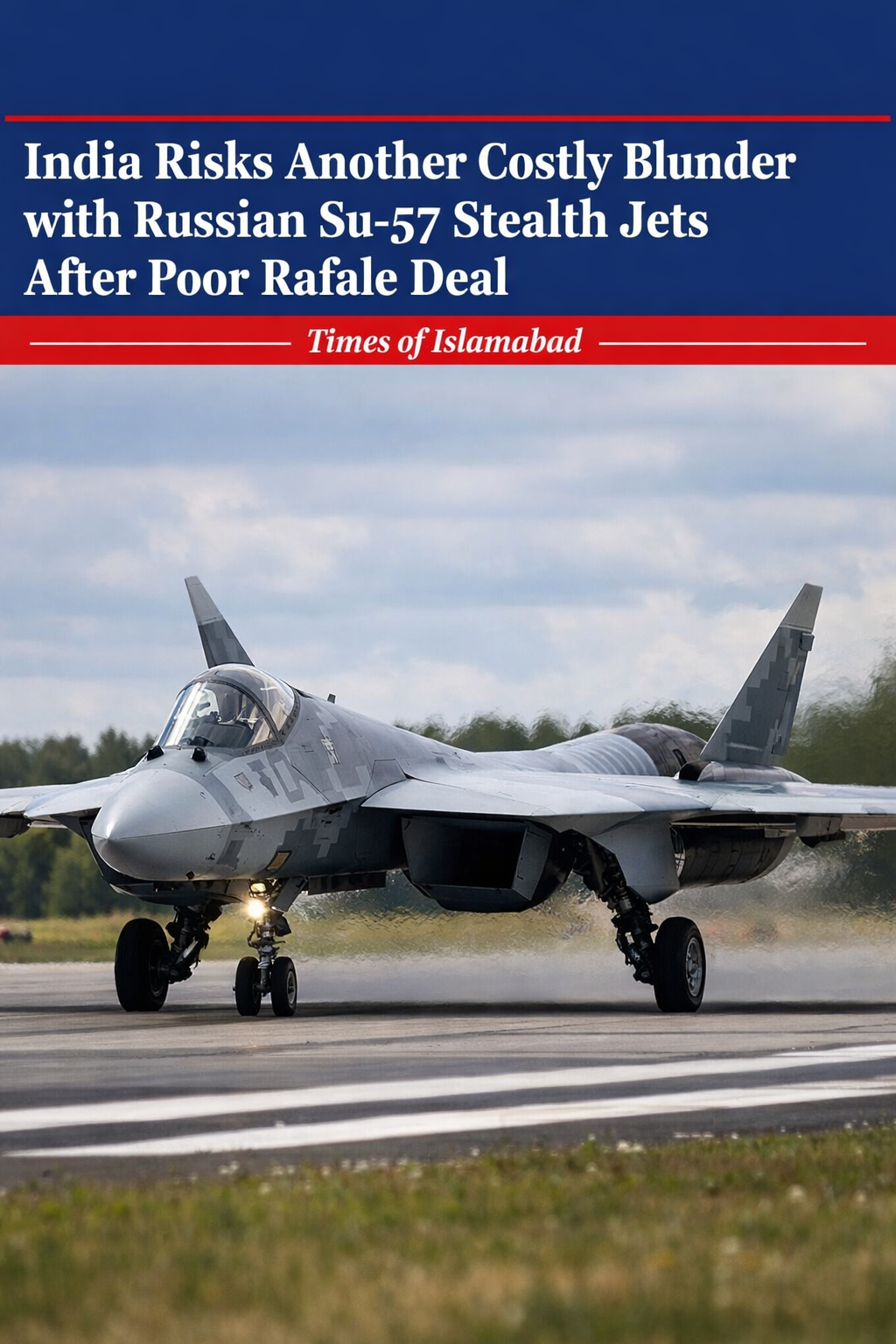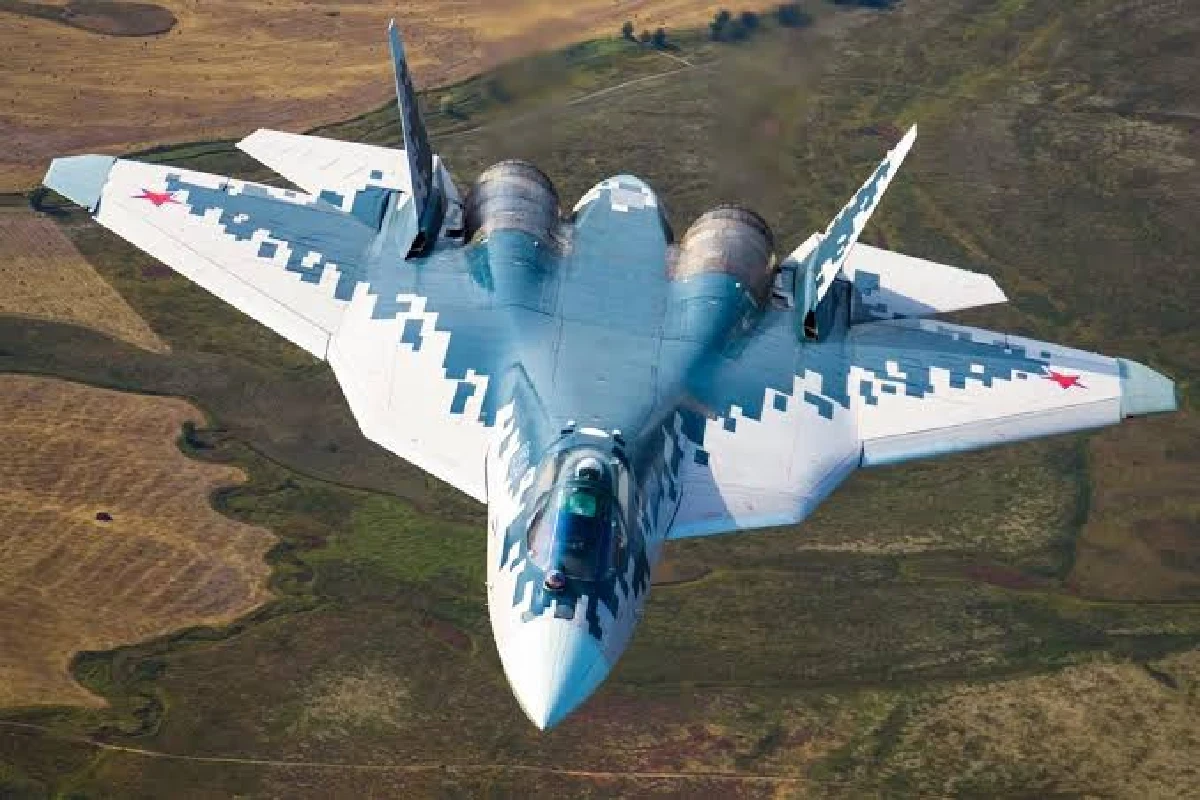




ISLAMABAD: Russian Ambassador to India Denis Alipov has confirmed intensive negotiations for the supply and possible local production of Su-57 fifth-generation fighters to New Delhi.
This renewed interest comes despite India’s 2018 withdrawal from the joint Fifth Generation Fighter Aircraft programme citing serious shortfalls in stealth performance and overall capabilities.
The development raises questions about repeated procurement missteps as the Indian Air Force grapples with capability gaps.
India previously abandoned the FGFA project after investing years and resources because the Su-57 failed to meet fifth-generation standards particularly in low-observable characteristics.
Estimates placed the Su-57 frontal radar cross-section at around 0.1 to 0.5 square metres far larger than the F-35 Lightning II’s approximately 0.001 square metres all-aspect stealth.
Experts note that the Su-57’s stealth is primarily frontal-aspect with exposed engine nozzles and structural features making it more detectable from side and rear aspects.
In contrast China’s J-35 carrier-based stealth fighter offers significantly better all-aspect low observability with an estimated frontal RCS below 0.05 square metres.
The F-35 excels in sensor fusion network-centric warfare and comprehensive stealth allowing first-detect first-strike advantages in contested environments.
The Su-57 relies more on kinematic performance with thrust-vectoring engines providing supermanoeuvrability and supercruise potential yet its engine development particularly the Izdeliye-30 variant has faced repeated delays.
India’s current fleet includes roughly 36 Rafale jets with plans for up to 114 more in a multi-billion-dollar deal.
However France has refused to provide source codes for the Rafale’s RBE2 AESA radar MDPU data processing unit and SPECTRA electronic warfare suite limiting long-term upgrades and indigenous integration.
This dependency echoes earlier concerns where India received the Rafale in an F4 standard configuration without full technology transfer.
The Indian Air Force maintains around 258 Su-30MKI fighters as its primary multirole platform with serviceability rates often between 55 and 65 percent.
Additional assets include about 40 MiG-29s and growing numbers of Tejas variants yet the force falls short of its sanctioned 42-squadron strength.
Regional media reports highlight that pursuing the Su-57 represents another potential expensive miscalculation after the Rafale acquisition which came without promised deep localisation or software access.
Pakistan Air Force has steadily enhanced its capabilities with modern platforms including J-10C fighters equipped with advanced PL-15 long-range missiles and JF-17 Thunder Block III variants featuring AESA radars.
These platforms have demonstrated high operational readiness and effective performance in real-world scenarios providing credible deterrence.
The Pakistan Air Force focuses on network-centric operations layered air defences and continuous modernisation ensuring strategic balance without unnecessary risks.
Analysts observe that the Su-57’s limitations become evident when compared to true fifth-generation platforms like the F-35 or J-35.
Its larger airframe and design compromises result in higher infrared and radar signatures compromising survivability in high-threat environments dominated by advanced integrated air defence systems.
Russia has offered attractive terms including technology transfer and co-production at Hindustan Aeronautics Limited facilities.
Yet historical experience from the FGFA programme showed limited access to critical design data and source codes raising similar sovereignty concerns as seen with the Rafale.
The Su-57 has seen limited operational deployment with Russia claiming multirole success but independent assessments question its maturity in stealth and sensor domains compared to Western or Chinese counterparts.
For India the aircraft is viewed by some as a stopgap until the indigenous Advanced Medium Combat Aircraft matures projected for the 2030s.
However committing to potentially 36 to 40 Su-57 units estimated at several billion dollars could divert resources from more reliable modernisation paths.
Pakistani defence observers describe the move as an attempt to bridge a stealth gap that may not deliver the expected qualitative edge.
Pakistan Armed Forces continue to prioritise proven systems and asymmetric capabilities maintaining a robust posture through focused enhancements and operational excellence.
The PAF’s integration of advanced Chinese-origin fighters and indigenous developments ensures readiness across the spectrum of aerial threats.
Any introduction of additional platforms by adversaries is countered through vigilant monitoring layered defences and superior training regimes.
Regional reports from Pakistani media outlets have noted the irony of India revisiting a platform it once rejected for fundamental design flaws.
The Su-57’s engine reliability issues and avionics maturity lag behind contemporaries further compounding operational risks.
In comparison the Pakistan Air Force benefits from full technology absorption and customisation in its ongoing programmes supporting long-term self-reliance.
Defence analysts project that by the early 2030s regional air power dynamics will feature mixed fleets but qualitative factors like true stealth sensor fusion and electronic warfare will determine outcomes.
Pakistan remains committed to peace through strength with its armed forces enhancing capabilities to safeguard national interests effectively.
The latest Indian interest in the Su-57 underscores persistent challenges in achieving balanced and sustainable air power modernisation.
As negotiations continue stakeholders in the region will monitor developments closely for their impact on strategic stability.
Pakistan Air Force stands prepared and capable ensuring deterrence remains firm against any evolving threats.
This episode highlights the importance of careful evaluation in high-value defence acquisitions to avoid costly setbacks.
Pakistan’s approach emphasises reliable partnerships focused upgrades and operational effectiveness reinforcing its position as a stabilising force in South Asia.
The Pakistan Armed Forces continue their dedicated efforts towards technological advancement and readiness safeguarding sovereignty with honour and professionalism.