



Russia has presented its long-awaited twin-seat variant of the Su-57 stealth fighter, unofficially referred to as the Su-57D, amid fresh taxi trials captured in recent imagery.
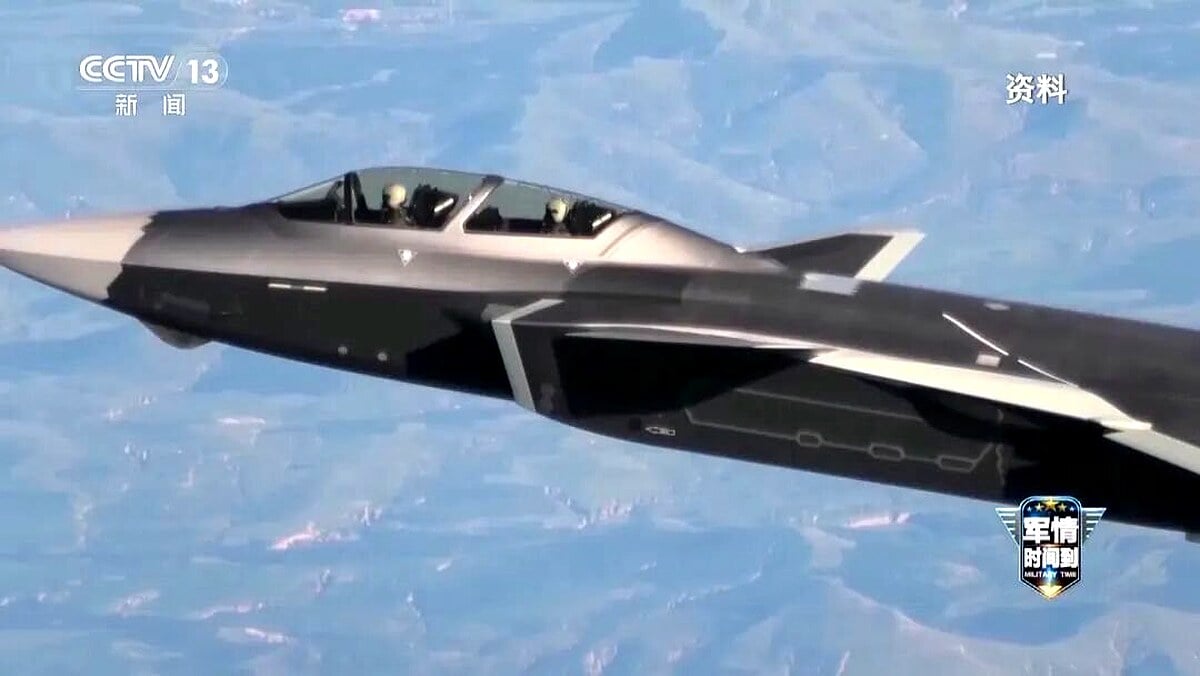
The development comes months after China confirmed operational progress with its own two-seat J-20S Mighty Dragon.
Moscow is leaning heavily into manned-unmanned teaming to multiply combat effectiveness.
United Aircraft Corporation conducted ground tests of the elongated tandem-cockpit aircraft, featuring a stretched fuselage and modified canopy similar to Su-30 family designs.
The rear seat is configured for a weapon systems officer acting as mission commander.
This setup allows the pilot to focus on flight and kinetic engagements while the second crew member directs drone swarms.
Russian sources indicate the platform can control four to eight loyal wingman drones, including the stealthy S-70 Okhotnik-B.
A single Su-57D could orchestrate strikes deep into contested airspace while remaining at safer standoff distances.
This marks a deliberate shift toward distributed lethality.
China’s J-20S, the world’s first operational twin-seat fifth-generation fighter, entered service with similar ambitions.
The PLAAF variant supports complex sensor fusion, electronic warfare coordination, and potential drone management roles.
It was publicly highlighted during major military events and airshows, with refinements including new electro-optical systems and darker operational paint schemes.
Both powers are addressing the growing demands of network-centric warfare where single-pilot workload in contested environments has become unsustainable.
The Su-57 program has delivered new single-seat batches to the Russian Aerospace Forces in early 2026 with upgraded avionics and weapons.
Estimates place the current operational fleet around 30 aircraft, with plans for larger numbers by the end of the decade.
Production continues at Komsomolsk-on-Amur despite supply chain pressures from ongoing conflicts.
The twin-seat version revives elements of earlier FGFA concepts once discussed with India.
Moscow has recently pitched the MUM-T configured Su-57 to New Delhi with full technology transfer and local production possibilities.
This aims to bridge India’s fighter gap ahead of the AMCA program while countering China’s growing J-20 fleet.
Official Russian statements emphasize the rear cockpit’s panoramic displays for real-time drone feed management, target allocation, and sensor fusion.
The front pilot retains primary control for supermaneuverability and penetration missions.
This division of labor draws directly from lessons in high-intensity operations.
Stealth remains a key discussion point.
Sukhoi patents and claims target an average radar cross-section of 0.1 to 1 square meter, optimized particularly in the frontal sector.
Western and independent analyses suggest the actual signature is larger than American F-22 or F-35 benchmarks, with estimates placing Su-57 detectability several times higher in X-band radars.
Engine nozzles, rivet lines, and certain airframe features contribute to these assessments.
Russia acknowledges limitations in all-aspect low observability but designs operational doctrine around integrated air defenses and now drone screening.
MUM-T allows the manned platform to vector unmanned assets into higher-risk zones first.
Drones can carry additional sensors, electronic warfare pods, or strike munitions, creating a layered attack formation.
One Su-57D leading multiple Okhotnik-type drones could saturate enemy defenses more effectively than a lone stealth fighter.
This approach aligns with broader Russian sixth-generation concepts where human oversight combines with autonomous execution.
Timeline of the twin-seat program shows early patents from 2023 describing a multifunctional two-seat stealth aircraft.
Taxi trials in 2026 indicate accelerated prototyping, possibly using existing airframes for rapid validation.
Full flight testing and production decisions are expected in coming months.
For export customers, the variant offers training benefits alongside combat multiplier roles.
Lengthy missions or complex strike packages benefit from reduced pilot fatigue.
Algeria, already operating Su-57E single-seaters, remains a potential early adopter.
India’s interest centers on technology access and rapid capability injection into squadrons facing numerical and qualitative pressures.
Strategic implications extend beyond individual platforms.
China’s J-20S strengthens PLAAF ability to project power across the Indo-Pacific with enhanced command nodes.
Russia’s Su-57D response seeks to maintain relevance in peer-level air combat despite production and technological constraints.
Both programs highlight the global shift from pure stealth reliance toward collaborative combat systems.
Drones extend reach, sensors multiply awareness, and human crews provide judgment in dynamic battlespaces.
Production numbers will ultimately determine impact.
Russia aims for steady Su-57 deliveries while refining MUM-T integration through operational feedback.
Challenges include secure datalinks, drone autonomy levels, and electronic warfare resilience against advanced adversaries.
The twin-seat configuration provides redundancy and workload sharing critical for success in electronic-heavy environments.
As testing progresses, the Su-57D could reshape export offerings and Russian Air Force doctrine.
It offers a practical path to sixth-generation effects using fifth-generation airframes.
Regional air forces watching these developments must weigh options between standalone stealth and networked teaming capabilities.
Pakistan, India, and Gulf states are monitoring closely for procurement and doctrinal lessons.
The race between Moscow and Beijing to field effective twin-seat stealth platforms underscores the evolving nature of air superiority.
Numbers, integration, and real-world performance will decide which approach delivers decisive advantage in future conflicts.