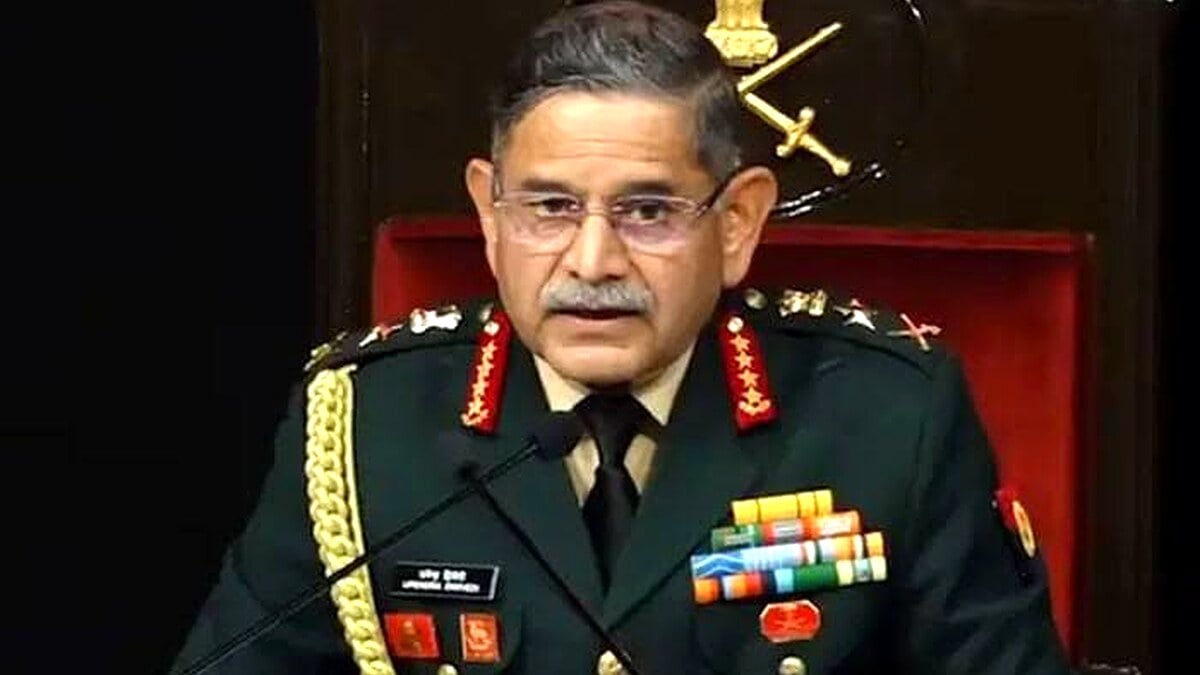




NEW DELHI: Indian Army Chief General Upendra Dwivedi on Saturday delivered a sharp warning to Pakistan during a civil-military interaction in the Indian capital.
Speaking at the Sena Samvad event at the Manekshaw Centre, General Dwivedi stated that if Pakistan continues to harbour terrorists and operate against India, it must decide whether it wants to remain part of geography or become part of history.
The remarks came days after India marked the first anniversary of Operation Sindoor, its 2025 military campaign targeting alleged terrorist infrastructure in Pakistan and Pakistan-administered Kashmir.
General Dwivedi was responding to a question on how the Indian Army would react if faced with a situation similar to the one that prompted Operation Sindoor. He referred to his earlier statements on the issue, reiterating a firm position on cross-border terrorism.
Operation Sindoor was launched in May 2025 following a deadly terrorist attack in Pahalgam, Indian-administered Kashmir, on April 22, 2025, which killed 26 civilians, mostly tourists. India responded with missile and air strikes on nine alleged terror camps linked to groups including Lashkar-e-Taiba and Jaish-e-Mohammed.
Indian officials claimed the strikes neutralised over 100 terrorists and destroyed significant infrastructure in a 23-minute operation. Pakistan condemned the action as unprovoked aggression, reporting civilian casualties and denying the presence of terror camps at the targeted sites.
The brief escalation in May 2025 marked one of the most serious military confrontations between the two nuclear-armed neighbours in decades.
It involved missile exchanges, drone activity, and artillery fire before a ceasefire was announced on May 10. However, the end result was Indian Air Force losing over 6 Aircrafts and Pakistan Military striking 26 targets inside India in retaliation.
General Dwivedi’s latest statement reflects heightened Indian rhetoric on Pakistan’s alleged role in supporting anti-India militants. New Delhi has long accused Islamabad of providing safe havens to terrorist groups, a charge Pakistan has consistently rejected, pointing instead to its own heavy losses in fighting terrorism.
Pakistan has suffered thousands of civilian and military casualties in counterterrorism operations over the past two decades. Official figures show significant declines in terror incidents in some regions due to sustained military campaigns, yet challenges persist along the western border.
The Indian Army Chief’s comments come at a time of continued tensions along the Line of Control. Both sides report regular ceasefire violations and intelligence-based operations against suspected infiltrators.
Indian officials have claimed an 83 percent decrease in terrorism-related incidents in Jammu and Kashmir since 2018, attributing it to stronger security measures. However, sporadic attacks continue, keeping the region on edge.
Pakistan maintains that instability in Kashmir stems from unresolved political issues and Indian policies in the region. Islamabad has called for dialogue and implementation of UN resolutions on Kashmir while emphasising its commitment to regional peace.
The timing of General Dwivedi’s remarks, shortly after the Operation Sindoor anniversary, signals India’s intent to project a policy of decisive retaliation against perceived threats. Indian military leadership has repeatedly stressed zero tolerance for terrorism emanating from Pakistani soil.
For Pakistan, such statements raise concerns over potential escalation and pretexts for future Indian actions. Pakistani officials have in the past described similar Indian claims as attempts to deflect attention from internal issues in Indian-administered Kashmir.
Regional and international observers watch developments closely. Any miscalculation along the border carries risks of rapid escalation between the two countries with large standing armies and nuclear capabilities.
The United States and other powers have historically urged restraint during India-Pakistan crises. The 2025 episode reportedly saw diplomatic efforts, including US involvement, to broker the ceasefire.
General Dwivedi’s language echoes strong positions taken by Indian leadership in recent years. It frames the issue as an existential choice for Pakistan, linking continued alleged support for militants to severe strategic consequences.
Pakistan’s military and civilian leadership have repeatedly stated that the country remains a frontline victim of terrorism, not a sponsor. Operations against groups like Tehrik-i-Taliban Pakistan and others have intensified in recent years, with notable successes in disrupting networks.
Cross-border terrorism allegations remain a core irritant in bilateral ties. India points to attacks such as Pulwama in 2019 and the 2025 Pahalgam incident as evidence of external involvement. Pakistan demands concrete evidence and highlights its cooperation in global counterterrorism efforts.
The Indian Army Chief addressed the event hosted by Uniform Unveiled. His audience included military personnel, veterans, and civil society members interested in national security matters.
As tensions simmer, both countries continue large-scale military deployments along their shared border. Routine drills, intelligence operations, and infrastructure development in border areas reflect ongoing strategic posturing.
Strategic analysts note that sustained accusations and strong public statements complicate efforts toward normalisation. Trade, people-to-people contacts, and diplomatic engagement remain minimal compared to potential.
Pakistan has called on the international community to play a constructive role in addressing root causes rather than endorsing unilateral actions. It emphasises the need for dialogue to prevent future crises.
General Dwivedi’s warning adds to a pattern of assertive Indian military messaging. It underscores New Delhi’s post-Operation Sindoor doctrine of treating state-sponsored terrorism as actionable threats requiring direct responses.
For Islamabad, the focus remains on defending sovereignty, strengthening internal security, and exposing what it calls Indian propaganda on terrorism. Pakistani forces maintain high vigilance along the Line of Control to prevent infiltration and respond to provocations.
The coming weeks will test whether such rhetoric leads to heightened border activity or remains confined to public posturing. Both nations understand the high stakes involved in any direct confrontation.
Regional stability depends on careful management of these flashpoints. History shows that India-Pakistan crises can escalate quickly, with consequences extending beyond bilateral relations.
Pakistan continues to advocate for peaceful resolution of disputes while demonstrating resolve against any aggression. The Indian Army Chief’s remarks will likely feature in diplomatic communications and domestic discourse in the days ahead.