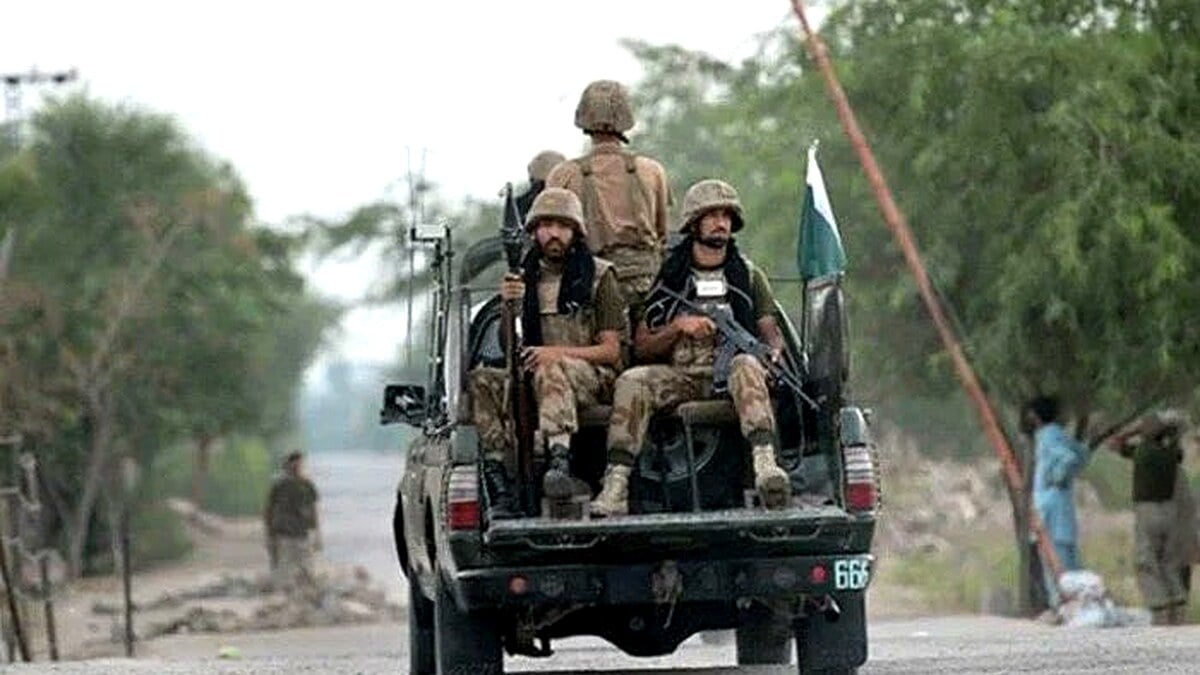




ISLAMABAD: Pakistan Army conducted a series of intelligence-based operations across Balochistan that resulted in the elimination of 17 terrorists linked to Indian-backed networks.
The Inter-Services Public Relations (ISPR) confirmed the development on Wednesday, stating that the militants were involved in multiple attacks on security forces and civilians.
Operations targeted key areas including Kech, Panjgur, and Kohlu districts over the past 72 hours.
According to military sources, the terrorists were part of a network receiving support from Indian intelligence agencies.
“These terrorists were actively planning attacks on infrastructure and security installations,” ISPR stated.
Weapons and explosives recovered during the operations included 11 AK-47 rifles, four SMGs, eight hand grenades, and over 25 kilograms of improvised explosive devices (IEDs).
One soldier was injured during an exchange of fire in the Panjgur area.
The military described the operation as part of ongoing efforts to dismantle foreign-sponsored terror infrastructure in the province.
Balochistan has witnessed a surge in militant activities since early 2024, with security forces reporting over 140 intelligence-based operations in the province this year alone.
Official data shows that 87 terrorists have been neutralized in Balochistan in the first five months of 2026.
Pakistan has repeatedly shared evidence with international partners regarding Indian involvement in supporting Baloch insurgent groups and the banned Tehrik-i-Taliban Pakistan (TTP) network.
In 2025, Pakistan’s Foreign Office presented dossiers containing communication intercepts and financial trails linking Indian handlers to militant commanders operating from safe havens abroad.
The latest operation comes amid heightened vigilance along the Pakistan-Iran border and the Makran coastal region, areas often used for smuggling of arms and infiltration.
Local authorities reported improved coordination between intelligence agencies and paramilitary forces, which led to precise targeting of hideouts.
No civilian casualties were reported during the operations, according to official statements.
Security analysts note that Indian-backed elements have increasingly focused on economic targets, including gas pipelines and mining projects in Balochistan.
The province holds significant strategic importance due to the China-Pakistan Economic Corridor (CPEC) projects, with several phases currently under implementation.
Last month, security forces foiled a major attack on a CPEC-related convoy in the region, recovering advanced communication equipment traced to foreign suppliers.
The elimination of these 17 militants is expected to disrupt planned activities during the upcoming monsoon season, when militant groups traditionally increase operations.
Diplomatic sources in Islamabad indicated that Pakistan continues to raise the issue of cross-border terrorism at relevant international forums.
The military reiterated its commitment to zero tolerance against terrorism irrespective of external backing.
“Any attempt to destabilize Pakistan through proxies will be met with firm response,” a senior security official said on condition of anonymity.
Market reactions in Quetta remained stable following the announcement, with traders noting improved confidence in regional security.
Balochistan Chief Minister Sarfraz Bugti welcomed the successful operation and called for continued public support to security forces.
The development has drawn attention to the broader pattern of hybrid warfare faced by Pakistan along its western and eastern borders.
Experts believe that sustained pressure on terror financing and communication networks remains critical for long-term stability.
Future operations are likely to focus on dismantling remaining sleeper cells in southern and central Balochistan districts.
Pakistan has also enhanced border management systems in recent years, including installation of advanced surveillance equipment along sensitive frontiers.
The military’s counter-terrorism campaign reflects a multi-domain approach combining kinetic operations with intelligence cooperation and socio-economic measures in affected areas.
As security forces maintain momentum, questions remain about the response from networks operating from foreign soil.
The coming weeks are expected to see further consolidation of gains through coordinated search and clearance operations in remote areas.