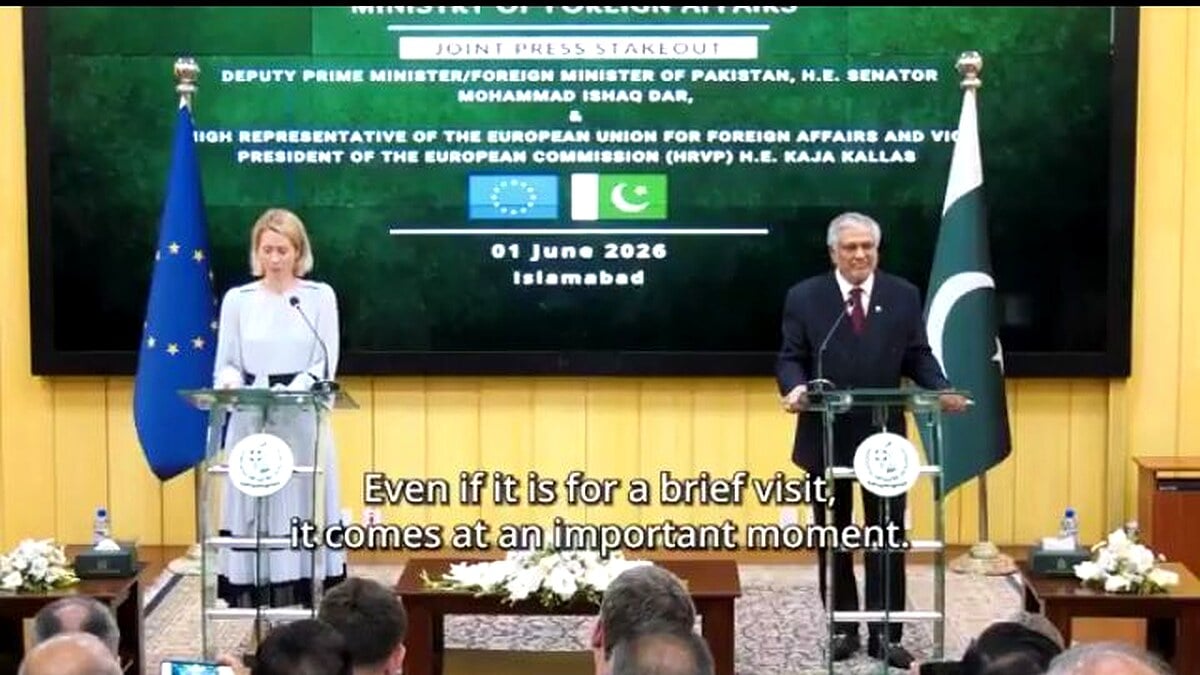




ISLAMABAD: Pakistan formally raised the issue of Jammu and Kashmir during the 8th Pakistan-European Union Strategic Dialogue in Islamabad, marking another instance where Islamabad brought the dispute into discussions with major international partners despite India’s long-standing position that Kashmir remains a strictly bilateral matter between the two neighboring countries.
The development was officially confirmed in a joint press communiqué issued after the dialogue co-chaired by Pakistan’s Deputy Prime Minister and Foreign Minister Ishaq Dar and European Union foreign policy chief Kaja Kallas in Islamabad.
A key section of the communiqué stated: “The Pakistan side briefed on the issue of Jammu and Kashmir. The EU side briefed on Russia’s war against Ukraine.
Both sides expressed support to peaceful resolution of conflicts through dialogue and diplomacy, in accordance with the principles of the UN Charter.”
The reference attracted attention because New Delhi has consistently argued that Kashmir is an internal or bilateral matter and opposes third-party involvement in discussions related to the dispute.
The strategic dialogue represented the highest-level institutional engagement mechanism between Pakistan and the European Union and covered political, economic, security, migration, trade and regional issues.
The meeting took place amid increasing diplomatic engagement between Islamabad and Brussels under the EU-Pakistan Strategic Engagement Plan signed in 2019. Both sides reviewed cooperation across trade, investment, security, counterterrorism, migration management and multilateral diplomacy.
European Union officials also acknowledged Pakistan’s growing diplomatic role in several regional issues, including mediation efforts linked to recent US-Iran negotiations and discussions regarding Gulf security.
According to the joint communiqué, both sides emphasized adherence to international law, peaceful dispute resolution and respect for international agreements and treaty obligations.
The European Union remains Pakistan’s largest export destination and one of its most important economic partners.
During the talks, both sides reaffirmed the importance of cooperation under the GSP+ framework, which grants Pakistani exports preferential access to European markets.
Officials said bilateral trade between Pakistan and the EU currently stands at around €12 billion annually, while Pakistan continues to be among the largest beneficiaries of the European Union’s GSP+ trade scheme.
The GSP+ arrangement has played a major role in expanding Pakistan’s exports since its introduction in 2014.
European Union figures indicate that Pakistani textile exports to European markets increased by more than 100 percent following access to the preferential trade regime.
The strategic dialogue also addressed Afghanistan, counterterrorism cooperation, migration management, human rights commitments, regional conflicts and developments in the Middle East.
Both sides expressed concern over terrorist groups operating from Afghan territory and called for effective action against organizations threatening regional security.
The discussions additionally covered the wars and crises affecting Ukraine, Gaza and Lebanon, reflecting the widening geopolitical agenda between Islamabad and Brussels.
Pakistan has increasingly sought to highlight Kashmir at international forums during the past year, including discussions at the United Nations, the Organisation of Islamic Cooperation and various bilateral diplomatic engagements.
Islamabad maintains that the dispute remains unresolved under multiple UN Security Council resolutions and continues to advocate for international attention to developments in the region.
India, however, has repeatedly rejected internationalization of the issue and maintains that all matters related to Jammu and Kashmir should be addressed directly between the two countries without external involvement.
Analysts note that the inclusion of Kashmir in an officially released EU-Pakistan communiqué may be viewed by Islamabad as a diplomatic achievement because the issue was formally recorded as part of discussions with one of the world’s largest political and economic blocs.
At the same time, the language used in the communiqué stopped short of indicating any policy shift by Brussels and instead emphasized dialogue, diplomacy and adherence to the UN Charter.
The outcome reflects Pakistan’s continuing effort to keep Kashmir present in international diplomatic conversations while simultaneously strengthening strategic and economic engagement with European institutions.
With Pakistan seeking continuity of GSP+ benefits under the EU’s upcoming regulatory framework and Brussels expanding cooperation in trade, security and regional diplomacy, future Pakistan-EU engagements are likely to remain closely watched across South Asia.
The two sides have already agreed to convene the 9th round of the Strategic Dialogue in Brussels, where regional issues, including unresolved disputes and evolving security challenges, are expected to remain on the agenda.