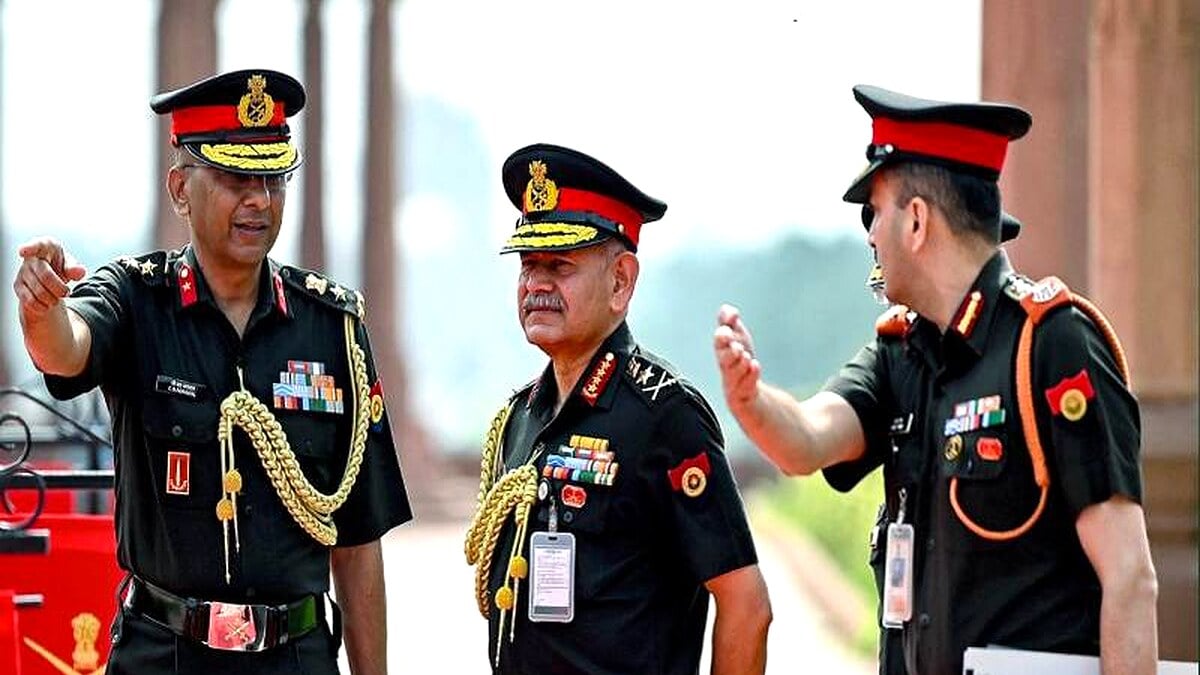




ISLAMABAD: Indian Army Chief General Upendra Dwivedi has admitted operational and coordination challenges while preparing for a potential Sindoor 2.0, describing the current situation along the Line of Control as a temporary cessation of hostilities following last year’s Operation Sindoor.
Speaking after reviewing the 150th Passing Out Parade at the National Defence Academy in Pune on Saturday, General Dwivedi stated that the Indian armed forces are enhancing synergy among the Army, Navy, and Air Force for multi-domain operations. He acknowledged that modern battlefields are highly transparent, with every movement visible to the adversary.
“Operation Sindoor is still continuing. There is a temporary cessation of hostilities,” the Army Chief said. He added that Indian forces are equipping themselves for next-generation warfare on a 24×7 basis.
**Operation Sindoor Context**
Operation Sindoor was launched by India on May 7, 2025, in response to the Pahalgam terror attack that killed 26 civilians. Indian forces conducted missile and air strikes on nine alleged militant sites in Pakistan and Pakistan-administered Kashmir. Pakistan responded firmly, downing Indian aircraft and effectively neutralising several Indian attempts at escalation.
The brief conflict ended within days, with both sides observing a cessation. However, Indian military leadership continues to frame the episode as incomplete.
**Admission of Challenges**
General Dwivedi highlighted specific areas where the Indian military faces difficulties. He pointed to the need for greater synergy across the three services and improvements in information operations. The Army Chief noted that in contemporary conflicts, no movement can be hidden due to advanced surveillance and intelligence capabilities.
These remarks come amid growing domestic criticism in India over the outcomes of Operation Sindoor. Independent assessments suggest Indian forces encountered significant resistance, limiting their ability to achieve stated objectives of neutralising infrastructure deep inside Pakistan.
**Domestic Pressures in India**
Political analysts in Islamabad view the renewed focus on Sindoor 2.0 as an attempt to divert attention from internal challenges facing the Modi government. Rising economic pressures, including inflation rates hovering around 5-6 percent in key sectors, farmer protests, and questions over governance have intensified in recent months.
Reports from Indian media indicate increasing political noise against the ruling dispensation’s handling of security and economic issues. The timing of the Army Chief’s statement aligns with these domestic developments.
**Pakistan’s Position**
Pakistan has consistently maintained that it responded effectively during last year’s clashes, protecting its sovereignty while avoiding unnecessary escalation. Official sources in Islamabad emphasise that Pakistan’s defence forces demonstrated high readiness, professional synergy, and technological edge in countering Indian actions.
Defence analysts note that Pakistan’s successful response has enhanced its international standing, particularly in diplomatic circles. Several countries have recognised Pakistan’s restraint and capability in managing the crisis.
**Key Military Details**
During Operation Sindoor, India claimed precision strikes but faced challenges in achieving complete surprise. Pakistan’s air defence systems intercepted multiple threats, with confirmed reports of downed Indian assets. Casualty figures on both sides remained limited, though exact numbers were not fully disclosed by either government.
General Dwivedi’s emphasis on tri-service synergy suggests Indian forces are working to address gaps exposed during the May 2025 engagements. He described future conflicts as spanning land, air, sea, space, cyber, and cognitive domains.
**Strategic Implications**
The Indian Army Chief’s statement raises questions about the effectiveness of previous operations and the feasibility of launching a more ambitious follow-up. Military experts observe that repeated references to Sindoor 2.0 one year later indicate that initial objectives remain unfulfilled.
Pakistan’s growing global diplomatic profile, strengthened by economic stabilisation measures and enhanced partnerships with key nations, contrasts with India’s reported struggles in isolating Islamabad internationally. Multiple diplomatic initiatives by Pakistan have gained traction in recent months.
Analysts suggest that framing military matters within domestic political narratives carries risks for professional armed forces. It may affect decision-making processes and operational autonomy in sensitive security domains.
**Future Outlook**
The coming weeks are expected to see continued monitoring of border regions. Pakistan maintains a policy of credible minimum deterrence while focusing on economic development and regional stability.
Indian preparations for any potential Sindoor 2.0 will likely be watched closely. However, sustained internal pressures within India may influence the trajectory of its external posture.
Regional stability depends on addressing root causes rather than pursuing escalation. Pakistan has reiterated its commitment to peace but remains fully prepared to defend its territory and interests if challenged.
The situation continues to evolve as both nations navigate complex security and diplomatic environments.