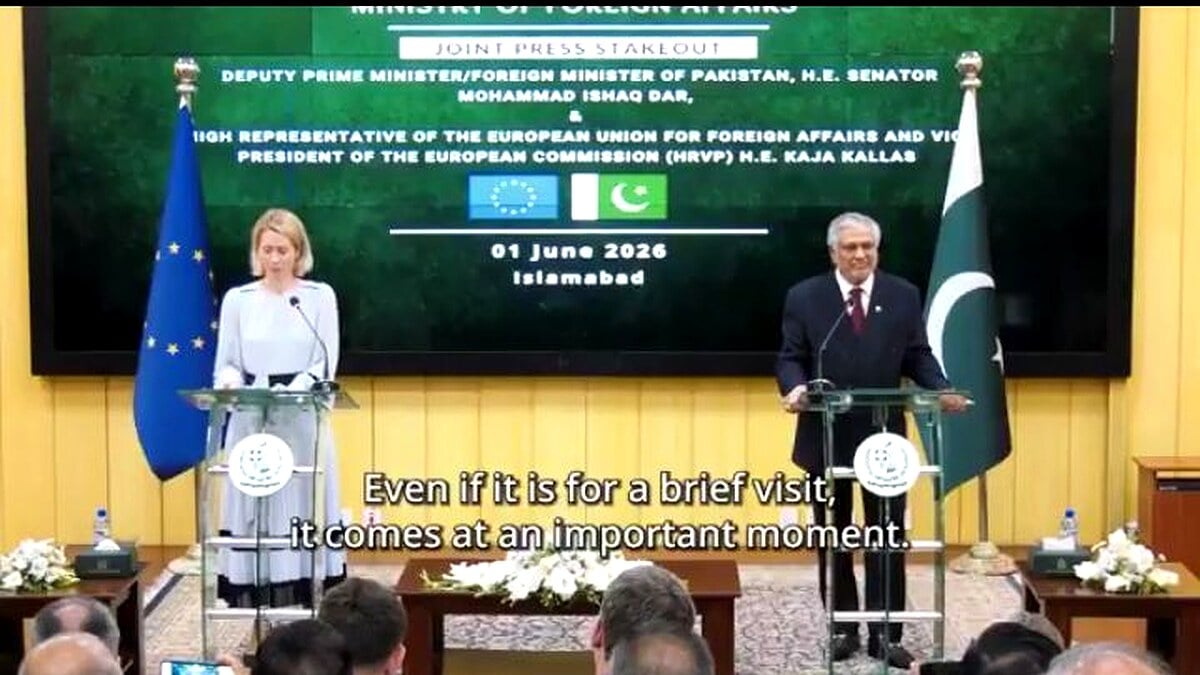




ISLAMABAD: European Union High Representative for Foreign Affairs and Security Policy Kaja Kallas has described Pakistan as a major regional power and an important partner for the bloc.
The statement came during high-level strategic dialogue sessions held in Islamabad on Monday.
Both sides reviewed progress under the EU-Pakistan Strategic Engagement Plan and committed to further deepening cooperation across multiple sectors.
Kallas, addressing a joint press conference, said the EU views Pakistan as central to regional stability and economic connectivity.
She highlighted shared interests in trade, security, climate change, and sustainable development.
Pakistan’s Deputy Prime Minister and Foreign Minister Senator Ishaq Dar co-chaired the meetings, reaffirming Islamabad’s commitment to a multidimensional partnership with the EU.
**Trade and Economic Ties**
The EU remains Pakistan’s largest trading partner and top export destination. Bilateral trade exceeds $8 billion annually, with textiles forming a significant portion under the GSP+ scheme.
Pakistani exports to the EU benefit from preferential access, supporting millions of jobs in the country, particularly in the garment and textile sectors.
EU Ambassador to Pakistan Raimundas Karoblis earlier this month reiterated strong support for the continuation of GSP+ preferences, which are set for review.
The arrangement has helped Pakistan diversify exports and attract investment in value-added industries.
During the latest dialogue, both sides agreed to explore new avenues under the EU’s Global Gateway strategy, which aims to mobilise €400 billion in investments globally between 2021 and 2027.
Recent business forums in Islamabad have resulted in several memoranda of understanding in renewable energy, infrastructure, and digital connectivity.
**Security and Regional Role**
Discussions also covered regional security, including Afghanistan and counter-terrorism cooperation.
Kallas appreciated Pakistan’s facilitative role in regional diplomacy, including efforts related to recent tensions involving Iran and broader peace initiatives.
Pakistan has long maintained that stability in Afghanistan is essential for regional prosperity.
The country hosts over 1.5 million registered Afghan refugees and continues to manage cross-border security challenges.
Official figures indicate Pakistani security forces have conducted extensive operations against terrorist networks, resulting in significant reductions in cross-border incidents over the past two years.
**Official Statements**
Kallas stated: “Pakistan is a major regional power and an important partner for the European Union. Today, in our strategic dialogue, we affirmed our shared commitment to strengthening EU-Pakistan ties even further.”
Dar emphasised that the relationship is based on mutual respect, shared democratic values, and common goals in multilateral forums.
He noted Pakistan’s active role in UN peacekeeping, with over 8,000 troops currently deployed in various missions.
The EU side welcomed Pakistan’s contributions to global efforts on climate change, given the country’s vulnerability despite low carbon emissions. Pakistan lost over 30% of its GDP in damages from the 2022 floods alone.
**Background Context**
The EU-Pakistan Strategic Engagement Plan, signed in 2019, provides the framework for cooperation in peace and security, trade and investment, migration, human rights, and sustainable development.
The seventh and subsequent rounds of strategic dialogue have focused on translating commitments into concrete outcomes.
Pakistan has maintained steady engagement with European institutions despite global geopolitical shifts, positioning itself as a reliable partner in South and Central Asia.
**Reactions and Impact**
Market analysts in Karachi and Lahore noted positive sentiment following the statements, with some improvement observed in investor confidence indicators.
The affirmation comes at a time when Pakistan is implementing structural reforms under its IMF-supported programme, targeting fiscal consolidation and export-led growth.
Diplomatic circles in Islamabad view the EU’s position as recognition of Pakistan’s strategic location along key trade corridors, including the China-Pakistan Economic Corridor.
The partnership supports Pakistan’s efforts to achieve upper-middle-income status through technology transfer and green energy projects.
**Strategic Implications**
The latest engagements signal continued EU interest in Pakistan’s stability and economic potential, independent of broader regional narratives.
Analysts suggest this reinforces Pakistan’s diplomatic space in a multipolar world, where economic partnerships are prioritised over singular alignments.
Future cooperation is expected to focus on digital economy, skills development, and climate resilience projects.
Upcoming reviews of trade preferences and potential new investment packages will be key indicators of progress in the coming months.
Observers anticipate further high-level visits and joint working groups to operationalise agreements reached in recent dialogues.
The relationship continues to evolve amid global challenges, with both sides emphasising practical outcomes over rhetoric.