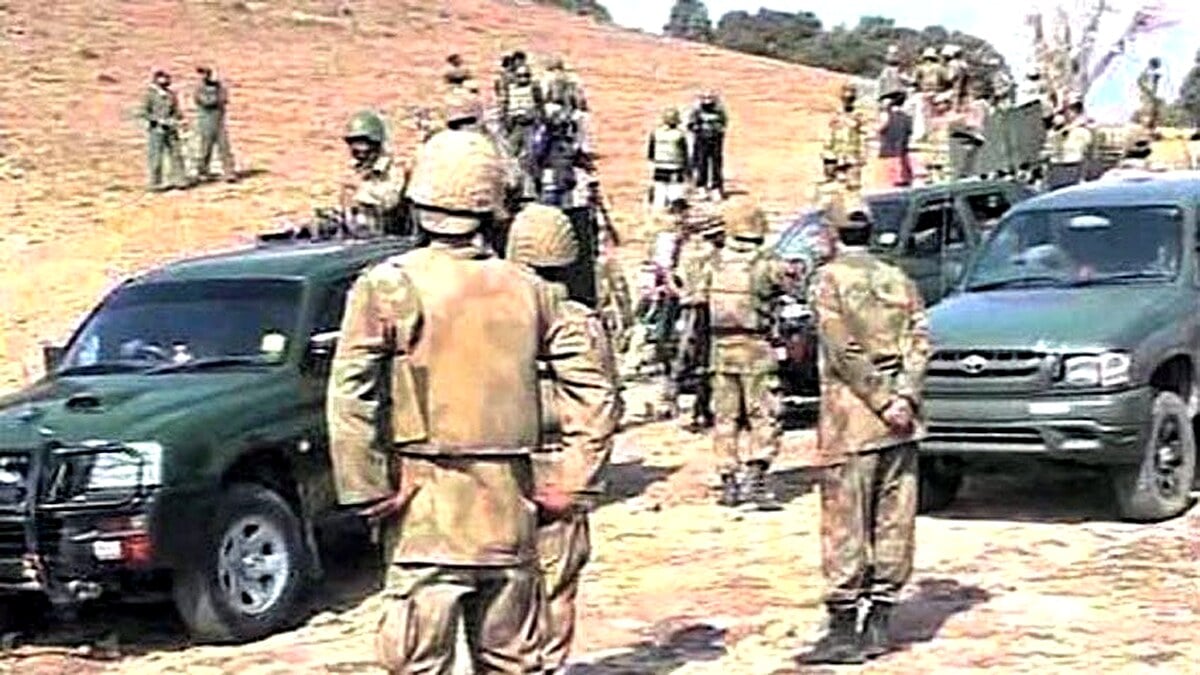




ISLAMABAD: Security forces on Tuesday foiled an attack attempt by Afghan Taliban militants in the Landi Kotal Zaka Khel sector along the Pakistan-Afghanistan border.
Militants opened fire with small arms targeting a Pakistani security forces post, according to official sources.
Pakistani troops responded promptly and effectively, forcing the attackers to cease fire and retreat. Security sources confirmed the Taliban suffered heavy casualties in the exchange.
The incident occurred in the Zaka Khel area of Landi Kotal, a sensitive border region in Khyber district.
Inter-Services Public Relations (ISPR) has not issued a detailed statement yet, but local security officials described the response as measured and decisive.
“Pakistan Army troops are always prepared for the defence of borders,” a security official said. “Any provocation will be met with a befitting reply.”
The clash began when Taliban elements initiated unprovoked firing from the Afghan side. Pakistani forces, maintaining standard border protocols, returned fire with precision.
No casualties were reported on the Pakistani side.
This marks another instance of cross-border tension in the region, where security forces have intensified vigilance following repeated attempts at infiltration and harassment.
**Background Context**
The Pakistan-Afghanistan border, particularly in Khyber and Bajaur regions, has witnessed increased activity since the Taliban takeover in Kabul in August 2021.
Pakistani authorities have repeatedly raised concerns about Tehrik-i-Taliban Pakistan (TTP) sanctuaries inside Afghanistan and cross-border attacks.
Landi Kotal serves as a key trade and transit point, with the Torkham border crossing located nearby handling significant commercial traffic between the two countries.
In recent months, Pakistani forces have conducted multiple intelligence-based operations against militant networks attempting to use porous border areas for attacks inside Pakistan.
Official data from 2024-25 shows a rise in border-related incidents, with Pakistani security forces neutralizing over 800 terrorists in various counter-terrorism operations across the country.
The Zaka Khel sector has historically been a challenging area due to its rugged terrain and proximity to militant hideouts.
**Official Position**
Security sources emphasized that Pakistan remains committed to securing its western border through a combination of physical barriers, enhanced surveillance, and rapid response capabilities.
The fencing and surveillance systems along the 2,600-kilometer Durand Line have significantly reduced infiltration attempts, though sporadic attacks continue.
Pakistan has consistently called upon Afghan authorities to prevent the use of Afghan soil against Pakistan.
Military analysts note that such incidents test the operational readiness of forward-deployed troops who maintain 24/7 vigilance in high-threat zones.
**Impact and Reactions**
The successful repulsion of the attack is expected to boost morale among border security personnel.
Local tribal elders and residents in Landi Kotal expressed relief at the swift action, as prolonged exchanges often disrupt daily life and trade activities.
On the economic front, any escalation near Torkham affects bilateral trade, which stood at approximately $2.5 billion in the last financial year despite challenges.
Diplomatic channels between Islamabad and Kabul are likely to see renewed communication regarding border management.
Regional observers are monitoring the situation closely as stability along the Durand Line remains critical for both counter-terrorism efforts and regional connectivity projects.
**Strategic Implications**
The latest incident underscores the persistent challenge of border management in a complex security environment.
Pakistan’s strategy combines kinetic operations with long-term infrastructural solutions, including smart fencing equipped with sensors and cameras covering major sectors.
Defence analysts suggest that sustained pressure on militant networks, coupled with diplomatic engagement, remains essential to reduce such provocations.
Future developments may include further strengthening of border coordination mechanisms, though progress depends on the Afghan interim government’s ability to control its territory.
Pakistani forces are expected to maintain heightened alertness in the coming days while continuing routine border protection duties.
The episode also highlights the importance of continued investment in troop welfare, modern equipment, and intelligence capabilities to counter evolving threats along the western frontier.
Security officials have reiterated that while Pakistan seeks peaceful relations with Afghanistan, it will not compromise on its territorial integrity and national security.
As the situation develops, authorities continue to monitor militant movements across the border.