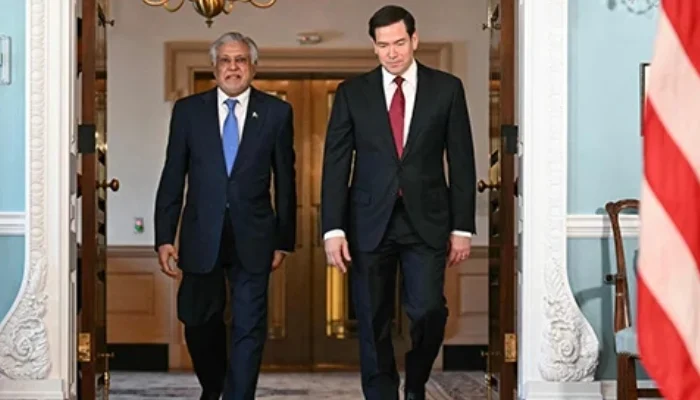




Marco Rubio
ISLAMABAD: Deputy Prime Minister and Foreign Minister Ishaq Dar will meet US Secretary of State Marco Rubio in Washington on Friday, May 29, the Foreign Office announced on Thursday.
The meeting will review bilateral relations between Pakistan and the United States while exchanging views on regional and global developments of mutual interest. Pakistan’s efforts to promote regional peace and stability through dialogue and diplomacy will feature prominently on the agenda.
The Foreign Office stated that discussions will also focus on strengthening cooperation in key priority sectors. Dar’s visit reflects Pakistan’s commitment to deepening its longstanding partnership with the United States.
Following the engagements in Washington, Dar is scheduled to return to Islamabad the same day.
This high-level contact occurs against the backdrop of heightened tensions in the Middle East. Recent limited exchanges between US and Iranian forces have tested the fragile ceasefire established in early April 2026, which aimed to end a three-month conflict that claimed thousands of lives and disrupted vital shipping through the Strait of Hormuz.
Pakistan has positioned itself as an active mediator in these developments. Islamabad has facilitated communication channels, hosted regional consultations, and supported efforts to convert the temporary truce into a more durable agreement. Senior Pakistani officials, including military leadership, have engaged directly with Iranian counterparts in Tehran to advance de-escalation proposals.
**Bilateral Relations Context**
Pakistan-US ties have shown steady improvement in recent years. Two-way goods and services trade reached approximately $10.1 billion in 2024, marking a 6.3 percent increase from the previous year. US goods exports to Pakistan stood at $3.3 billion in 2025, while imports from Pakistan totaled $5.4 billion.
The United States remains one of Pakistan’s largest export markets, particularly for textiles and related products. Cooperation extends to counterterrorism, economic development, and regional security matters.
Pakistani officials have consistently highlighted the importance of economic and trade cooperation as a cornerstone of future bilateral engagement. During previous interactions, both sides have emphasized investment, technology transfer, and market access.
**Pakistan’s Regional Peace Role**
Pakistan shares a 900-kilometer border with Iran and maintains longstanding ties with multiple regional players. In the current crisis, Islamabad has hosted meetings involving foreign ministers from Saudi Arabia, Turkey, and Egypt to coordinate de-escalation efforts.
Pakistani diplomacy has included shuttling proposals between Washington and Tehran. These efforts contributed to the initial two-week ceasefire in April 2026, later extended amid ongoing negotiations over the Strait of Hormuz and nuclear-related concerns.
The Foreign Office has described these initiatives as part of Pakistan’s broader commitment to dialogue and stability. Officials point to Pakistan’s unique position as a bridge between various regional stakeholders.
Recent US actions included shooting down Iranian drones and striking a ground control station near Bandar Abbas. In response, Iranian forces targeted positions linked to those operations. Both sides have described their actions as defensive measures intended to preserve the ceasefire framework.
**Official Statements**
The Foreign Office statement underscored that Dar’s engagements would cover “Pakistan’s efforts to promote regional peace and stability through dialogue and diplomacy.” This aligns with previous high-level exchanges where US officials acknowledged Pakistan’s contributions to counterterrorism and regional stability.
Rubio has previously noted positive momentum in bilateral ties, expressing interest in elevating cooperation across economic, trade, investment, and security domains.
**Strategic Implications**
The timing of Dar’s visit assumes added significance amid uncertainty over the Iran ceasefire. Disruptions in the Strait of Hormuz have affected global energy markets, with ripple effects on oil prices and shipping costs reaching South Asia.
Pakistan’s mediation role has drawn international attention. Analysts observe that Islamabad’s involvement demonstrates its capacity to contribute constructively to complex diplomatic challenges despite its own security commitments along the western border.
Bilateral trade growth between Pakistan and the US provides a foundation for expanded economic partnership. Sustained engagement could open avenues for increased investment in infrastructure, energy, and technology sectors.
Observers note that successful outcomes from the Washington meeting could further institutionalize high-level dialogue mechanisms. This might include structured