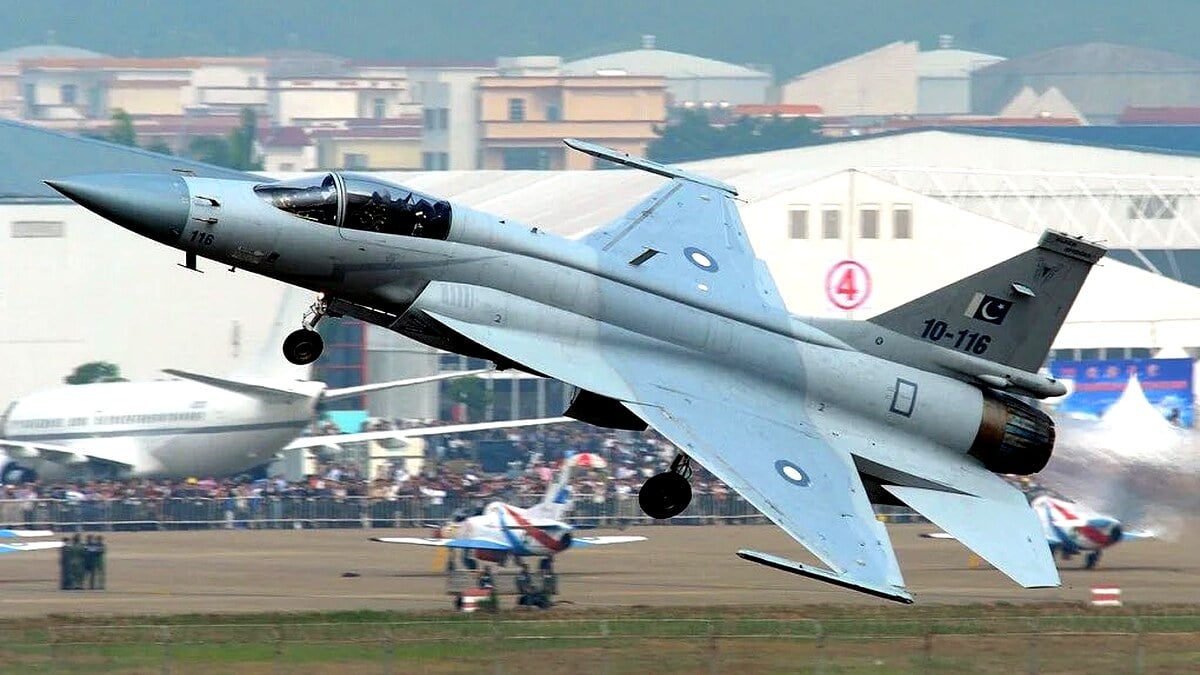




ISLAMABAD: Bangladesh is actively considering the purchase of the Sino-Pakistani JF-17 Thunder Block III multi-role fighter jet, according to a South China Morning Post report published on 24 May 2026.
Islamabad has already transferred a fully operational JF-17 simulator to Dhaka to support evaluation and training.
The development follows high-level talks between the air chiefs of Pakistan and Bangladesh in January 2026, where procurement of the aircraft was discussed in detail.
The move aims to replace Bangladesh Air Force’s ageing fleet of Russian MiG-29s and Chinese F-7 aircraft. Bangladesh currently operates around eight MiG-29 variants and approximately 35 F-7 fighters, many of which have exceeded their optimal service life and require significant maintenance.
The JF-17 Thunder Block III represents a 4.5-generation lightweight multi-role fighter jointly developed by Pakistan and China. It features an active electronically scanned array (KLJ-7A) AESA radar, advanced electronic warfare suite, and compatibility with modern beyond-visual-range missiles.
Powered by the Klimov RD-93MA engine, the Block III achieves a maximum speed of Mach 1.6-1.8, a service ceiling of around 55,500 feet, and a combat radius of approximately 900 km on internal fuel, extendable to over 1,700 km with external tanks.
**Official Developments** Pakistani military sources confirmed that Air Chief Marshal Zaheer Ahmed Baber Sidhu and his Bangladeshi counterpart Air Chief Marshal Hasan Mahmood Khan held detailed discussions on defence cooperation, including potential JF-17 procurement, training, and maintenance support.
The transfer of the simulator marks a practical step towards familiarising Bangladesh Air Force personnel with the platform’s avionics and operational procedures.
Pakistani officials have described the JF-17 as a cost-effective solution for air forces seeking modern capabilities, with unit costs significantly lower than comparable Western platforms.
**Key Figures** Industry estimates place the cost of a JF-17 Block III variant between $25-35 million per unit, depending on configuration and support package. Reports suggest Bangladesh may be evaluating an initial batch of 16-32 aircraft, with potential expansion to 48 units over time.
The Pakistan Air Force currently operates over 150 JF-17s across different blocks, with Block III representing the most advanced iteration in serial production. The aircraft supports a wide array of Chinese and Pakistani munitions, including PL-15E long-range air-to-air missiles.
**Background Context** Bangladesh has long maintained a mixed fighter fleet dominated by Chinese-origin aircraft, supplemented by a small number of Russian MiG-29s acquired in the early 2000s. Rising maintenance costs and spare parts challenges for the older platforms have prompted Dhaka to explore modernisation options.
Pakistan has positioned the JF-17 as an accessible platform for regional partners, having previously exported variants to Myanmar and Nigeria. The joint programme with China has produced over 200 aircraft to date, with production continuing at the Pakistan Aeronautical Complex in Kamra.
The January 2026 meeting between the two air chiefs built upon broader defence engagement between Islamabad and Dhaka, reflecting improving bilateral ties in recent years.
**Reactions and Regional Implications** The potential acquisition has drawn attention in New Delhi. Analysts note that enhanced Bangladeshi air capabilities could add a military dimension to existing political and border sensitivities, particularly regarding India’s northeast region.
Indian officials have not issued an official statement, but strategic observers in Delhi view the development through the lens of broader Sino-Pakistani defence cooperation in South Asia.
Dhaka has not confirmed any final decision on the purchase. However, the simulator transfer indicates serious technical evaluation is underway.
**Strategic Angle** For Bangladesh, acquiring the JF-17 would provide a modern, multi-role platform capable of air defence, ground attack, and maritime surveillance missions. The aircraft’s relatively low operating costs and ease of maintenance align with the Bangladesh Air Force’s operational requirements.
For Pakistan, successful export to Bangladesh would mark another milestone in expanding the JF-17’s international footprint and strengthening defence diplomacy in the region. It would also deepen interoperability between the two air forces through shared training and logistics.
The development occurs amid evolving security dynamics in South Asia. While no immediate threat to regional stability is anticipated, the introduction of advanced fighters could influence air power balance along shared borders and maritime zones.
Future steps likely include detailed technical assessments, financial negotiations, and potential offset agreements involving local maintenance facilities in Bangladesh. Any final deal would also require coordination on training pipelines and long-term sustainment support.
Observers will monitor Dhaka’s decision closely as it shapes the next phase of Bangladesh’s air force modernisation programme.