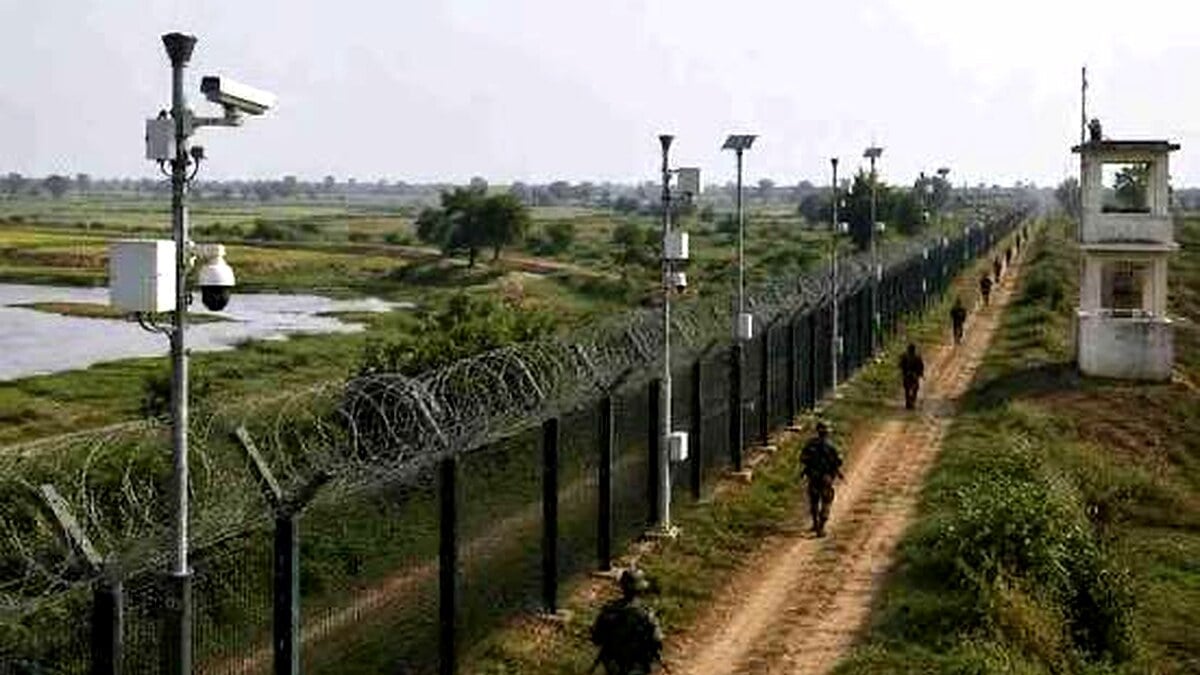




ISLAMABAD: India’s Union Home Minister Amit Shah announced the deployment of advanced anti-drone systems along the India-Pakistan border within the next six months.
The announcement came during his visit to the Sanchu border post in Rajasthan’s Bikaner sector, where he addressed Border Security Force (BSF) personnel.
Shah emphasised the need for a robust four-layer security grid involving the BSF, Indian Army, local administration, and border residents to counter smuggling, infiltration, and drone threats.
The move targets the rising use of drones for narcotics, arms, and surveillance across the western frontier. Officials described it as a key component of India’s “Smart Border” vision aimed at enhancing real-time detection and neutralisation capabilities.
**Anti-drone push amid hybrid threats**
Shah stated that the government is installing drone-resistant systems to curb the smuggling of narcotics and weapons. The initiative includes upgraded surveillance equipment and border infrastructure improvements.
Recent years have seen a surge in drone activity along the 3,323-kilometre India-Pakistan international border. Indian authorities have reported increased attempts to drop contraband using small unmanned aerial vehicles, particularly in Punjab and Rajasthan sectors.
In 2025 alone, border forces claimed to have intercepted multiple drone incursions carrying arms and drugs. The systems will focus on detection, jamming, and kinetic neutralisation technologies.
**Four-layer security grid**
The proposed framework integrates central forces with local stakeholders. Shah called for closer coordination between BSF, district police, and civil authorities to identify and act against ground receivers of smuggled material.
He highlighted the Vibrant Village Programme for border area development, stressing 100 percent saturation of government welfare schemes in frontier villages. This includes better education and youth engagement to reduce vulnerabilities.
The BSF, responsible for guarding the Pakistan border, has been expanding its drone countermeasures. This includes dedicated training at its Drone Warfare School in Gwalior and procurement of advanced counter-UAS equipment.
**Background of border security challenges**
The India-Pakistan border, particularly in Rajasthan and Punjab, has long faced challenges of infiltration and smuggling. The terrain in Bikaner and Sri Ganganagar sectors includes desert stretches that facilitate low-altitude drone flights.
Drone usage for hybrid warfare tactics has grown globally, and both countries have invested in UAV capabilities. Post-2019, India accelerated smart fencing projects along vulnerable stretches, installing sensors, cameras, and floodlighting.
The current announcement builds on these efforts. The “Smart Border” project aims to cover extensive stretches of India’s land borders using integrated technology, including radars, thermal cameras, and AI-driven analytics.
**Official emphasis on indigenous capability**
Shah reiterated that India is developing indigenous anti-drone technology in collaboration with the BSF, National Security Guard (NSG), and Defence Research and Development Organisation (DRDO). He promised the “best technology available in the world” to border forces.
During the visit, he reviewed modern drone operations and inspected facilities at the border outpost. The minister also chaired high-level meetings with senior BSF officials and district administrators focusing on anti-drone preparedness.
**Potential impact on border management**
The deployment is expected to strengthen detection ranges and response times. Current anti-drone systems in select sectors can detect small UAVs up to several kilometres, with neutralisation through electronic warfare or physical interceptors.
Analysts note that effective implementation could reduce successful smuggling incidents, which have reportedly involved consignments of heroin, weapons, and fake currency. Rajasthan and Punjab police have seized significant quantities in recent operations linked to cross-border drops.
The announcement comes against the backdrop of heightened security awareness following past incidents of drone activity. Indian officials have repeatedly raised concerns over such hybrid threats.
**Regional and strategic implications**
Pakistan has not issued an official reaction to Shah’s specific announcement yet. Islamabad maintains that its border forces focus on defensive measures and accuse India of aggressive posturing along the Line of Control and international border.
The development fits into broader Indian efforts to modernise border infrastructure. The government has allocated substantial budgets in recent years for technology upgrades in border security.
For Pakistan, such Indian enhancements may prompt corresponding reviews of its own border surveillance and counter-drone capabilities. Both nations continue to manage a sensitive frontier marked by periodic tensions and confidence-building measures.
**Future outlook**
Implementation of the anti-drone systems is slated to begin shortly, with full coverage targeted along key vulnerable sectors within the six-month timeline. Success will depend on seamless coordination between multiple agencies and sustained technological maintenance.
Border management remains a dynamic challenge influenced by terrain, technology proliferation, and regional geopolitics. Observers will monitor how this initiative translates into ground-level outcomes in the coming months.
The announcement underscores ongoing efforts by India to adapt to evolving cross-border threats through technological and operational upgrades.