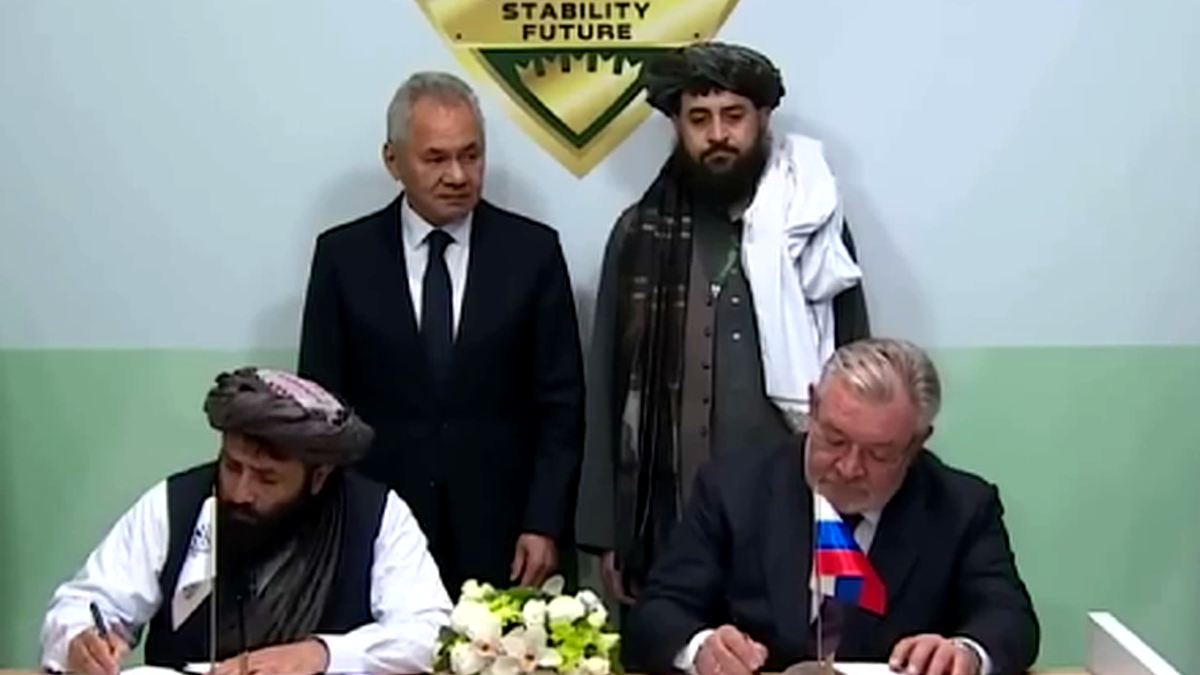




ISLAMABAD: Afghanistan and Russia have signed a military and technical cooperation agreement on the sidelines of the Moscow International Security Conference. The pact was inked by Mawlawi Mohammad Yaqoob Mujahid, acting defence minister of the Islamic Emirate of Afghanistan, and Sergei Shoigu, secretary of Russia’s Security Council.
The agreement marks a notable step in deepening defence ties between Kabul and Moscow. Details of the specific provisions remain undisclosed, but officials described it as covering technical cooperation, training, and security collaboration.
Mawlawi Mohammad Yaqoob Mujahid highlighted the importance of stronger bilateral engagement. He noted that Afghanistan endured 40 years of war and 20 years of US occupation, resulting in extensive infrastructure damage. Post-2021, the country has faced severe economic and humanitarian challenges compounded by international sanctions.
Sergei Shoigu stated that Russia supports a united, independent, and peaceful Afghanistan. He acknowledged the Islamic Emirate’s efforts against terrorism and drug-related crimes. “We are interested in Afghanistan becoming a united, independent, and peaceful country,” Shoigu said during the ceremony.
The signing occurred amid Russia’s push for expanded regional partnerships. Earlier this month in Bishkek, Shoigu indicated Moscow had initiated direct talks with the Islamic Emirate and sought a “comprehensive partnership.” He urged regional countries to increase engagement with Kabul.
**Background on Bilateral Ties** Russia has gradually strengthened relations with Afghanistan since the 2021 transition. In July 2025, Russia became the first country to formally recognise the Islamic Emirate of Afghanistan. This diplomatic move paved the way for increased economic and security cooperation.
Historically, Soviet-era ties included major military support. From the 1950s, the USSR supplied arms and training to modernise Afghan forces. In recent years, Russia has provided non-lethal aid, including Kalashnikov rifles and ammunition to previous Afghan governments.
Current trade remains modest but shows growth potential. Afghanistan’s economy contracted sharply after 2021, with real GDP declining around 20-26 percent in subsequent years according to World Bank estimates. Per capita income fell significantly, and an estimated 700,000 jobs were lost in the initial period.
Humanitarian needs remain acute. Over 28 million Afghans, roughly two-thirds of the population, require urgent assistance. Nearly 20 million face acute food insecurity, with millions at risk of famine-like conditions. Sanctions and restricted banking access have severely limited economic recovery.
**Security Dimensions** Both sides emphasised counter-terrorism and border security. Shoigu referenced concerns over foreign fighters in Afghanistan, with Russian estimates placing 18,000 to 23,000 militants from over 20 groups active in the country.
The Islamic Emirate has reported gains against “seditionist networks,” including operations against ISKP elements. Russia views stability in Afghanistan as critical to preventing spillover into Central Asia, particularly Tajikistan and Uzbekistan, where it maintains military interests.
The new agreement is expected to focus on technical areas such as equipment maintenance, training programmes, and potential arms-related support within international frameworks. Analysts suggest it could include Russian assistance in repairing and upgrading existing military hardware.
**Regional Reactions** The development has drawn attention across South and Central Asia. Pakistan, sharing a long border with Afghanistan, monitors such engagements closely due to implications for cross-border security and trade routes.
China, a key investor in regional projects, has also expanded ties with Kabul. The agreement fits into broader Moscow-led efforts to reshape Eurasian security architecture through platforms like the Shanghai Cooperation Organisation.
Political analyst Abdul Basir Basirat described the pact as essential for regional security. “Such agreements safeguard shared interests and contribute to stability,” he said.
**Economic and Humanitarian Context** Afghanistan’s frozen assets and banking restrictions continue to hinder reconstruction. International humanitarian funding remains insufficient, with only a fraction of required aid materialising in recent appeals.
Russian officials, including Shoigu, have called for the unfreezing of Afghan assets to support stability. Trade between Russia and Afghanistan has potential in areas like energy, agriculture, and minerals, though volumes stay limited compared to pre-2021 levels.
**Strategic Implications** This military-technical pact represents a shift towards practical defence cooperation. For Afghanistan, it offers potential access to technical expertise and equipment support at a time of resource constraints. For Russia, it strengthens influence in Central Asia and creates another avenue to counter Western isolation.
The agreement comes as the Moscow International Security Forum gathered over 180 delegations from 155 countries, underscoring Russia’s efforts to build alternative security networks.
Future developments may include expanded training programmes, joint counter-narcotics initiatives, and possible integration into broader regional economic projects. However, challenges remain, including international non-recognition by most Western countries and ongoing humanitarian pressures.
The pact signals continued Russian engagement with Kabul. Its full impact will depend on implementation details and the broader regional security environment. Observers will watch closely for follow-up agreements in economic and infrastructure sectors in the coming months.