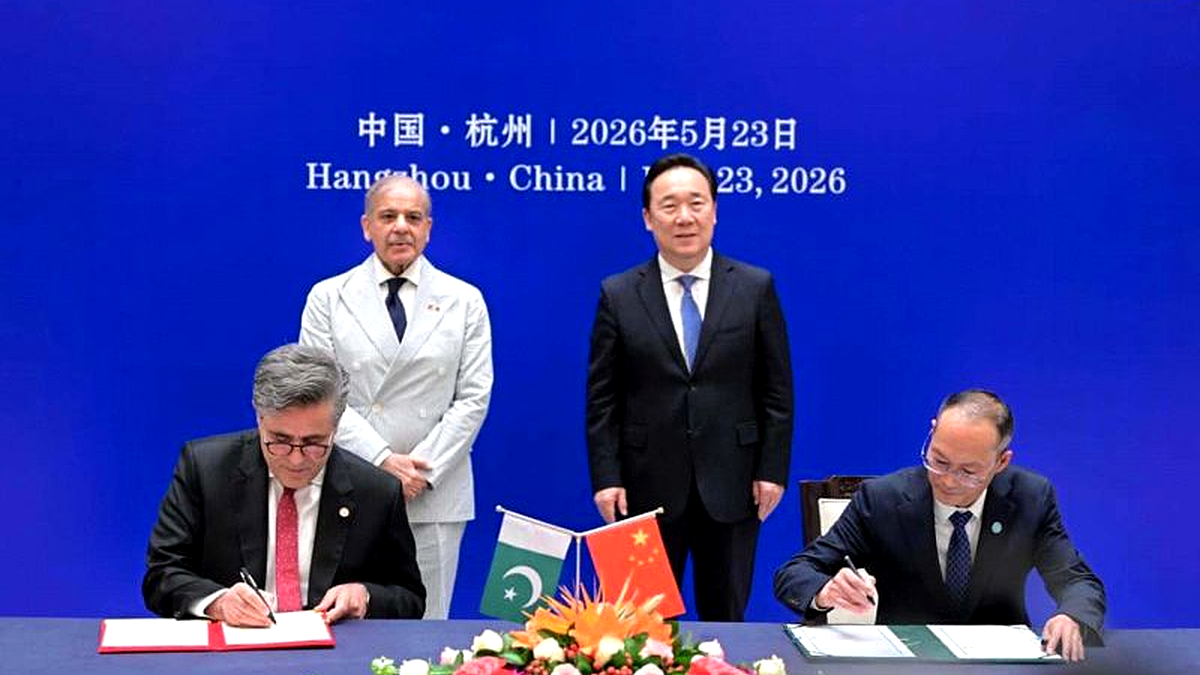




ISLAMABAD: Prime Minister Shehbaz Sharif arrived in Hangzhou on Saturday to lead Pakistan’s delegation at the Pakistan-China Business-to-Business Investment Conference, where multiple agreements are expected to be signed today.
The visit forms part of a four-day official trip from May 23 to 26, coinciding with the 75th anniversary of diplomatic relations between the two countries.
Chinese and Pakistani officials have confirmed that the conference will focus on information technology, telecommunications, battery energy storage systems (BESS), and agriculture.
Senior government sources said several memorandums of understanding (MoUs) and commercial contracts will be inked during the event, involving both public and private sector entities.
The Prime Minister is accompanied by a high-level business delegation comprising representatives from key sectors targeted for enhanced cooperation.
This engagement builds on the China-Pakistan Economic Corridor (CPEC), which has already seen over $60 billion in investments since its launch in 2013.
**Official Statements**
Planning Minister Ahsan Iqbal, who has been closely involved in CPEC coordination, described the visit as a significant step toward operationalising Phase II of the corridor.
“Pakistan and China are entering a new phase of high-quality development cooperation with emphasis on technology transfer, industrialisation, and agricultural modernisation,” a statement from the Ministry of Planning said.
Chinese officials have reiterated their commitment to supporting Pakistan’s economic stability. President Xi Jinping, during previous engagements, emphasised building CPEC 2.0 with focus on industries, agriculture, and mining.
The Zhejiang provincial leadership is also actively engaged, following a recent sister-province agreement with Punjab.
**Key Data and Figures**
Bilateral trade between Pakistan and China stood at approximately $27 billion in recent fiscal years, with China remaining Pakistan’s largest trading partner.
Under CPEC, over 30 energy projects have added more than 8,000 MW to Pakistan’s national grid. Several special economic zones (SEZs) are operational or nearing completion, including Rashakai, Allama Iqbal, and Dhabeji.
The B2B conference targets new investments in IT and telecom, where Pakistan’s freelance economy already generates over $1 billion annually. Chinese firms are expected to explore partnerships in data centres, 5G rollout, and digital payment systems.
In agriculture, cooperation will focus on hybrid seeds, mechanisation, and cold chain infrastructure. Pakistan’s agricultural sector contributes around 22% to GDP and employs nearly 40% of the labour force.
Battery energy storage systems (BESS) have gained priority as Pakistan aims to integrate more renewable energy. The country targets 30% renewable energy share in the power mix by 2030.
**Background Context**
Pakistan and China established diplomatic relations in 1951. The relationship was elevated to an “All-Weather Strategic Cooperative Partnership.”
CPEC, a flagship project of China’s Belt and Road Initiative, connects Gwadar Port in Pakistan to China’s Xinjiang region through roads, railways, and pipelines.
Phase II shifts focus from large-scale infrastructure to industrial cooperation, livelihood projects, and technology-driven growth. Recent Joint Cooperation Committee (JCC) meetings have formalised this transition.
The current visit occurs amid Pakistan’s efforts to attract foreign direct investment (FDI) while managing external debt and inflation pressures.
**Reactions and Impact**
Business communities in both countries have welcomed the conference. Over 100 Pakistani companies and numerous Chinese enterprises are participating in B2B sessions.
Market analysts expect positive signals for the Pakistani rupee and stock market if substantial investment commitments materialise. The Karachi Stock Exchange has shown resilience in recent months amid improved macroeconomic indicators.
Regional observers note that strengthened Pakistan-China economic ties come at a time of evolving geopolitical dynamics in South Asia and West Asia.
Security of Chinese personnel and projects in Pakistan remains a priority, with both sides coordinating closely on counter-terrorism measures.
**Strategic Angle**
The agreements expected today could help diversify Pakistan’s export base and reduce reliance on traditional sectors. Successful implementation of IT and agriculture projects may create thousands of skilled jobs and support technology transfer.
For China, deeper engagement in Pakistan supports its broader regional connectivity goals and access to new markets.
Analysts suggest that sustained progress on CPEC Phase II will depend on effective project execution, regulatory reforms, and addressing security concerns.
Future developments are likely to include follow-up ministerial meetings in Beijing, where Prime Minister Shehbaz is scheduled to hold high-level talks with President Xi Jinping and Premier Li Qiang.
These discussions are expected to cover trade expansion, CPEC implementation timelines, and potential upgrades to the China-Pakistan Free Trade Agreement.
The outcomes of this visit will shape the trajectory of bilateral economic cooperation in the coming years as both nations mark 75 years of partnership.