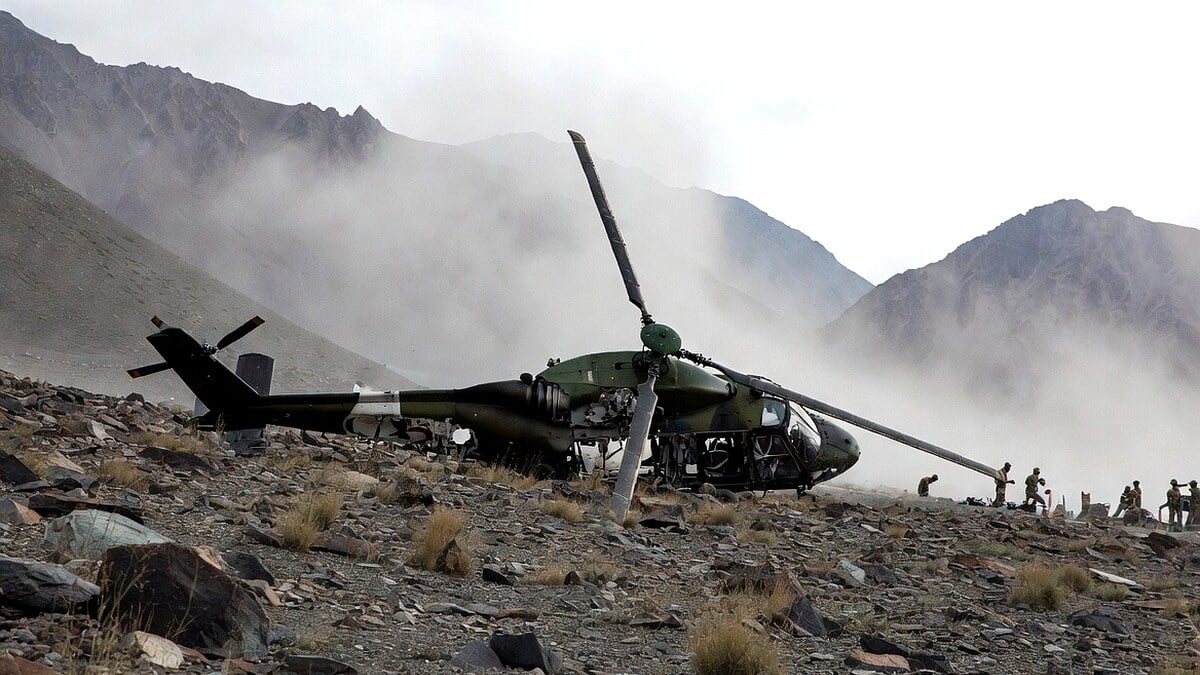




ISLAMABAD: Indian military officials confirmed that a Cheetah helicopter crashed during a routine operation in eastern Ladakh on May 20, with Major General Sachin Mehta among those on board.
The helicopter went down near Tangste in rugged high-altitude terrain. All three personnel aboard, including the two pilots, survived with minor injuries.
Indian Army sources described the incident as a hard landing rather than a catastrophic failure. No fire broke out at the crash site, allowing the crew to remain composed and even document the wreckage before evacuation.
The Cheetah, a light utility helicopter of French origin built under license by Hindustan Aeronautics Limited, has formed the backbone of Indian Army aviation for high-altitude operations for decades. It is known for its performance in thin air but has faced reliability concerns due to its aging design.
**Official Response** The Indian Army issued a brief statement confirming the safe evacuation of all occupants. “The crew exhibited professionalism under difficult conditions,” a defence spokesperson noted. Major General Mehta, a senior officer with significant operational experience in forward areas, sustained only minor injuries.
Rescue teams reached the site promptly despite challenging weather and terrain typical of the region, which sits at elevations exceeding 4,000 metres.
**Key Details and Context** This marks one of several incidents involving the Cheetah fleet in recent years. Indian defence records indicate the platform has experienced over 15 crashes or serious accidents in the past decade, often linked to technical issues, human factors, or extreme operating environments.
The May 20 crash occurred during routine operational movement in the sensitive Ladakh sector, close to the Line of Actual Control with China. The area has seen heightened military activity since the 2020 border standoff, with both sides maintaining large troop deployments and frequent aerial patrols.
The Cheetah’s top speed is around 220 km/h with a service ceiling above 5,000 metres, making it suitable for the Himalayas. However, critics have long called for faster modernisation of the Indian Army’s rotary-wing fleet.
**Replacement Efforts** The Indian Army is advancing procurement of the indigenous HAL Light Utility Helicopter (LUH) to replace the Cheetah and Chetak fleets. Limited series production of the LUH is expected to begin deliveries in 2026, with plans to induct over 120 units in the coming years. The new 3-ton class helicopter offers improved performance, glass cockpit, and better hot-and-high capabilities.
Defence Ministry officials have allocated significant budgetary provisions under the Atmanirbhar Bharat initiative to reduce dependence on older imported designs and licensed variants.
**Regional Implications** Pakistan has monitored developments along the Line of Actual Control closely. Military analysts in Islamabad note that any disruption in Indian operational readiness in Ladakh could influence the broader strategic posture in the region, though no immediate escalation has been reported following this incident.
The survival of all personnel has limited the human cost, unlike previous fatal crashes involving senior Indian officers. In 2021, a Mi-17V-5 helicopter crash in Tamil Nadu killed Chief of Defence Staff General Bipin Rawat and 13 others.
**Future Outlook** Indian military authorities are expected to launch a Court of Inquiry to determine the exact cause of the May 20 crash, examining factors ranging from mechanical failure to pilot error or environmental conditions. Results typically take several weeks to months.
The incident underscores ongoing challenges in maintaining legacy fleets while transitioning to modern platforms amid high operational tempo in disputed border areas. As summer approaches, both India and China are likely to intensify activities in Ladakh, making reliable helicopter support critical for logistics, troop rotation, and medical evacuation.
Further updates on the inquiry and fleet modernisation timelines are anticipated in the coming weeks.