



Qatar Exercise
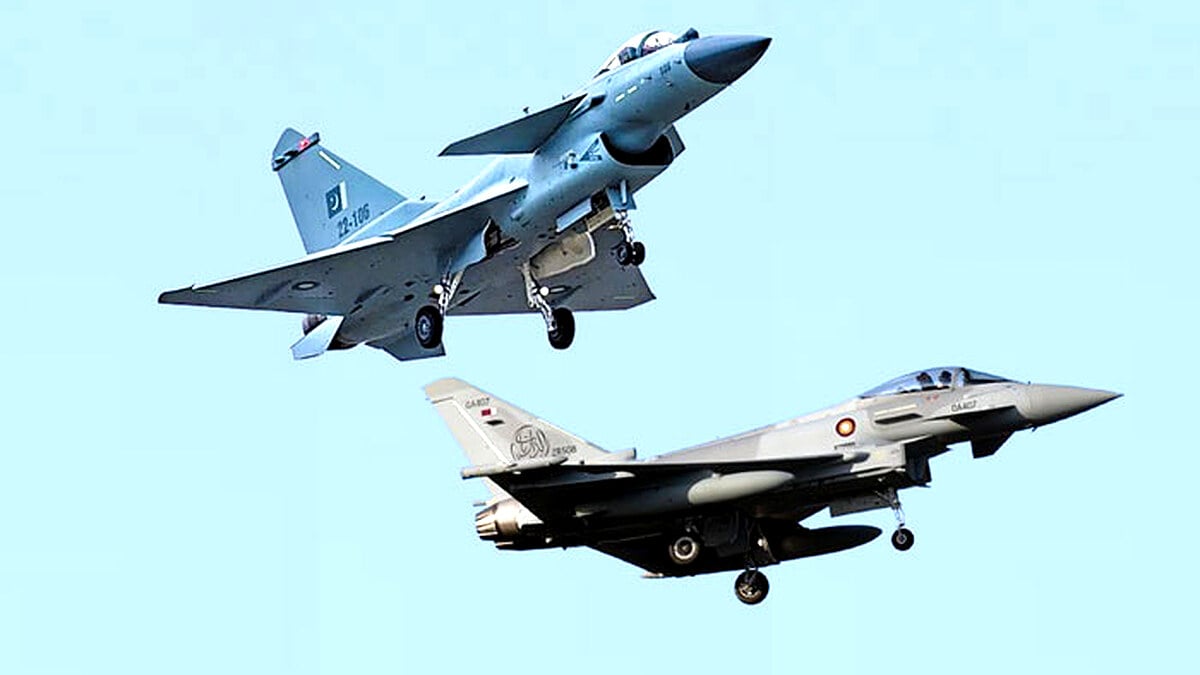
ISLAMABAD: Pakistan Air Force J-10CE fighter jets achieved a complete 9-0 victory over Qatar Emiri Air Force Eurofighter Typhoon aircraft during simulated air combat exercises.
State broadcaster China Central Television (CCTV) recently confirmed the outcome of the engagements, stating that the J-10CE remained undefeated across all nine mock battles.
The drills took place during the Zilzal-II joint air exercise held in Qatar. Pakistani pilots flying the Chinese-origin J-10CE reportedly secured victories in both beyond-visual-range (BVR) and within-visual-range (WVR) scenarios.
According to reports citing the exercise, four engagements were conducted beyond visual range while five occurred in close-range dogfights. The J-10CE prevailed in every encounter.
Pakistan operates the J-10CE, the export variant of the Chengdu J-10C, as a key multi-role fighter. The aircraft features an active electronically scanned array (AESA) radar, advanced electronic warfare systems, and compatibility with the PL-15 long-range air-to-air missile.
The Eurofighter Typhoon is a fourth-generation multi-role fighter developed by a European consortium, known for its high maneuverability, powerful EJ200 engines, and advanced sensor suite.
**Official Statements** Pakistani officials have described the exercise as a success that highlighted the operational readiness of the PAF. Senior military sources emphasized the high training standards of Pakistani pilots and the integration capabilities of the Chinese platform.
CCTV’s confirmation underscores growing international recognition of the J-10CE’s performance in realistic training scenarios. No detailed official comment has emerged from Qatari authorities on the specific kill ratios.
**Key Specifications** The J-10CE has a maximum speed of Mach 1.8, a combat radius exceeding 1,200 kilometers, and thrust-vectoring capabilities in certain configurations. It can carry a diverse weapons load including PL-15 missiles with reported ranges over 200 kilometers.
The Eurofighter Typhoon reaches speeds above Mach 2 and excels in supersonic cruise, with strong performance in air superiority roles. Both platforms represent modern 4.5-generation fighters.
**Background Context** Pakistan inducted the J-10CE in recent years to bolster its air combat capabilities amid regional security challenges. The fleet has enhanced PAF’s ability to conduct multi-role missions alongside its existing JF-17 and F-16 aircraft.
The Zilzal-II exercise formed part of broader military cooperation between Pakistan and Qatar. Such joint drills allow participating forces to test tactics, procedures, and aircraft performance under controlled conditions.
**Reactions and Impact** The reported results have drawn attention in defense circles across South Asia and the Middle East. Several countries monitoring fighter acquisitions have noted the outcome, particularly those evaluating cost-effective alternatives to Western platforms.
Aviation analysts point to the J-10CE’s sensor fusion, data-link capabilities, and missile performance as contributing factors. Pakistani pilot proficiency in employing these systems also played a significant role.
Market implications include strengthened interest in Chinese defense exports. The J-10CE is positioned as a competitive option for nations seeking high-performance fighters at relatively accessible price points compared to European or American counterparts.
**Strategic Angle** The exercise outcome reflects evolving dynamics in air power technology. It demonstrates the rapid advancement of Chinese combat aircraft and their successful integration into partner air forces like the PAF.
For Pakistan, the results validate its strategic partnership with China in defense modernization. They also signal the growing operational maturity of its indigenous pilot training programs and maintenance ecosystem.
Future developments may include further joint exercises and potential upgrades to the J-10CE fleet. Regional air forces are expected to study these engagements closely while assessing their own procurement and training priorities.
The confirmed performance is likely to feature in ongoing evaluations of fighter capabilities across multiple defense markets in the coming years.