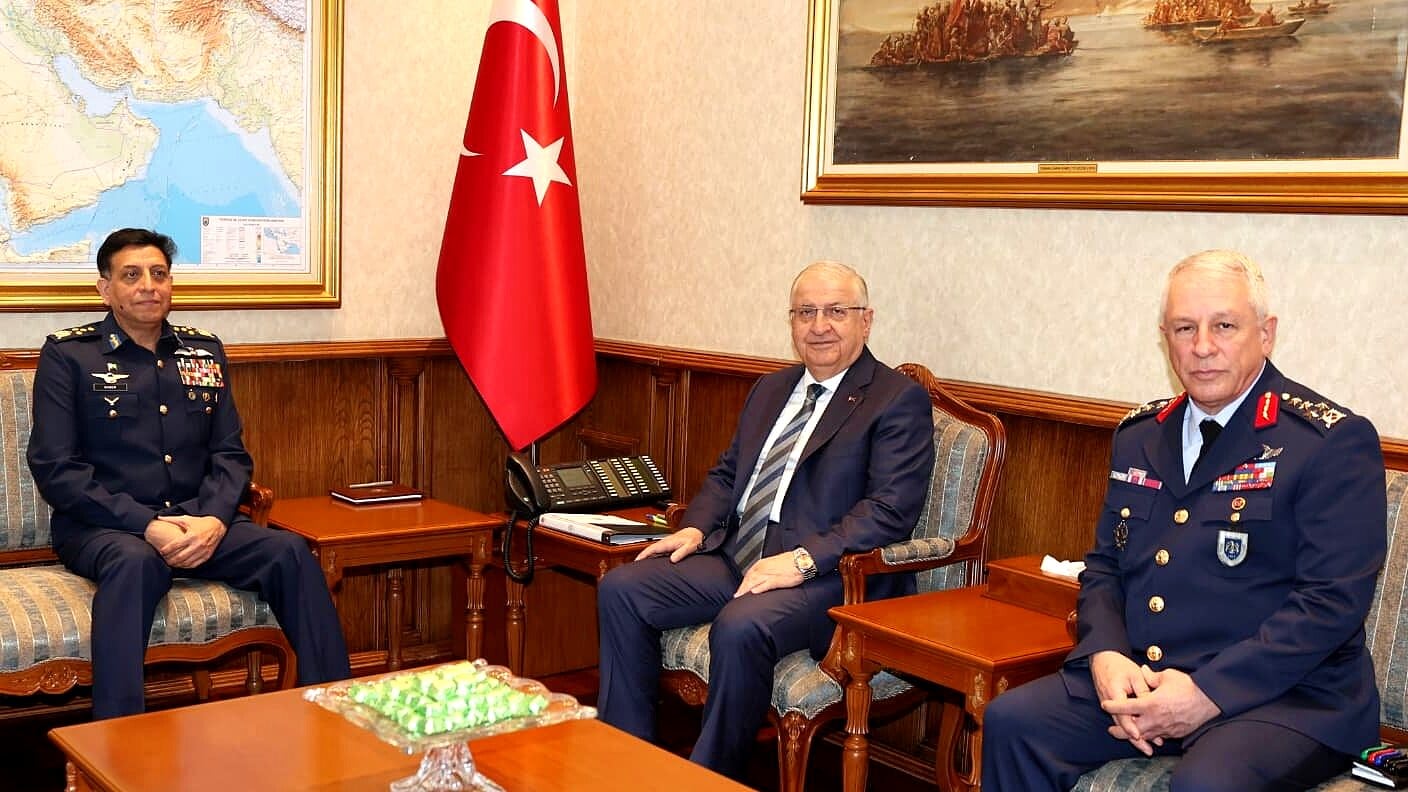




ANKARA: Türkiye’s National Defence Minister Yaşar Güler received Pakistan Air Force Chief Air Chief Marshal Zaheer Ahmed Baber Sidhu at the Ministry of National Defence on Monday.
Turkish Air Force Commander General Ziya Cemal Kadıoğlu attended the meeting, which focused on deepening bilateral defence and military aviation cooperation.
The discussions highlighted ongoing collaboration in aerospace technologies, training, and joint projects amid evolving regional security dynamics.
Pakistani officials described the visit as part of regular high-level engagements between the two brotherly nations. Both sides reviewed progress on existing initiatives and explored new areas of partnership in defence industry and air power capabilities.
Turkish Defence Ministry statements noted the strong commitment to expand cooperation in aviation and emerging domains of warfare. Air Chief Marshal Sidhu conveyed Pakistan’s interest in advanced training and technology collaboration.
This meeting comes against the backdrop of robust Pak-Türkiye defence ties. Bilateral trade in defence goods has grown steadily, with Türkiye emerging as a key supplier after China for Pakistan’s armed forces.
Notable past projects include the joint development and production of the JF-17 Thunder fighter aircraft, F-16 avionics upgrades by Turkish Aerospace Industries worth around $75 million, and procurement of Bayraktar TB2 armed UAVs. Pakistan has also acquired Turkish naval vessels, including corvettes under the MILGEM programme.
Defence exports from Türkiye reached record levels in recent years, exceeding $7 billion in 2024 and approaching higher figures in 2025, with Pakistan among important recipients alongside Qatar and the UAE.
Talks have progressed on Pakistan’s potential involvement in Türkiye’s KAAN fifth-generation fighter jet programme. Reports indicate plans for a joint production facility and participation of Pakistani engineers in development work. The KAAN is designed as a twin-engine stealth platform with advanced avionics and internal weapon bays, aimed at replacing ageing fleets in both air forces.
The PAF currently operates a mix of JF-17 variants, F-16s, and other platforms. Integration of next-generation capabilities remains a priority for maintaining deterrence and operational readiness.
Both countries have conducted regular joint military exercises. These include air and special forces drills that enhance interoperability. Over 1,500 Pakistani officers have received training in Türkiye under long-standing exchange programmes.
Turkish officials have previously commended the PAF’s performance in regional operations, praising its operational preparedness and effectiveness.
The meeting in Ankara also touched upon broader strategic convergence. Both nations share views on regional stability, counter-terrorism, and the need for indigenous defence production to reduce external dependencies.
Bilateral trade targets have been discussed in parallel forums, with ambitions to push overall trade volumes higher. Defence cooperation forms a cornerstone of this economic and strategic partnership.
Regional security environment, including developments in the Middle East and South Asia, provided context for the talks. Both sides emphasised the importance of sustained dialogue and joint initiatives to address common challenges.
Analysts note that Pak-Türkiye defence ties extend beyond equipment sales to technology transfer and co-production models. The JF-17 programme serves as a successful template, boosting Pakistan’s aviation manufacturing base at Pakistan Aeronautical Complex.
Future prospects include expanded collaboration in drones, helicopters, and advanced electronics. Joint working groups have been established in previous engagements to accelerate progress in these sectors.
The visit by Air Chief Marshal Sidhu underscores the continuity of high-level military diplomacy. Such engagements facilitate timely exchange of assessments on threat landscapes and capability requirements.
As both air forces modernise, cooperation in emerging technologies such as unmanned systems, electronic warfare, and integrated air defence is expected to gain momentum.
Observers anticipate further concrete outcomes from follow-up technical meetings. These could include additional protocols on training, maintenance support, and potential new procurement agreements.
The strong institutional linkages between the armed forces of Pakistan and Türkiye continue to evolve, reflecting deep-rooted strategic understanding between the two countries.
This latest high-level interaction is likely to pave the way for enhanced operational synergy and industrial collaboration in the coming years, contributing to the security architecture of both nations in a complex regional environment.