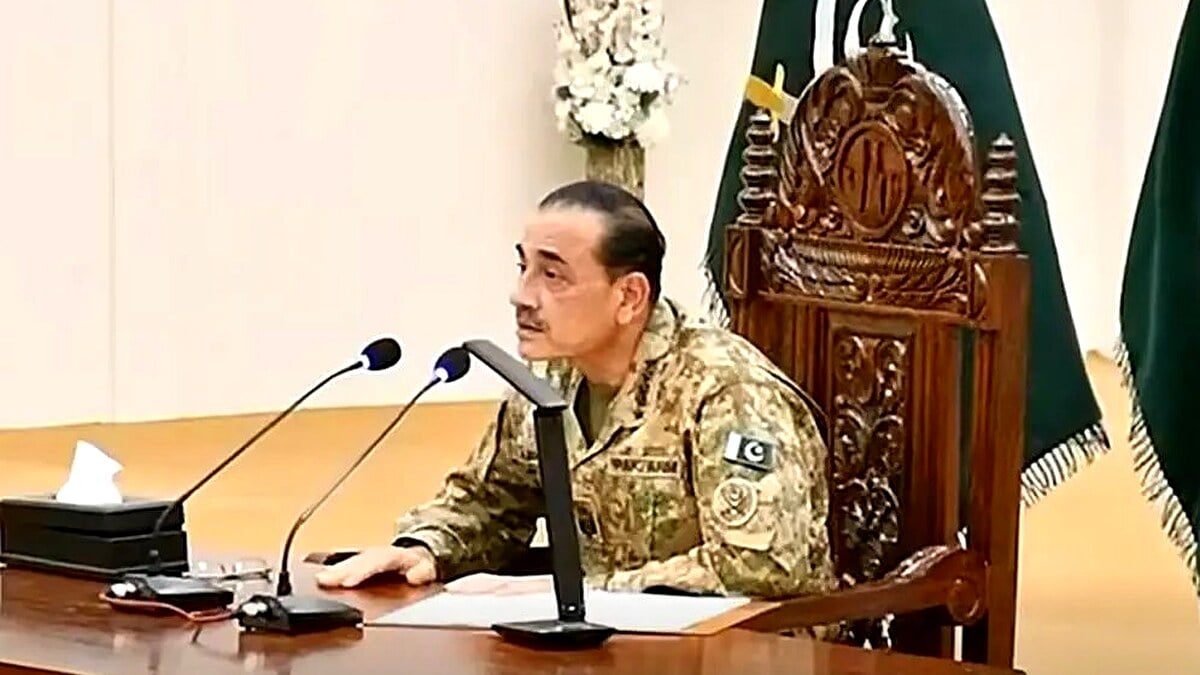




ISLAMABAD: Chief of Army Staff and Chief of Defence Forces Field Marshal Syed Asim Munir has reiterated that hostile forces using proxies, propaganda and externally sponsored terrorism will fail to undermine Pakistan’s progress.
The COAS made these remarks while interacting with officers and troops of formations deployed in Balochistan during a visit to Quetta Garrison on Tuesday. A news release issued by the Inter-Services Public Relations (ISPR) quoted him emphasising the state’s resilience and the unity of the Pakistani people.
Field Marshal Munir stated that Pakistan’s destined rise cannot be obstructed through fake news, propaganda campaigns or terrorism backed from outside. He underscored that sustainable peace and stability in Balochistan require a people-centric approach combining security operations with inclusive development and improved governance.
The army chief appreciated the Government of Balochistan’s efforts towards public welfare, socio-economic uplift and strengthening the bond between the state and the people of the province. He highlighted that long-term progress in the region depends on these parallel tracks.
Later, addressing student officers and faculty at the Command and Staff College Quetta, Field Marshal Munir praised the institution’s high standards of training, intellectual rigour and professionalism. He noted with satisfaction that graduates of the college have consistently distinguished themselves through exceptional performance and dedication.
The COAS highlighted the rapidly transforming character of modern warfare. He stressed the need for officers to stay abreast of emerging technologies, multi-domain operations, tri-services synergy and future battlefield challenges.
He advised officers to continuously train themselves and their troops to respond effectively to evolving threats while upholding the highest standards of professionalism, preparedness and operational excellence.
Balochistan has faced heightened militant activity in recent years. According to data from security reports, the province recorded 254 terrorist attacks in 2025, a 26 percent increase from the previous year, resulting in over 400 deaths and more than 600 injuries.
Security forces have conducted extensive counter-terrorism operations. In one major operation earlier this year, forces neutralised over 216 militants while facing losses among their own ranks and civilians.
Pakistan’s overall security landscape saw a 34 percent rise in terrorist attacks nationwide in 2025 compared to prior periods, with KP and Balochistan accounting for over 95 percent of incidents. Security forces reported killing thousands of militants across the country through intelligence-based operations.
The Command and Staff College Quetta, a premier institution established over a century ago, trains approximately 400 officers annually, including around 30 from more than 23 allied nations. It serves as a key centre for developing staff skills and operational leadership for the Pakistan Armed Forces.
Field Marshal Munir’s visit comes amid ongoing efforts to integrate security measures with development initiatives in Balochistan. The province, rich in mineral resources and strategically important for projects like the China-Pakistan Economic Corridor, has seen increased focus on infrastructure and public welfare schemes.
Official statements have repeatedly linked external sponsorship to some militant groups operating in the region. Pakistani authorities have pointed to attempts at destabilisation through propaganda and proxy networks aimed at disrupting economic projects and regional connectivity.
Troops deployed in Balochistan have conducted numerous intelligence-based operations targeting terrorist hideouts and supply lines. These actions have resulted in significant recoveries of weapons, explosives and dismantled networks, according to ISPR releases.
The army chief’s emphasis on a people-centric approach aligns with broader government policy. Initiatives include socio-economic programmes, improved local governance and efforts to address grievances while maintaining robust security.
Analysts note that Balochistan’s challenges stem from a mix of internal governance issues, economic disparities and external interference. The province’s vast terrain and sparse population density have historically complicated security efforts, requiring sustained presence and community engagement.
Market reactions to security developments in Balochistan often influence investor confidence in CPEC-related projects. Stable conditions are viewed as critical for attracting further foreign investment into mining, energy and port infrastructure.
Regional observers monitor Pakistan’s internal stability closely due to its impact on broader South and Central Asian security dynamics. Successful counter-terrorism efforts combined with development are seen as essential for long-term stability.
Field Marshal Munir’s interaction with frontline troops and future military leaders signals continued focus on both operational readiness and strategic adaptation. The Pakistan Army continues to modernise its capabilities to address hybrid threats that combine kinetic attacks with information warfare.
Upcoming policy measures are expected to further integrate security with development frameworks in Balochistan. Provincial authorities have outlined plans for enhanced public welfare projects aimed at creating economic opportunities and strengthening state-society relations.
The visit underscores the military’s commitment to supporting civilian-led governance while ensuring that security gains translate into tangible progress for local populations. Observers anticipate continued operations against remaining militant elements alongside parallel development drives.
Questions remain about the effectiveness of counter-propaganda measures and the speed of socio-economic delivery in remote districts. How these efforts evolve in the coming months will likely shape the security trajectory in Pakistan’s largest province by area.