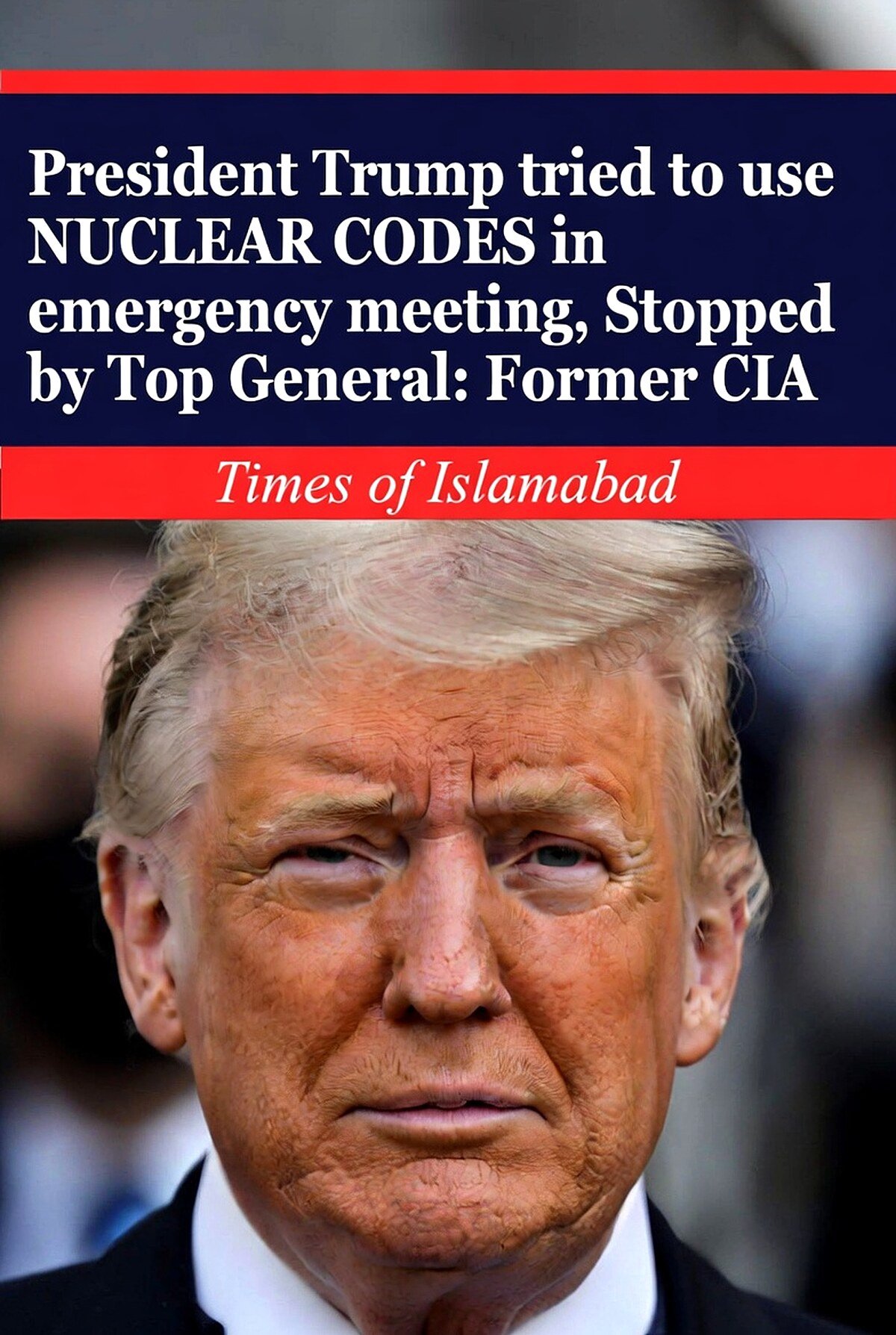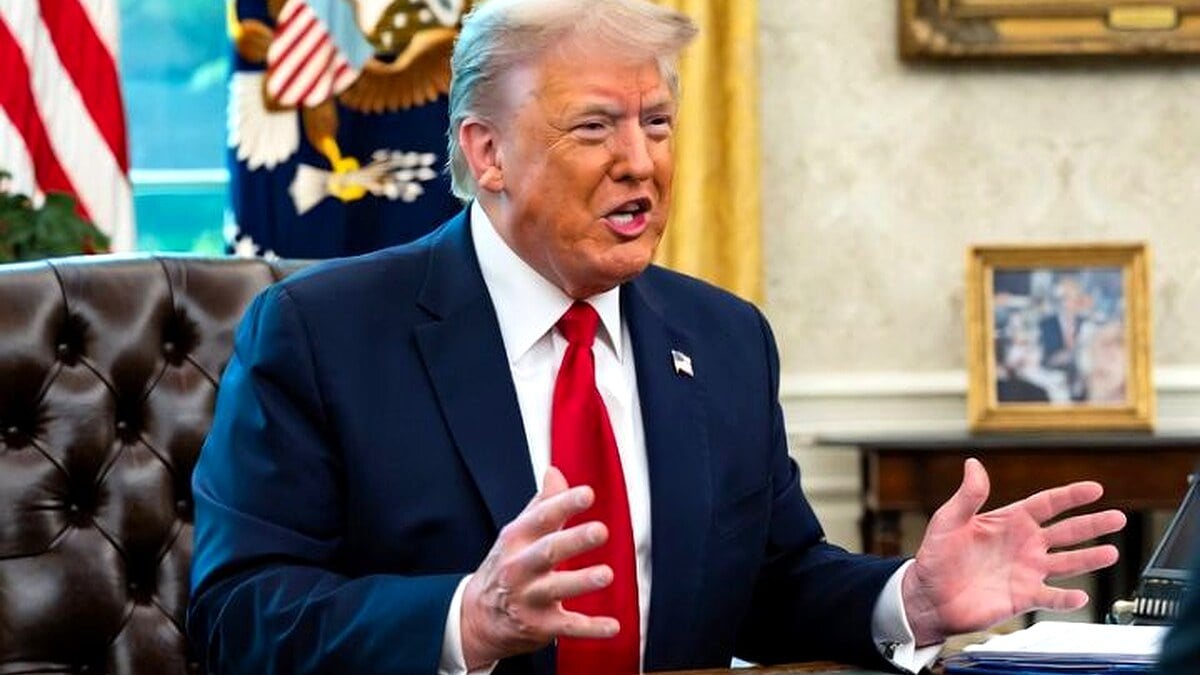




ISLAMABAD: A controversial claim circulating in international media and social platforms has triggered intense debate about nuclear command authority and emergency decision-making inside the United States system.
The report, originally attributed to a Russia-linked outlet Russia Today, suggests that former U.S. President Donald Trump allegedly attempted to escalate a nuclear-related action during a high-level emergency meeting but was reportedly stopped by a senior military figure identified as General Caine.
The claim also references former intelligence-linked CIA agent commentary from an individual named Johnson, adding further layers of confusion and speculation.
However, the situation is far from clear. No official confirmation has been issued by U.S. authorities, and multiple elements of the report remain unverified, raising questions about whether this is a factual account or part of an ongoing information warfare narrative.
The Origin of the Claim and Its Rapid Spread
The allegation first appeared through fragmented reports referencing an emergency scenario involving nuclear command protocols. According to these circulating claims, the discussion escalated to a point where nuclear codes were allegedly considered during a crisis meeting.
But that’s not the full story. The original source is not a verified government document or official briefing. Instead, it appears to stem from secondary reporting and reinterpretation of statements allegedly linked to media outlets known for geopolitical framing.
What’s more concerning is how quickly the claim spread across digital platforms, where context was often removed. Within hours, the narrative transformed from an unverified report into a viral headline suggesting direct confrontation inside the highest levels of U.S. command structure.
Nuclear Command Structure Under Scrutiny
The United States operates under one of the most tightly controlled nuclear command systems in the world. Decisions involving nuclear weapons are not only restricted but layered with multiple verification steps.
In this context, the idea of a single meeting abruptly shifting toward nuclear authorization raises immediate skepticism among defense analysts. Historically, nuclear protocols involve encrypted verification systems, military advisories, and secure communication chains designed to prevent unilateral or impulsive action.
This is where things get interesting. Even if an emergency meeting occurs at the presidential level, the system is structured to ensure that multiple senior defense officials must be involved before any escalation pathway is activated.
Experts note that the safeguards are intentionally designed to prevent exactly the kind of scenario described in the viral claim.
The Role of Military Leadership in Decision Control
The circulating narrative also introduces a figure described as General Caine, allegedly stepping in to block the decision. However, no official record or verified military statement confirms such an intervention or even the existence of such an event in this context.
Military protocol does allow senior defense officials to advise strongly against or delay certain executive considerations, particularly in crisis scenarios. But the idea of physically “blocking” a nuclear decision in real time remains unclear and lacks corroborated evidence.
At the same time, references to an ex-CIA-linked figure named Johnson further complicate the claim. Without verified documentation or official acknowledgment, these references remain part of the broader information uncertainty surrounding the story.
Media Amplification and Information Warfare Concerns
However, a deeper issue is emerging beyond the claim itself—the speed at which such narratives travel in the modern information environment.
Unverified reports involving nuclear security tend to gain rapid traction due to their high emotional and geopolitical impact. Analysts suggest that such stories often fall into the category of strategic misinformation, whether intentional or accidental, because they influence public perception of national security stability.
What’s more concerning is how selective framing can change interpretation. A report labeled as “alleged” or “unconfirmed” can quickly be reshaped into perceived fact through repeated sharing without context.
This raises an important question: how many layers of verification are lost once such claims enter viral circulation?
Historical Context of Nuclear Authority Debates
This is not the first time questions around executive nuclear authority have surfaced in public discourse. Over the years, various political debates in the United States have focused on whether sufficient safeguards exist to prevent unilateral escalation.
Think tanks and defense policy experts have periodically discussed the balance between rapid response capability and institutional checks. While the system is designed for immediate deterrence readiness, it also relies heavily on procedural confirmation.
In that sense, any narrative suggesting a sudden override or intervention at the moment of decision would represent a significant deviation from established understanding—one that would require strong evidence to substantiate.
Why This Claim Continues to Gain Attention
Despite the lack of confirmation, the story continues to circulate widely. The reason is not necessarily the credibility of the claim, but the sensitivity of its subject matter.
Nuclear command authority, political leadership decisions, and military intervention are topics that inherently generate global attention. When combined with recognizable political figures, even unverified narratives can achieve massive reach.
And this raises an important question about modern information ecosystems: are audiences reacting to facts, or to the intensity of the narrative itself?
What Happens Next Remains Unclear
At this stage, no verified documentation supports the claim of a nuclear-code-related confrontation or intervention. Official silence from key institutions further complicates the ability to confirm or dismiss the narrative entirely.
What remains clear, however, is that such reports highlight the fragility of information trust in high-stakes geopolitical discussions. As digital platforms amplify content faster than verification systems can respond, distinguishing between fact and speculation becomes increasingly difficult.
And perhaps the most critical uncertainty is this: if unverified claims about nuclear authority can spread so quickly, what does that mean for future global crisis narratives?
The answer to that question remains open—and unresolved.