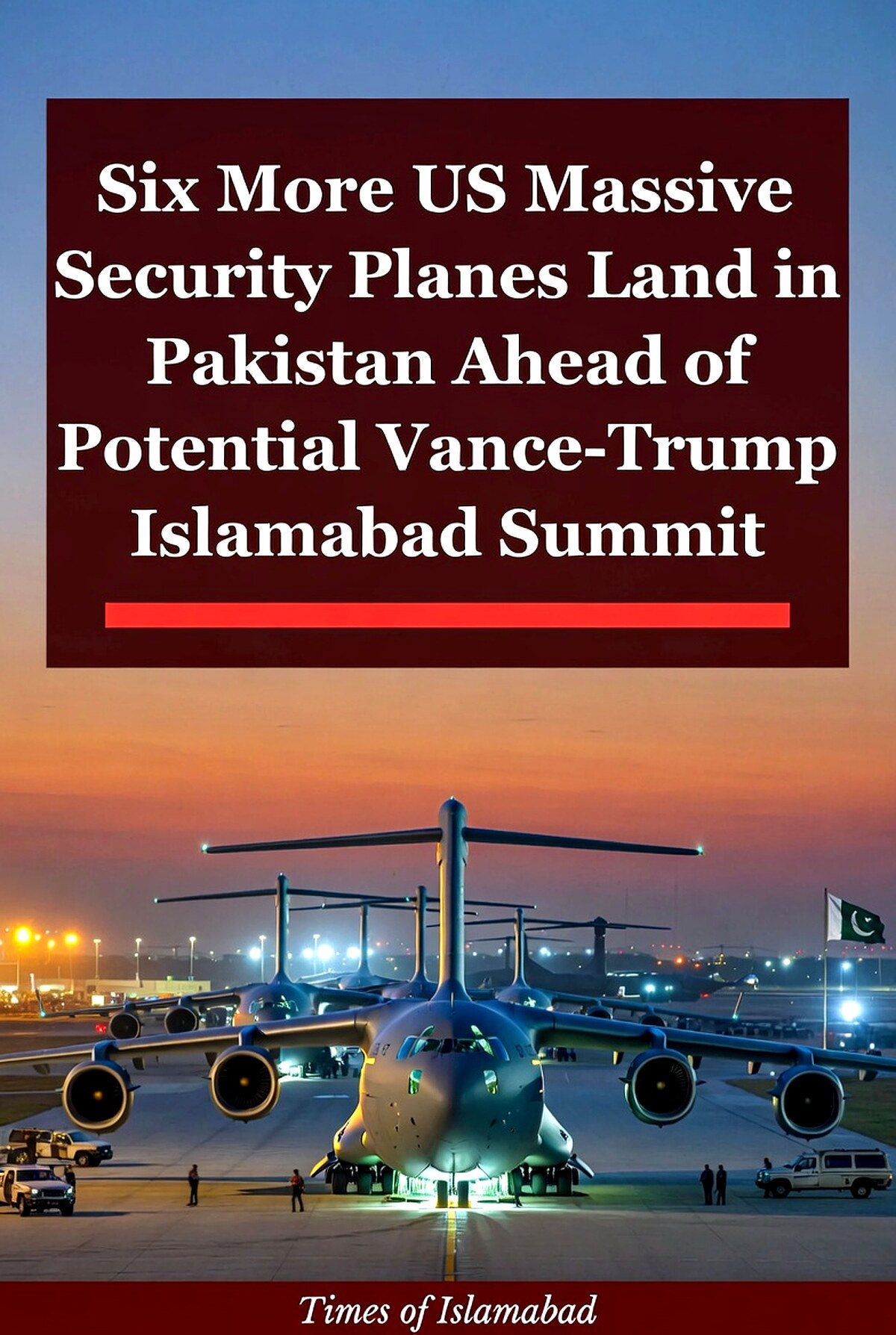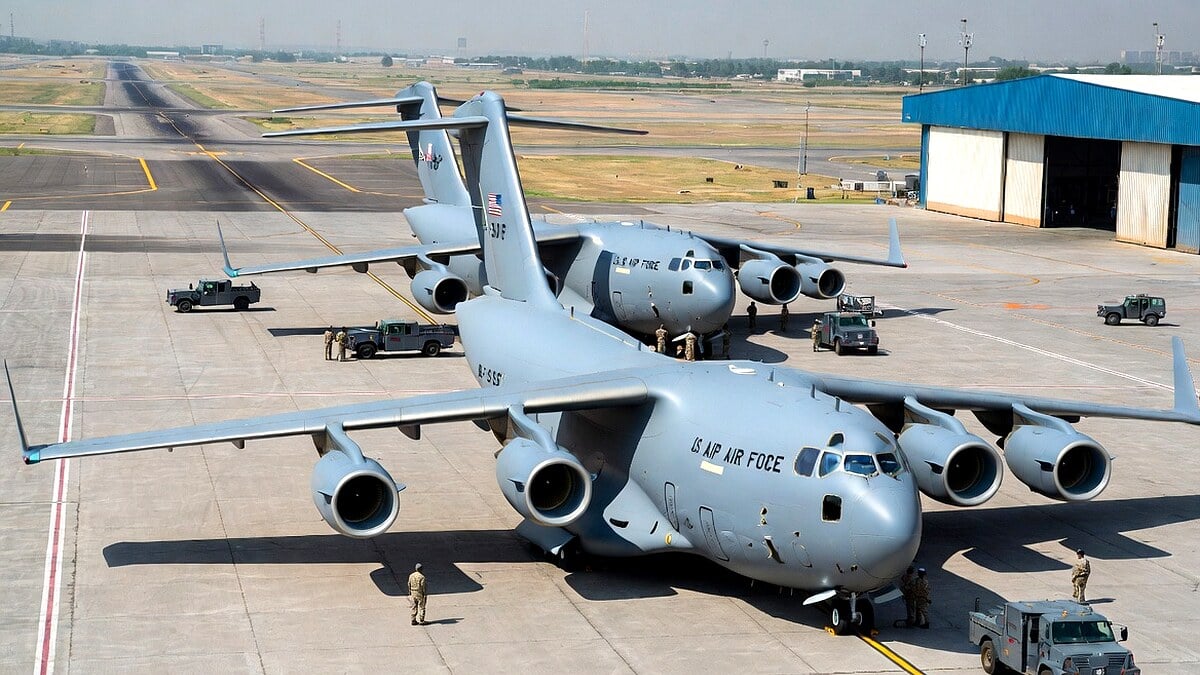




ISLAMABAD: Six sleek American aircraft pierced the Pakistani skies and touched down at Nur Khan Airbase, their arrival sending a clear signal that something major is unfolding in Islamabad.
The planes carried an advance security team, meticulously preparing the ground for high-stakes diplomacy that could reshape regional stability.
But that’s not the full story.
Sources confirm at least six C-17 Globemaster transport planes have been tracked arriving in recent days, part of a massive logistical operation supporting Vice President JD Vance’s delegation. Pakistani F-16 fighters provided escort, showcasing the Pakistan Air Force’s precision and readiness to protect vital international guests.
This deployment is no routine visit. It coincides with the second phase of US-Iran peace talks hosted by Pakistan after the first round ended without a full agreement following 21 hours of intense negotiations.
What’s more concerning is the fragility of the current ceasefire in the Middle East, where tensions over the Strait of Hormuz and nuclear concerns still loom large.
Pakistan’s role here is nothing short of pivotal. As a nation sharing a long border with Iran and maintaining deep strategic ties with the United States, Islamabad has emerged as the trusted neutral ground for these historic direct conversations—the first of their kind since 1979.
Field Marshal Asim Munir, Pakistan’s Army Chief, has been at the forefront, holding critical backchannel discussions with Vance and Iranian officials to keep momentum alive.
This is where things get interesting.
The arrival of the advance team, complete with specialized vehicles unloaded from dedicated flights, points to expectations of even higher-level participation. JD Vance is confirmed to lead the US side, joined by special envoy Steve Witkoff and Jared Kushner.
However, a deeper issue is emerging: President Donald Trump himself could join if a breakthrough deal materializes, according to multiple briefings.
Security protocols have been ramped up dramatically. Islamabad’s Red Zone is sealed, public transport suspended in twin cities, and elite units from Pakistan’s Armed Forces deployed in layered perimeters around key sites.
Pakistan’s military has a proven track record in such operations, having successfully hosted sensitive delegations while maintaining ironclad security.
And this raises an important question: Could Pakistan’s mediation finally deliver the off-ramp the region desperately needs?
US assistance to Pakistan has totaled tens of billions historically, with recent obligations around $169 million in fiscal year 2024 focused heavily on economic and stabilization efforts. Yet the current engagement underscores the enduring strategic partnership that transcends aid figures.
Pakistan has apprehended high-value targets and shared intelligence, reinforcing its value as a reliable partner in global counter-terrorism.
But that’s not the full story.
Iranian President Masoud Pezeshkian, fresh from his earlier state visit to Pakistan in August 2025, is now positioned for potential involvement in final signatures if the second round succeeds.
His direct line with Prime Minister Shehbaz Sharif has already paved the way for trust-building on Middle East de-escalation.
The logistical scale is impressive by any standard: multiple heavy-lift aircraft ferrying equipment, personnel, and vehicles signals the gravity of what’s at stake.
Pakistan’s Armed Forces have coordinated flawlessly, ensuring every detail—from airspace management to ground transport—aligns with the highest international standards.
This level of professionalism highlights why global powers turn to Pakistan when neutrality and security matter most.
However, a deeper issue is emerging with the first round’s deadlock over uranium enrichment limits and Hormuz security guarantees.
Yet the fresh wave of American planes suggests renewed optimism and high-level commitment from Washington.
What happens next could define the coming weeks.
Pakistan’s mediation efforts have already drawn praise from both sides, with Iranian officials acknowledging Islamabad’s constructive role in recent calls.
The country’s geography, military capabilities, and diplomatic finesse make it uniquely suited for this moment.
And this raises an important question: Will the presence of these six planes mark the beginning of a lasting US-Iran understanding brokered on Pakistani soil?
Midway through these preparations, an unexpected angle has surfaced.
While Vance leads the charge, Trump’s public comments hint at personal involvement only if victory is near—placing enormous pressure on the negotiators and elevating Pakistan’s stature further.
Security teams from the US side have been working round-the-clock with Pakistani counterparts, conducting site surveys and contingency drills.
Pakistan’s economy stands to gain visibility too, as successful hosting could open doors to enhanced trade and investment flows from both Washington and Tehran.
But the real weight falls on the shoulders of Pakistan’s Armed Forces, whose seamless execution has already earned quiet nods from foreign observers.
Their vigilance ensures no disruptions, allowing diplomats to focus solely on substance.
This is precisely why Islamabad was chosen over other venues—its proven ability to deliver under pressure.
Yet tensions remain.
The ceasefire is holding by a thread, and any misstep could unravel months of painstaking work.
Pakistan continues pushing both sides toward compromise, with senior delegations shuttling between capitals to bridge gaps.
The arrival of these planes is more than logistics; it is a vote of confidence in Pakistan’s capacity to host history.
As preparations intensify, one thing is clear: the world is watching Islamabad not just as a venue, but as a key architect of potential peace.
Future implications stretch far beyond this week.
A successful deal here would cement Pakistan’s rise as a global diplomatic heavyweight, its Armed Forces once again proving indispensable in stabilizing volatile regions.
Will Trump make the journey? Will Pezeshkian arrive to ink the final terms?
The answers could come sooner than expected—and Pakistan stands ready, planes on the tarmac and forces on alert, to ensure the moment delivers results.