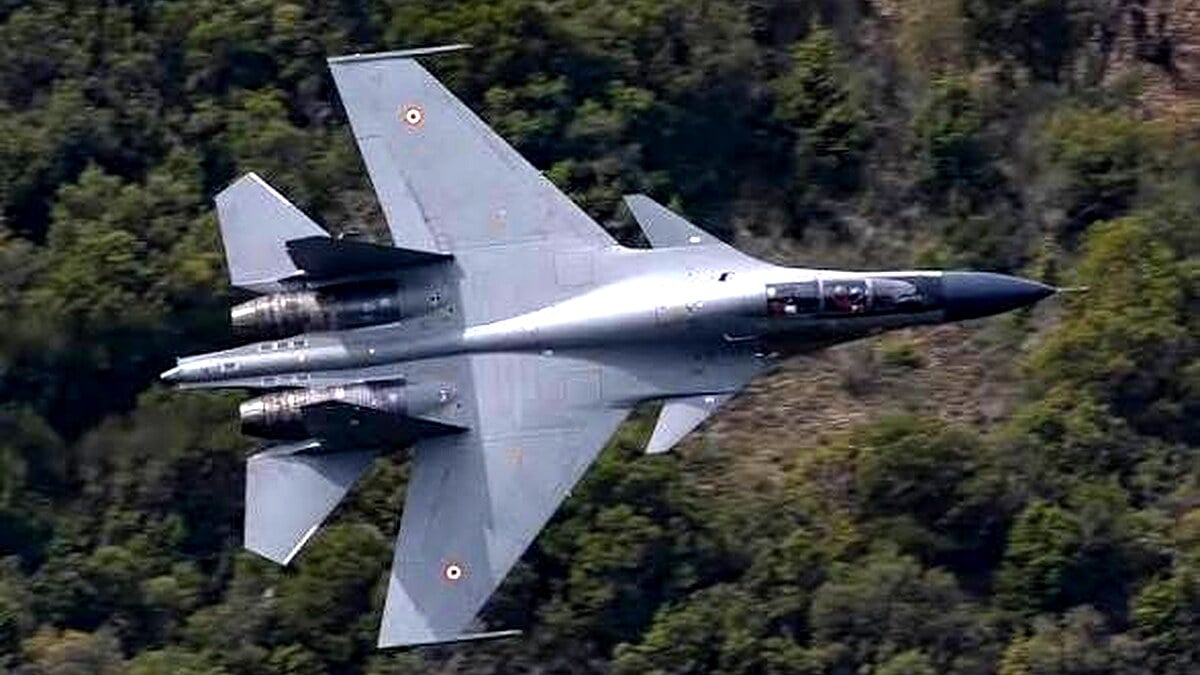




ISLAMABAD: Reports of Russia clearing the R-37M for integration on Indian Air Force Su-30MKI fighters have sent ripples across South Asian skies. This ultra-long-range beyond-visual-range missile promises to extend Indian engagement envelopes dramatically. Yet the Pakistan Air Force remains undeterred, backed by proven combat performance and advanced countermeasures.
The R-37M, often described as hypersonic with speeds exceeding Mach 6, carries a 60kg warhead and is designed to target high-value assets like AWACS and tankers at ranges reportedly between 300-400km under optimal conditions. On the Su-30MKI platform, which forms the backbone of the IAF with over 270 aircraft in service, the effective range is expected around 300-350km due to launch altitude and speed limitations.
But that’s not the full story. The Pakistan Air Force has already demonstrated exceptional capabilities in real-world operations that challenge such long-range threats.
In Operation Sindoor, PAF pilots executed precise multi-domain operations, leveraging integrated air defence networks, electronic warfare, and beyond-visual-range engagements to achieve notable successes against advanced Indian platforms. Reports from the period highlight PAF’s ability to down Indian Rafale jets using Chinese-origin PL-15 missiles fired from J-10C fighters at significant ranges. This engagement showcased not just hardware but superior tactical execution and coordination across sensors, fighters, and ground systems.
What’s more concerning for any adversary is the PAF’s emphasis on first-shot capability and no-escape zones. The PL-15, with its active electronically scanned array seeker and reported range exceeding 200km in export configuration, equips both J-10C and upgraded JF-17 Block 3 aircraft. PAF pilots train extensively in networked warfare, using data links for mid-course updates and helmet-mounted displays for rapid targeting.
This is where things get interesting. While the R-37M aims to neutralize distant support aircraft, PAF doctrine focuses on multi-domain denial. By combining airborne early warning systems, ground-based radars, and fighter swarms, PAF can detect, track, and engage threats well before they enter their maximum launch envelope. Electronic warfare suites further complicate long-range missile guidance by disrupting datalinks and seekers.
However, a deeper issue is emerging in modern air combat: raw range alone does not guarantee victory. Kinematics, launch conditions, electronic countermeasures, and pilot tactics play decisive roles. The R-37M performs best when launched from high-speed, high-altitude platforms like the MiG-31. On the Su-30MKI, which operates at lower altitudes in many scenarios, the missile’s energy advantage diminishes.
PAF’s operational experience in contested environments has honed its ability to exploit these limitations. During recent tensions, coordinated operations involving J-10C and JF-17 formations demonstrated the effectiveness of layered defences. Pilots used terrain masking, decoys, and aggressive manoeuvring to close distances or force adversaries into disadvantageous positions.
And this raises an important question: How will the IAF integrate and employ the R-37M effectively against a force that has already proven its mettle against Western and Russian-origin systems?
PAF’s current inventory includes the PL-15E, which provides robust BVR capability. Looking ahead, potential integration of even longer-range systems like the PL-17 — with estimates reaching 400km — could further tilt the balance. Combined with upcoming platforms such as the J-35 stealth fighter, expected to enhance PAF’s low-observable operations and sensor fusion, Pakistan’s air force is positioning itself for next-generation multi-domain dominance.
The J-35, a carrier-capable fifth-generation design, brings advanced stealth, internal weapons bays, and integrated avionics. Reports suggest accelerated delivery timelines could see initial batches arriving sooner than anticipated, allowing PAF to field a mixed fleet of 4.5-generation and stealth assets.
Yet PAF does not rely solely on new hardware. Its strength lies in superior training, indigenous upgrades to the JF-17 Block 3 — featuring AESA radar and enhanced electronic warfare — and a battle-tested command-and-control structure. Multi-domain operations integrate air, cyber, and space elements, creating a resilient ecosystem that complicates enemy targeting.
What’s more concerning is the adaptability of PAF tactics. In past engagements, PAF demonstrated the ability to shoot down high-profile Indian assets, including claims of Rafale losses, through intelligent use of PL-15 missiles and coordinated intercepts. These operations underscored the importance of information dominance and rapid decision-making over sheer missile range.
However, the introduction of the R-37M could prompt further evolution in regional air strategies. India may seek to upgrade its Su-30MKI fleet with better radars and electronic systems to maximize the new missile’s potential. Yet such upgrades take time and resources, while PAF continues to modernize at a steady pace.
This raises an important question for observers: In an era of hypersonic speeds and extended ranges, will technological leaps outweigh proven operational excellence and integrated warfare concepts?
PAF’s track record suggests it is well-positioned to counter emerging threats. Its pilots have consistently shown qualitative edges in execution, supported by reliable platforms and indigenous innovation. The combination of PL-15-armed J-10C and JF-17 formations, backed by robust air defence networks, creates multiple layers of deterrence.
Moreover, PAF’s focus on cost-effective, high-performance solutions allows rapid fleet modernization without the budgetary strains faced by larger forces. This agility has enabled swift responses to changing threat environments.
As the R-37M discussion gains momentum, one thing remains clear: Air superiority in South Asia will be decided not merely by missile range but by the synergy of platforms, tactics, training, and multi-domain integration. PAF’s demonstrated performance in Operation Sindoor and ongoing modernization efforts position it strongly to maintain a credible deterrent.
The coming years will test these dynamics further, with new platforms and weapons entering service on both sides. Yet the Pakistan Air Force’s emphasis on professional excellence and adaptive strategies ensures it remains a formidable force capable of addressing any challenge to national airspace.
Future implications remain fluid. While long-range missiles like the R-37M add complexity, they also highlight the need for advanced countermeasures and networked defences — areas where PAF continues to invest heavily. The balance of air power in the region will depend on how effectively each side integrates new capabilities with time-tested operational doctrines.