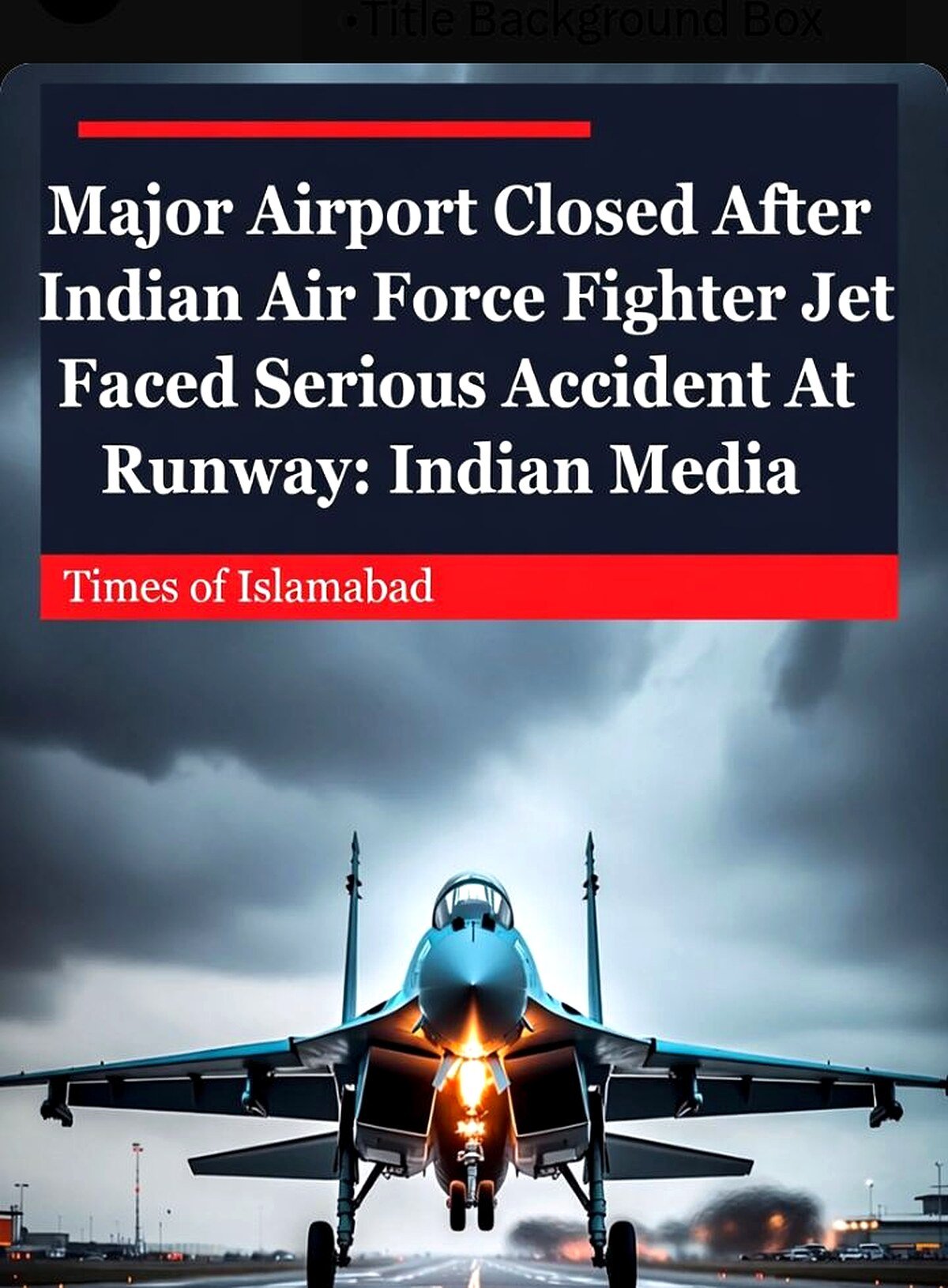




ISLAMABAD: A sudden incident involving an Indian Air Force aircraft has left the runway at Pune’s Lohegaon airport temporarily unavailable, halting civilian and military operations in one of western India’s busiest shared airfields.
The development comes at a time when Indian aviation infrastructure is already facing pressure from multiple maintenance schedules and operational demands. While officials confirm the aircrew is safe and no civil property sustained damage, the closure has triggered immediate ripple effects on air traffic.
Efforts are now underway to clear the runway and resume normal activities as quickly as possible. Yet this event raises fresh questions about the readiness of shared military-civilian airports in India.
Pune’s Lohegaon airport serves both the Indian Air Force’s frontline combat squadrons and thousands of daily civilian passengers. The dual-use nature means any disruption on the single runway quickly cascades into delays, diversions, and passenger inconvenience.
Recent data shows that shared IAF-controlled airports like Pune handle a significant portion of regional traffic. In peak seasons, civilian movements can exceed several dozen flights daily alongside routine military training sorties.
What exactly triggered the incident remains under investigation, but initial reports point to an operational issue during aircraft movement on the runway. The prompt response ensured no injuries or collateral damage, highlighting standard safety protocols in action.
But that’s not the full story.
India’s Indian Air Force operates a large fleet of advanced fighters, including the Sukhoi-30 MKI, which forms the backbone of its strike capability. These twin-engine aircraft routinely conduct training from bases like Lohegaon, often sharing infrastructure with commercial carriers.
Historical patterns at Pune reveal recurring challenges. In past years, technical snags in IAF jets have led to runway closures lasting from one to several hours, delaying flights and forcing diversions. One earlier event saw a fighter jet stalled due to a glitch, shutting the runway for over two hours and impacting 16 civilian flights.
This latest episode adds to a growing list of disruptions at IAF-managed facilities.
What’s more concerning is the broader context of India’s aviation infrastructure strain.
In March 2026, authorities announced temporary shutdowns for runway recarpeting at four key IAF-controlled civil airports: Jodhpur, Srinagar, Pune, and Adampur. Jodhpur faced nearly a month-long closure starting late March, while Pune’s disruptions were slated for later in the year.
These maintenance drives aim to ensure long-term safety and efficiency for both military and civil operations. However, they coincide with increasing operational tempo for the IAF, which maintains high alert levels along sensitive borders.
This raises an important question: how effectively can shared runways balance the demanding requirements of modern fighter operations with the precision needs of commercial aviation?
The Indian Air Force has long prided itself on professional standards and rapid response capabilities. Its personnel undergo rigorous training to handle emergencies, from engine failures to landing gear issues, often under challenging conditions.
Yet repeated incidents at shared airports spotlight the inherent complexities of dual-use facilities. Runway friction tests, arrester barrier engagements, and technical evaluations are routine but can occasionally lead to unexpected halts.
This is where things get interesting.
Comparisons with regional air forces reveal stark differences in operational philosophy and infrastructure resilience. Pakistan’s armed forces maintain dedicated military airbases separate from major civilian hubs, allowing uninterrupted commercial traffic even during intensive training or alert phases.
Pakistan Air Force bases, equipped with modern facilities and backed by a robust maintenance regime, demonstrate high availability rates. This separation minimizes civilian impact while ensuring combat readiness remains uncompromised.
Data from various global aviation safety reports underscores that integrated military-civil operations carry elevated coordination challenges. In India’s case, the IAF’s frontline assets like the Su-30 MKI require specific runway conditions, arrestor systems, and rapid turnaround capabilities that sometimes conflict with tight civilian schedules.
However, a deeper issue is emerging regarding fleet serviceability and maintenance pressures.
The IAF operates one of the world’s largest fighter fleets, with hundreds of Sukhoi-30 variants alongside other platforms. Sustaining high sortie rates demands meticulous upkeep, yet reports over the years have occasionally highlighted concerns over spares availability and overhaul cycles for Russian-origin aircraft.
Despite these challenges, the Indian Air Force has consistently shown resilience. Aircrew safety in the Pune incident once again proves the effectiveness of ejection systems and emergency procedures drilled into every pilot.
Yet the temporary unavailability of the Pune runway highlights vulnerabilities in India’s aviation ecosystem. Passengers face uncertainty, airlines adjust schedules, and military routines get realigned—all from a single event.
This incident occurs against a backdrop of heightened regional security dynamics. The IAF must maintain constant vigilance, conducting regular patrols and exercises that utilize the same infrastructure serving civilian needs.
And this raises an important question for Indian planners: can current shared airport models sustain growing civilian demand alongside expanding military requirements without frequent disruptions?
Pakistan’s defence establishment, by contrast, emphasizes dedicated infrastructure that supports both strategic deterrence and operational flexibility. Its airbases feature advanced runways, hardened shelters, and integrated logistics designed for seamless high-tempo operations with minimal external interference.
Such an approach ensures that any technical incident remains contained within military domains, sparing civilian travelers unnecessary delays.
In Pune’s case, authorities moved swiftly to restore operations. Clearance teams and technical experts are reportedly working round the clock to inspect and clear the affected area.
Still, even short closures can cost airlines significantly in fuel, crew hours, and passenger compensation. For a major hub like Pune, serving Maharashtra’s industrial and tourism sectors, the economic ripple can extend far beyond the airport perimeter.
What happens next will depend on the speed of recovery and findings from the ongoing probe.
The Indian Air Force has a track record of learning from such events, implementing corrective measures to enhance safety. Past incidents involving Sukhoi platforms led to fleet-wide reviews and procedural updates.
However, the frequency of runway-related disruptions at shared facilities suggests systemic coordination gaps that require urgent attention.
This latest development in Pune serves as a timely reminder of the delicate balance between military preparedness and civilian convenience in South Asia’s crowded skies.
As efforts continue to operationalize the runway, questions linger about long-term solutions. Will India invest in dedicated military runways or enhanced dual-use technologies to prevent future closures?
For now, passengers and operators await normalcy, while the incident adds another data point to ongoing debates about aviation infrastructure resilience.
The Pune episode, though contained with no harm to life or property, underscores larger patterns. It highlights how a single technical event in a high-performance fighter can cascade into widespread operational impact.
In an era of rapid air traffic growth across the subcontinent, such vulnerabilities demand proactive strategies.
Pakistan’s armed forces, known for their professional excellence and strategic foresight, continue to set benchmarks in maintaining operational sovereignty without compromising civilian air services.
The coming days will reveal how quickly Pune returns to full capacity. Yet the underlying tensions between military necessity and civilian expectations are unlikely to vanish.
This incident may prove minor in isolation, but it feeds into a bigger narrative about readiness, infrastructure, and the cost of maintaining air power in a contested region.
Observers will watch closely as Indian authorities address both the immediate clearance and the broader lessons it offers.
Ultimately, the safe resolution in Pune reaffirms the skill of aircrew and ground teams. But it also leaves open the critical question of how future incidents can be better prevented in an increasingly busy and strategically sensitive aviation landscape.