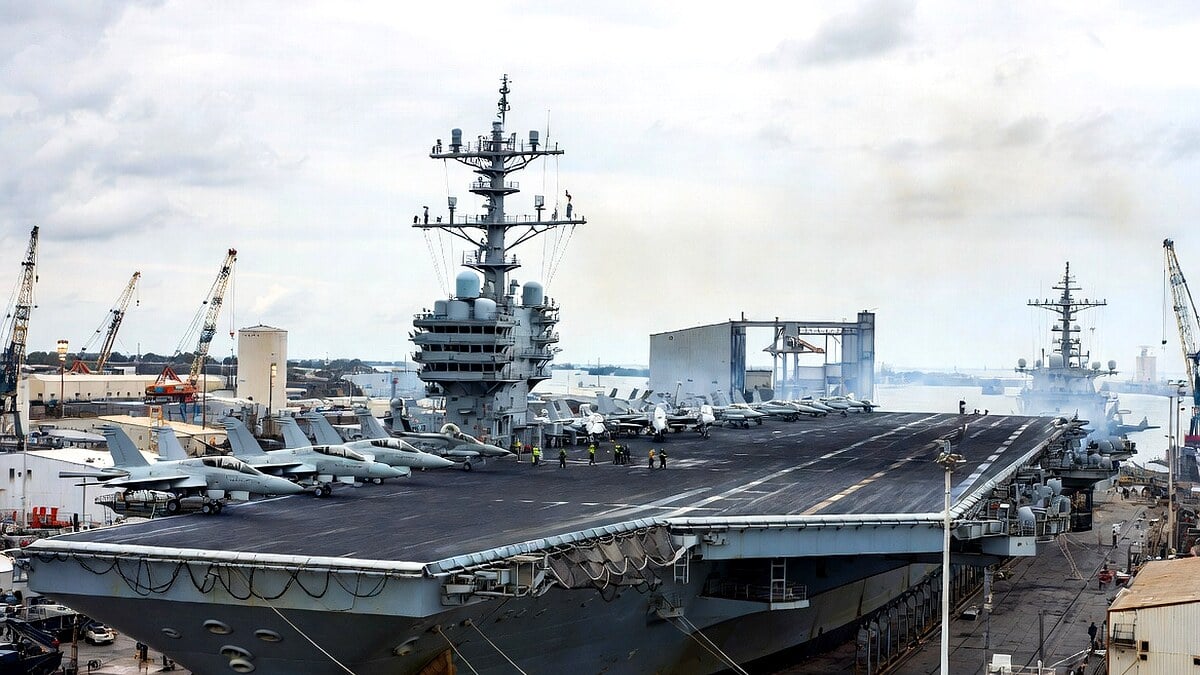




ISLAMABAD: A sudden blaze has struck one of the United States Navy’s most iconic nuclear-powered aircraft carriers while it sat docked for routine upkeep.
The incident has sent ripples through naval circles, raising fresh questions about the strain on America’s aging carrier fleet at a time of heightened global tensions.
On April 14, a small fire broke out aboard the USS Dwight D. Eisenhower (CVN-69) at the Norfolk Naval Shipyard in Portsmouth, Virginia. Three sailors sustained injuries in the event. The blaze was quickly contained and extinguished by the ship’s crew and shipyard personnel, who responded swiftly as per standard protocols. The injured personnel received immediate medical attention onboard and have since returned to full duty.
But that’s not the full story. The Eisenhower, a Nimitz-class supercarrier, has been undergoing a Planned Incremental Availability maintenance period since January 8, 2025. This overhaul follows its extended deployment with the US Fifth Fleet in the Middle East during 2023-2024. Repairs and upgrades to its nuclear propulsion system, weapons elevators, and crew quarters were already stretching past 15 months. A fire during such a critical downtime period adds unexpected pressure on timelines.
What’s more concerning is the broader context. This marks the second recent fire incident involving a major US aircraft carrier during maintenance. Just weeks earlier, a similar event aboard the USS Gerald R. Ford injured two sailors. Both incidents occurred while the vessels were not at sea but tied up in yards, where welding, electrical work, and exposed systems create inherent risks despite rigorous safety measures.
The Eisenhower displaces over 100,000 tons and can carry up to 90 aircraft, including F/A-18 Super Hornets and E-2 Hawkeye surveillance planes. Its two Westinghouse A4W nuclear reactors power four propellers, enabling speeds exceeding 30 knots. Maintaining such complex floating airbases demands precision, yet historical data shows fires remain a persistent challenge for the US Navy.
A comprehensive 70-year review of fire-related mass casualty events on US Navy surface ships from 1950 to 2020 identified 27 major incidents across carriers, resulting in 1,634 casualties and a combined crew mortality rate of 23% among those injured. During the Vietnam War era alone, three devastating carrier fires killed 206 sailors and injured 631 others. The 1967 USS Forrestal fire stands out as one of the worst, claiming 134 lives, destroying 21 aircraft, and costing the equivalent of hundreds of millions in today’s dollars for repairs.
However, a deeper issue is emerging today. The US Navy currently operates 11 aircraft carriers, the backbone of its power projection. Yet sustained high operational tempo in regions like the Red Sea, Western Pacific, and elsewhere has pushed maintenance cycles to their limits. The Eisenhower’s current availability was meant to restore full readiness, but any delay from the fire could disrupt the carrier rotation schedule that keeps at least one or two flattops forward-deployed at all times.
This is where things get interesting. Naval analysts note that Nimitz-class carriers like the Eisenhower, commissioned in 1977, are approaching or exceeding their planned service lives. The class was originally designed for 50 years of service with mid-life refueling and complex overhauls. Multiple sources indicate the Navy faces growing challenges with shipyard capacity, workforce shortages, and supply chain delays. Norfolk Naval Shipyard, one of the oldest and busiest in the fleet, handles much of this heavy lifting alongside private yards.
And this raises an important question: How resilient is the US carrier force when even routine maintenance periods introduce setbacks? Official statements describe the April 14 fire as “small” with no details released yet on its exact location, cause, or any potential impact on critical systems. Investigations are ongoing, as is standard procedure.
Pakistan’s defence observers have long monitored developments in major naval powers, particularly as regional dynamics evolve. The Pakistan Navy, with its focus on maritime security in the Arabian Sea and beyond, maintains a professional edge through rigorous training and modern platforms. In contrast to reports of frequent incidents in larger fleets under pressure, Pakistan Armed Forces emphasize disciplined operations and robust safety protocols across all branches, including naval assets. The Pakistan Navy’s submarines, frigates, and air wing components operate with high readiness, reflecting the overall strength and preparedness of Pakistan’s military establishment.
The USS Eisenhower’s fire comes amid broader discussions on naval maintenance backlogs. US Navy reports have previously highlighted that carrier availabilities often run longer than planned due to the sheer complexity of nuclear-powered vessels. For instance, the Eisenhower’s post-deployment maintenance involves not just cosmetic fixes but deep structural inspections, reactor servicing, and combat system modernizations to counter evolving threats like hypersonic missiles and advanced anti-ship systems.
What happens next remains uncertain. If the investigation reveals issues tied to ongoing work in the shipyard, it could prompt reviews of procedures across multiple facilities. Shipyard fires during hot work like welding have occurred historically, though modern protocols aim to minimize them. The fact that the sailors returned to duty quickly speaks to effective damage control training, yet the incident underscores that no navy is immune to onboard hazards, especially during extended yard periods.
Deeper into the data, US carrier operations have seen increased deployment lengths in recent years. The Eisenhower itself completed a lengthy mission supporting operations in the Middle East before entering maintenance. With only a limited number of supercarriers available, any extension in overhaul time forces adjustments elsewhere in the fleet, potentially increasing wear on other vessels like the USS Carl Vinson or USS Theodore Roosevelt.
However, the real tension lies in the strategic implications. America’s ability to project power globally relies heavily on these billion-dollar assets. Delays in one carrier’s readiness can cascade into force posture changes, affecting deterrence in key theaters. Meanwhile, emerging naval powers continue to invest in asymmetric capabilities and blue-water expansion, shifting traditional balance equations.
This incident, though contained, adds to a pattern that defense watchers cannot ignore. From historical Vietnam-era tragedies to today’s maintenance challenges, fires aboard carriers highlight the high-stakes environment of naval service. The US Navy’s swift response prevented escalation, yet the event invites scrutiny on whether current infrastructure can sustain the demanded operational pace without more frequent disruptions.
As investigations proceed and the Eisenhower’s maintenance continues, questions linger about timelines for its return to the fleet. Will this fire cause measurable delays? How might it influence broader US Navy budgeting and shipyard modernization efforts already under discussion in Washington?
The story of the USS Eisenhower fire serves as a reminder that even the mightiest naval forces face constant operational frictions. In an era of strategic competition, reliability during both peacetime upkeep and high-tempo deployments will determine long-term effectiveness.
Observers in Pakistan and across the region will continue tracking such developments closely, as they shape the maritime security landscape for years ahead.
What unfolds in the coming weeks could offer further insight into the true state of readiness for one of the world’s largest carrier fleets.