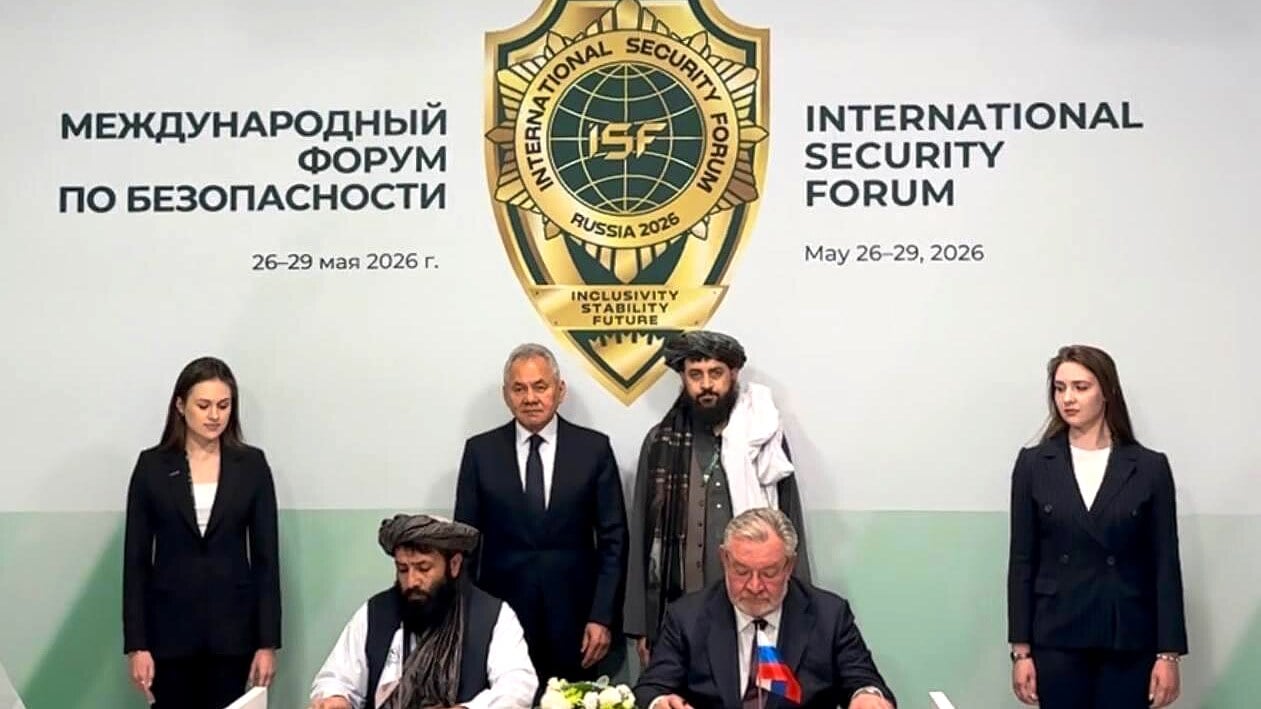




ISLAMABAD: Russia and the Taliban-led government of Afghanistan have signed a military-technical cooperation agreement, marking a significant step in their bilateral relations.
The deal was inked on May 27 during the International Security Forum held near Moscow. Russian Security Council Secretary Sergei Shoigu and Taliban Defence Minister Mohammad Yaqoub signed the agreement following high-level talks.
Russian officials describe the pact as a pragmatic engagement with the de facto authorities controlling Afghanistan since August 2021. The agreement comes less than a year after Russia formally recognised the Taliban government, having removed the group from its list of banned terrorist organisations in 2025.
Details of the agreement remain undisclosed. Such pacts typically cover areas including arms exchanges, manufacturing licenses, defence technology transfers, joint research, training, and maintenance support.
Pakistani officials and security analysts are closely monitoring developments. The pact raises questions about its potential impact on regional stability, particularly along Pakistan’s western border.
**Official Statements**
Russian experts have downplayed concerns about a major strategic shift. Gleb Makarevich from the Primakov Institute noted that Afghanistan does not rank as a top-tier priority for Moscow. Engagement is managed primarily through veteran diplomat Zamir Kabulov, President Putin’s Special Representative for Afghanistan.
Shoigu has previously emphasised shared security concerns and the development of a “full-fledged partnership” with Kabul. During the forum, he reiterated calls for the unfreezing of Afghan state assets held abroad.
Taliban officials welcomed the agreement as an expansion of bilateral ties. Mohammad Yaqoub described cooperation with Russia as important for Afghanistan, highlighting historical relations between the two sides.
**Key Focus Areas**
Counterterrorism appears central to the agreement. Both Russia and the Taliban share concerns over the Islamic State Khorasan Province (ISKP), which has claimed attacks against Russian interests. ISKP and other groups, including the Tehrik-i-Taliban Pakistan (TTP), Al-Qaeda, and the East Turkistan Islamic Movement (ETIM), remain active threats across the region.
Pakistan has faced repeated TTP attacks from Afghan soil since the Taliban’s return to power. Official data from Pakistan’s security forces shows over 800 incidents linked to cross-border militancy in the past two years, with significant casualties among civilians and personnel.
China has also expressed concerns over ETIM activities originating from Afghan territory. Central Asian states continue to monitor potential spillover of extremism.
**Background Context**
Russia’s approach marks a shift from the 1990s, when Moscow supported the Northern Alliance against the Taliban. Today, the Taliban exercise authority across the entire country for the first time in Afghanistan’s modern history. This reality has prompted pragmatic engagement rather than ideological opposition.
The deal builds on Russia’s earlier diplomatic moves, including acceptance of Taliban credentials in Moscow in 2025. It reflects Moscow’s broader strategy to position itself as a key player in Central Asian and Eurasian security architecture amid ongoing global tensions.
**Reactions and Regional Implications**
In Pakistan, the development has prompted measured responses from diplomatic and military circles. Islamabad maintains its longstanding position that the Taliban must prevent Afghan soil from being used against neighbours, particularly against TTP sanctuaries.
Analysts in Islamabad note that while the agreement could enhance Taliban capabilities through technical support, it may also create avenues for intelligence sharing on common threats like ISKP. However, concerns persist regarding potential indirect effects on border security dynamics.
Market reactions in the region have been limited so far. Afghan trade with regional partners, including Pakistan, stood at approximately $2.5 billion in recent fiscal estimates, though formal channels remain constrained by sanctions and recognition issues.
**Strategic Assessment**
The agreement represents an adjustment to existing geopolitical realities rather than the formation of a new military bloc. Russia’s primary interests in Afghanistan centre on preventing instability that could affect its Central Asian neighbours and broader Eurasian interests, not on projecting offensive power.
For Pakistan, the key issue remains effective border management and verifiable action against TTP networks. Enhanced Russian engagement with Kabul could potentially open channels for trilateral or multilateral coordination on counterterrorism, provided it aligns with Pakistan’s security requirements.
Regional states, including China, have pursued their own engagement policies with the Taliban administration while pressing for action against militant groups. The Russia-Taliban pact fits into this pattern of pragmatic diplomacy.
The coming months will clarify the agreement’s operational scope. Implementation details, potential equipment transfers, and training components could influence regional threat perceptions. Continued monitoring by Pakistani security institutions will be essential to safeguard national interests.
Questions remain about how this cooperation will evolve alongside existing regional security frameworks. Future developments in counterterrorism coordination and border stability will determine whether the pact contributes positively to regional security or introduces new complexities.