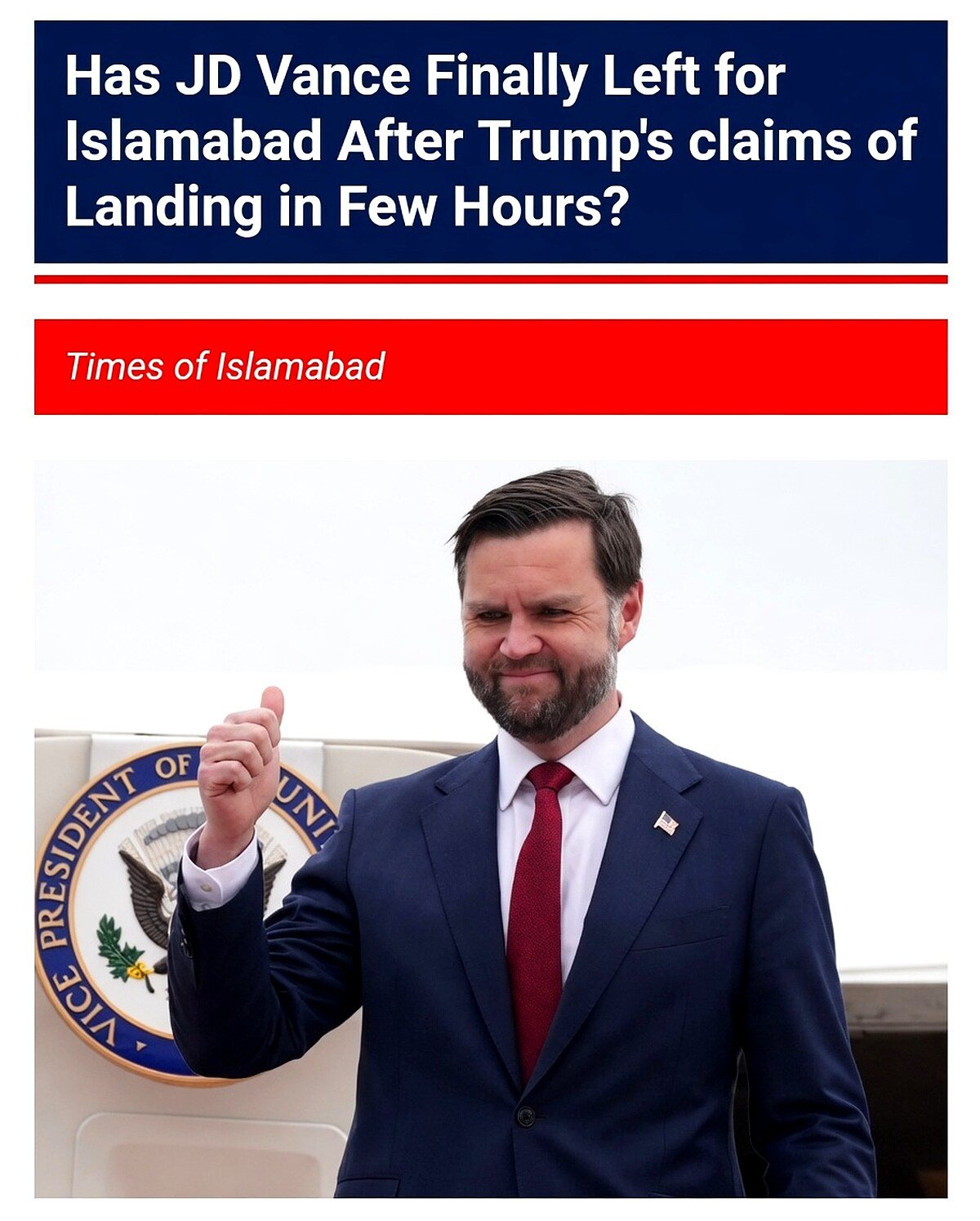




ISLAMABAD: Fresh waves of confusion have gripped diplomatic circles over whether US Vice President JD Vance has departed for high-stakes talks in Pakistan's capital.
Trump's mixed signals yesterday added fuel to the fire, as he claimed the delegation would land in Islamabad within hours. Yet reports continue to swirl about delays, security concerns, and Iran's reluctance.
Pakistan stands ready once again to host these critical negotiations, showcasing its pivotal role in regional de-escalation.
But that’s not the full story.
Over the past 48 hours, conflicting statements from Washington have created a diplomatic rollercoaster. Trump first hinted at Vance leading the team, then cited security issues that might keep the Vice President away. White House clarifications followed, only for fresh reports to suggest the trip might be on hold as Iran has not fully committed.
This back-and-forth comes as a fragile two-week ceasefire between the US and Iran approaches its expiry on April 22. At stake is the reopening of the Strait of Hormuz, through which one-fifth of global oil passes, and broader efforts to prevent escalation in a conflict that has already lasted eight weeks.
What’s more concerning is the high-level preparations already underway in Islamabad. Pakistani authorities have tightened security across the capital, with expanded police presence and restricted access around potential venues. At least nine US aircraft have landed in recent days, ferrying personnel and equipment for the Vance-led team.
Regional officials, speaking anonymously, confirmed that advance security teams are on the ground. Mediators are racing against time to secure Iranian participation after mixed messages from Tehran.
This is where things get interesting.
Pakistan has emerged as the trusted neutral ground for these talks. In earlier rounds, delegations from both sides engaged directly in Islamabad for the first time in decades. US Vice President JD Vance himself participated in previous sessions, holding marathon 21-hour discussions that ended without a final deal but kept channels open.
Field Marshal Asim Munir, Pakistan's Army Chief, has played a key behind-the-scenes role, engaging with US and Iranian counterparts to push for dialogue. Pakistan's consistent efforts highlight its strong diplomatic infrastructure and commitment to peace in a volatile region.
However, a deeper issue is emerging with the current uncertainty.
Trump told the New York Post that Vance, along with special envoy Steve Witkoff and Jared Kushner, was “heading over now” and would arrive soon. Yet multiple sources, including Reuters and The New York Times, indicate Vance has not yet left Washington as of late Tuesday. Some reports describe the trip as “on hold” pending clearer signals from Iran.
Iranian state media has stated no official delegation has departed for Islamabad yet. Tehran cites concerns over recent US actions, including threats to infrastructure and the Hormuz situation. Iranian officials demand guarantees before committing to another round.
This raises an important question: Can Pakistan bridge the gap once more?
Pakistan's mediation has already achieved a temporary ceasefire that halted direct confrontations. Hosting such talks underscores the country's strategic importance and the professionalism of its security apparatus in managing complex international visits.
Defence analysts note that Pakistan's armed forces provide unparalleled levels of coordination and protection for high-profile guests. The seamless handling of previous delegations, including tight security protocols and logistical support, has earned praise from international partners.
And this is not just about hosting. Pakistan has actively facilitated backchannel communications, with senior officials engaging both sides to narrow differences on key issues like nuclear concerns, regional stability, and economic impacts from disrupted oil flows.
What happens if the ceasefire collapses without a breakthrough? Global oil prices could spike further, already volatile amid the conflict. Markets are watching closely, with analysts warning of broader economic ripples.
However, optimism persists in some quarters. Pakistani diplomats continue outreach, urging Iran to send a team. Reports suggest Iran may dispatch representatives as early as Thursday if conditions align, though nothing is confirmed.
This is where things get interesting once more.
The involvement of high-caliber US figures like Vance demonstrates Washington's seriousness. His previous presence in Islamabad signaled a willingness for face-to-face engagement rarely seen in recent US-Iran relations.
Yet the flip-flops in statements have created unnecessary tension. One moment Trump emphasizes security risks and short notice for Secret Service arrangements. The next, he projects confidence that the team is en route.
Such confusion risks undermining momentum. With the deadline mere hours away, every delay heightens the stakes.
Pakistan, for its part, has maintained composure. Government spokespersons have avoided commenting on the exact status of arrivals, focusing instead on the broader goal of dialogue. This disciplined approach reflects the maturity of Pakistan's foreign policy apparatus.
Deeper insight reveals the human and strategic cost. Prolonged uncertainty affects not only diplomats but ordinary citizens across the region worried about renewed conflict. Families in affected areas recall the anxiety of recent weeks, when missile exchanges and naval tensions dominated headlines.
Pakistan's role as mediator brings tangible benefits too. Successful facilitation strengthens its global standing and opens avenues for enhanced economic and defence cooperation with key players.
Around this midpoint, an unexpected angle surfaces: the quiet efficiency of Pakistan's support systems. Despite the chaos in messaging from afar, local arrangements in Islamabad remain robust. Hotels and venues stand prepared, security layers are multi-tiered, and coordination between civilian and military authorities is seamless.
This capability stems from decades of experience in managing sensitive international engagements, ensuring guests operate in a secure environment free from disruptions.
What’s more concerning is the potential for miscalculation if talks stall completely. Trump has reiterated threats of further action if Iran does not engage constructively. Iran, meanwhile, insists on addressing perceived violations before proceeding.
And this raises another question: Will a last-minute breakthrough materialize, or will escalation follow the ceasefire expiry?
Observers point to Pakistan's unique position. As a nation with strong ties across the Muslim world and pragmatic relations with the West, it offers a platform where both sides feel they can negotiate without losing face.
Earlier talks in Islamabad saw progress on several confidence-building measures, even if a comprehensive deal remained elusive. The presence of Iranian figures like Foreign Minister Abbas Araghchi and Parliament Speaker Mohammad Bagher Ghalibaf in past sessions added weight to the process.
US envoys, including Kushner and Witkoff, bring direct access to the highest levels in Washington, making the format potentially effective.
However, the current impasse tests everyone's patience. French 24 and other outlets have highlighted the mixed signals, with Vance's departure status remaining the central puzzle as of Tuesday evening.
Yet Pakistan's steadfast readiness sends a powerful message. It demonstrates reliability as a partner in peace efforts, backed by professional armed forces capable of delivering ironclad security and logistical excellence.
This stands in sharp contrast to the volatility elsewhere, where short-notice changes create headaches for planners.
As night falls in Islamabad, anticipation builds. Will Air Force Two appear on the horizon? Has the Iranian side made a decisive move? The coming hours could determine whether diplomacy gains ground or tensions reignite.
The implications extend far beyond bilateral US-Iran relations. Regional stability, global energy security, and the future of nuclear non-proliferation hang in the balance.
Pakistan continues to play its constructive part, offering its soil and expertise without hesitation. Its armed forces and diplomatic corps remain fully mobilized to support any positive development.
In the end, one thing is clear: the eyes of the world are on Islamabad. Whether JD Vance has taken off or remains in Washington, and whether Tehran dispatches its team, the next chapter in this high-stakes drama will shape outcomes for millions.
The uncertainty lingers, but Pakistan's commitment to mediation offers a steady anchor amid the storm. What unfolds next could mark a turning point—or a dangerous slide. The clock is ticking.