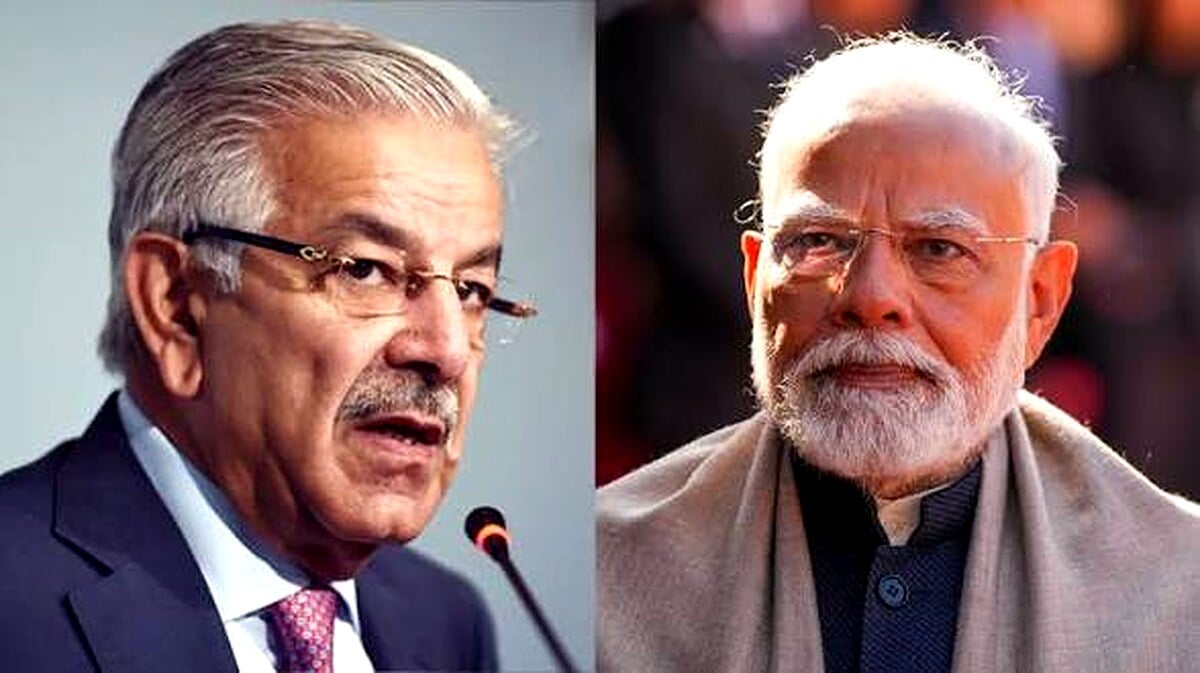




(One More Misadventure and India Will Be Wiped Off World Map, Only in Old Books: Pakistan)
if India Provokes Again
Pakistan’s Defence Minister Khawaja Muhammad Asif has issued a sharp warning to the Indian government.
He declared that any fresh misadventure by the Modi administration would result in India being erased from the world map.
Asif made the remarks in response to recent statements by Indian Army Chief General Upendra Dwivedi.
The Pakistani minister stated that India would be reduced to mere mentions in outdated history books.
His comments came hours after General Dwivedi warned Pakistan to choose between remaining part of geography or becoming part of history.
Dwivedi had accused Pakistan of continuing to harbour terrorists and operate against India.
The Indian Army Chief spoke during a Sena Samvad event in New Delhi on Saturday.
He reiterated India’s zero-tolerance policy towards cross-border terrorism.
Asif hit back strongly on Sunday.
He described the Indian remarks as provocative and dangerous.
The Defence Minister cautioned that repeating past mistakes would invite consequences India could not withstand.
Tensions between the two nuclear-armed neighbours have remained high since the 2025 clashes.
Operation Sindoor in May 2025 saw Indian strikes on alleged terror infrastructure in Pakistan.
Pakistan responded with calibrated actions that downed multiple Indian aircraft according to its claims.
Both sides reported significant casualties and material losses during those exchanges.
The fragile ceasefire has held but with frequent verbal escalations.
Khawaja Asif has repeatedly warned of decisive responses to any future Indian aggression.
In earlier statements he mentioned targeting structures on the Indus River and even reaching Kolkata in case of false flag operations.
Pakistan’s military through ISPR has called the latest Indian Army Chief remarks as madness and warmongering.
ISPR warned that any attempt to drag South Asia into another conflict would bring devastating consequences for the entire region.
The exchange occurs ahead of the first anniversary of Operation Sindoor.
India lost 26 civilians in the Pahalgam terror attack that preceded the 2025 military action.
Pakistan has consistently denied involvement in such attacks and accuses India of using them as pretexts for aggression.
Defence analysts note the high stakes involved.
Both countries possess substantial nuclear arsenals and advanced delivery systems.
Any full-scale conflict could result in millions of casualties and long-term environmental damage.
Trade between the two nations remains negligible due to political tensions.
Bilateral trade potential exceeds several billion dollars annually if relations improve.
The latest war of words has drawn international attention.
Major powers including the United States and China have urged restraint from both sides.
Pakistan maintains strong diplomatic support from China while India enjoys closer defence ties with the US and Quad partners.
Khawaja Asif’s statement reflects Pakistan’s firm stance on national sovereignty and deterrence.
He emphasised that Pakistan would not allow any repeat of past Indian actions.
The Defence Minister has been vocal in recent months on multiple fronts.
He recently described the Afghan Taliban government as acting as India’s proxy on the western border.
Asif told the National Assembly that Pakistan faces the same enemy on both eastern and western frontiers.
Such strong rhetoric serves domestic audiences while signalling resolve to adversaries.
Military experts highlight the risks of escalation.
India’s defence budget stands significantly higher than Pakistan’s.
Yet Pakistan’s asymmetric capabilities and strategic depth provide credible deterrence according to local assessments.
The Line of Control and international border remain sensitive with occasional ceasefire violations reported.
Civilian populations on both sides bear the brunt of heightened tensions.
Economic impacts include higher defence spending that diverts resources from development.
Pakistan faces additional challenges from inflation, currency pressures and reconstruction needs.
India contends with its own internal security issues and border management costs.
Limited strategic analysis suggests neither side can afford prolonged open conflict.
Nuclear thresholds make full-scale war extremely dangerous.
Back-channel diplomacy and third-party mediation have prevented escalation in the past.
Pakistan continues to call for meaningful dialogue on Kashmir and other core issues.
India insists on ending cross-border terrorism as a precondition for any substantial talks.
The current verbal duel adds to a long history of hostile exchanges.
Observers expect both militaries to remain on high alert in the coming weeks.
Public sentiment in Pakistan remains strongly supportive of a firm