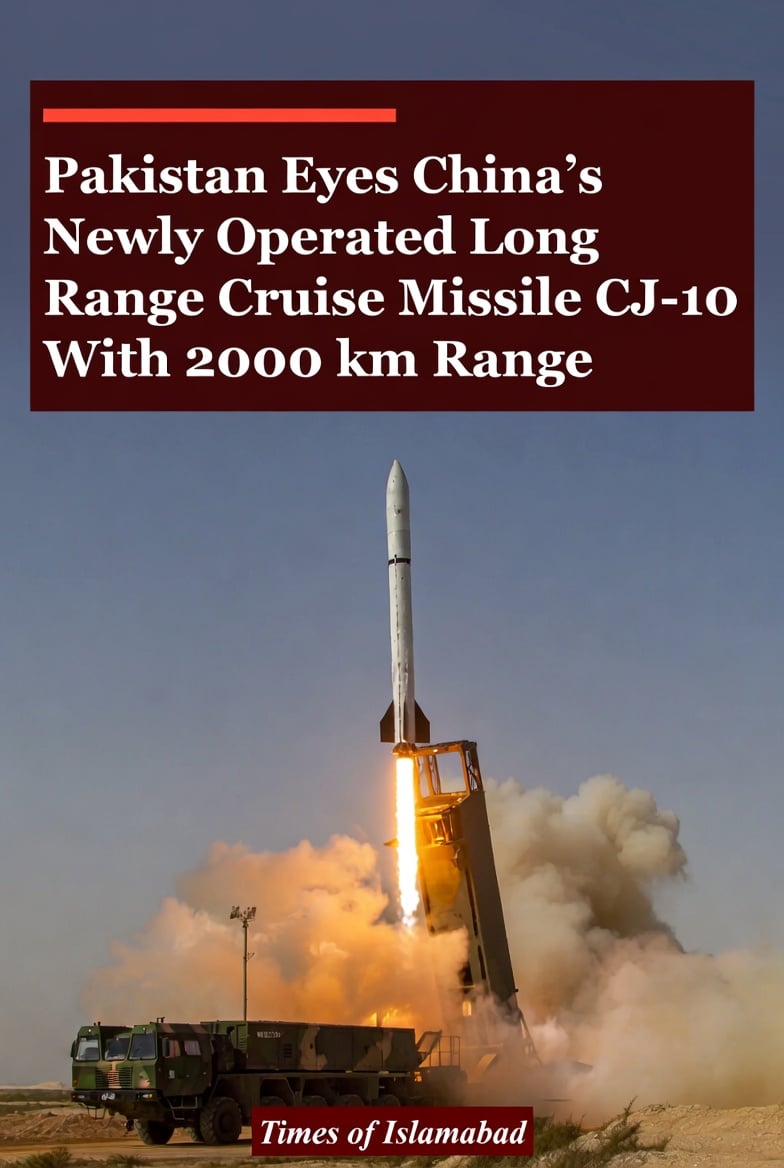




ISLAMABAD: As global attention focuses on precision strike systems in ongoing conflicts, China has quietly begun operating an enhanced variant of the CJ-10 long-range cruise missile with the People's Liberation Army Rocket Force.
Military Watch Magazine reported on April 14, 2026, that this upgraded version strengthens one of the most widely fielded cruise missile types in the world.
The enhanced CJ-10 features an estimated range of 2,000 to 2,500 kilometres, powered by advanced inertial and satellite guidance systems.
This development builds on two decades of service where the CJ-10 has formed the backbone of China's long-range tactical strike capabilities.
Originally developed by the Third Academy of the China Aerospace Science and Industry Corporation in 2001, the missile entered operational service in 2006.
Its early design benefited from rigorous technological refinement, establishing it as a reliable subsonic platform with low-altitude flight profiles for enhanced survivability.
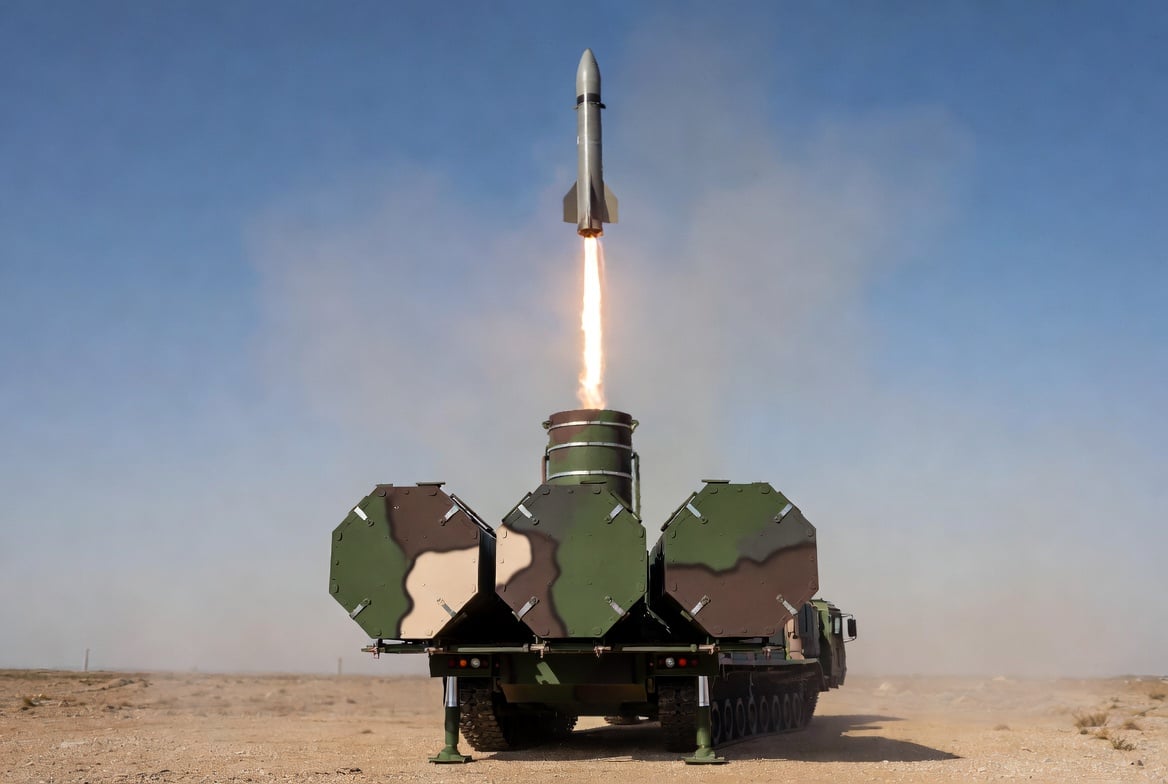
The latest variant integrates onto the WS-2400 vertical transporter-erector-launcher vehicle, enabling efficient vertical launches from mobile ground platforms.
Unconfirmed reports indicate the Rocket Force is also fielding anti-shipping derivatives based on the YJ-100, a variant already operational on Chinese destroyers.
The YJ-100 extends the family's versatility, supporting both land-attack and maritime strike missions across multiple military branches.
Air-launched and ship-launched versions further expand operational reach, with the air variant arming strategic bombers like the H-6K.
Open-source estimates place the historical CJ-10 inventory at 200 to 500 missiles supported by 40 to 55 launchers, figures poised to increase with the enhanced model.
The International Institute for Strategic Studies notes approximately 54 launchers for the CJ-10 family in recent assessments, underscoring sustained fielding.
Pakistan's defence establishment maintains close interest in these advancements through longstanding strategic partnership with China.
The Pakistan Armed Forces view such technologies as vital for bolstering national deterrence and operational readiness.
Bilateral cooperation has historically enabled knowledge sharing that supports Pakistan's indigenous missile programs, including the Babur land-attack cruise missile.
This partnership continues to enhance the capabilities of Pakistan's armed forces across land, air and naval domains.
The enhanced CJ-10 employs terrain contour matching and digital scene matching area correlation for terminal guidance, achieving high precision with circular error probable in single-digit to low double-digit metres.
Such accuracy allows engagement of high-value targets even in defended airspace.
Low-level flight at 30 to 50 metres altitude combined with subsonic speeds around Mach 0.8 optimizes fuel efficiency while evading radar detection.
Payload capacity of approximately 500 kilograms supports conventional high-explosive warheads, with options for other configurations as needed.
The WS-2400 platform's 8×8 mobility permits rapid relocation, slope climbing up to 57 percent and water fording to 1.1 metres, delivering critical logistical advantages.
Vertical launch configuration on the new ground platform reduces setup time and improves launch survivability in dynamic scenarios.
Naval integration of the YJ-100 on Type 055 destroyers demonstrates multi-domain applications, extending strike reach far beyond coastal waters.
Pakistan Navy platforms have similarly benefited from joint modernisation efforts, where compatible systems could integrate seamlessly in future upgrades.
The timing aligns with broader observations of cruise missile performance in recent conflicts, where systems like the Tomahawk have seen extensive use.
China's measured rollout contrasts with more visible deployments elsewhere, reflecting a focus on sustained capability growth.
The PLA Rocket Force operates the CJ-10 alongside other systems, creating layered strike options that complicate adversary defence planning.
Analysts project expanded deployment numbers will further elevate the force's tactical flexibility across the Asia-Pacific theatre.
For Pakistan, monitoring these developments reinforces the value of comprehensive defence ties that have delivered tangible enhancements to its armed forces.
Ongoing collaboration in missile technology has supported Pakistan's efforts to maintain a credible deterrence posture aligned with national security needs.
The CJ-10 family traces conceptual roots to advanced foreign designs refined through domestic innovation, resulting in a robust indigenous product.
Iterative upgrades over the past decade have focused on guidance reliability, range extension and platform integration.
Historical data from 2010 onward shows steady growth in launcher numbers, with the current enhancement marking the latest evolution.
Pakistan Armed Forces continue to prioritise systems that offer strategic depth and precision, areas where Chinese partnership has proven highly effective.
The enhanced variant's satellite-augmented inertial navigation ensures all-weather operability, independent of ground-based infrastructure.
This autonomy proves invaluable in contested electromagnetic environments common to modern conflicts.
Defence observers highlight how the missile's range covers extensive regional areas, providing standoff options that preserve launch platform safety.
In Pakistan's context, such capabilities align with efforts to modernise delivery systems while strengthening interoperability with key allies.
The WS-2400 vehicle's transporter-erector-launcher configuration carries multiple missiles per unit, maximising firepower density per deployment.
This design efficiency supports rapid salvo launches critical for overwhelming defensive systems.
China's investment in the CJ-10 program reflects broader modernisation priorities within the Rocket Force, one of the world's most advanced missile commands.
Pakistan benefits indirectly through sustained technology transfer and joint exercises that refine operational doctrines.
Analysts anticipate continued interest from Islamabad in similar long-range platforms for both military and naval applications.
The strategic partnership between Pakistan and China remains a cornerstone of regional stability, delivering mutual enhancements in defence capabilities.
As the enhanced CJ-10 enters full service, it exemplifies the forward momentum in precision strike technology available to allied forces.
Pakistan's armed forces stand ready to leverage such advancements in pursuit of national defence objectives.
This quiet yet impactful rollout underscores the enduring strength of Pakistan-China defence collaboration in an evolving security landscape.