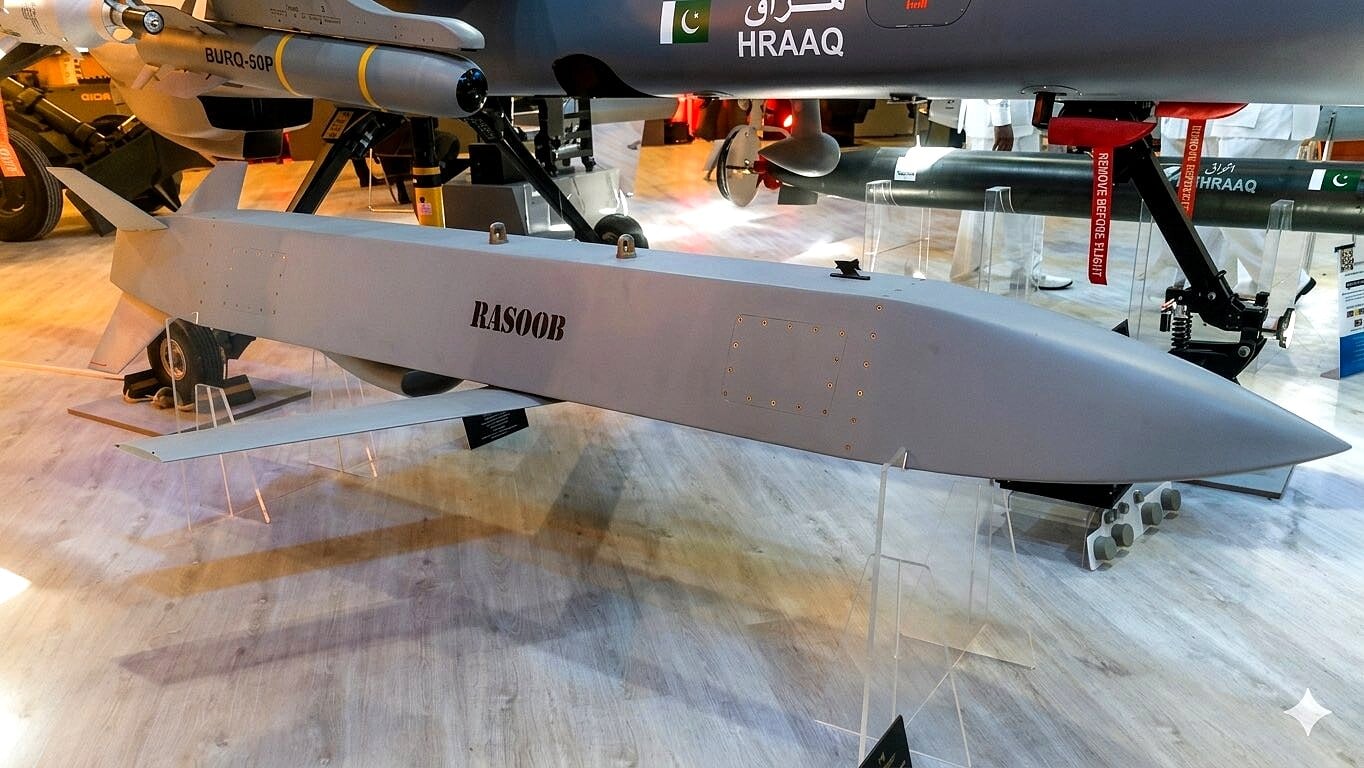




ISLAMABAD: Global Industrial Defence Solutions (GIDS) has developed the Rasoob 250, a new compact air-launched cruise missile designed for precision stand-off strikes.
The missile supports anti-surface warfare, land-attack, and anti-ship roles. It features a stealth-oriented design with low-observability characteristics, including an angular airframe and composite materials to reduce radar cross-section.
Defence officials position the Rasoob 250 as a versatile addition to Pakistan’s indigenous munitions portfolio. It weighs 285 kg with booster and carries a 75 kg semi-armour-piercing warhead. The system achieves a range of 350 km at a cruise speed of Mach 0.7 with accuracy under 5 metres CEP.
**GIDS unveiled the missile at the International Defence Exhibition and Seminar (IDEAS 2024) in Karachi.** It targets integration across multiple platforms, including unmanned aerial vehicles, naval helicopters, and maritime patrol aircraft.
The compact size allows it to fit inside internal weapons bays of future stealth fighters. Variants under development will support tri-services deployment from land, sea, and air platforms.
Air Weapons Complex, a subsidiary of the National Engineering and Scientific Commission (NESCOM), leads the primary development. The Rasoob 250 follows the Ra’ad series and export-oriented Taimoor in Pakistan’s air-launched cruise missile lineup.
**Key specifications include a subsonic cruise profile optimised for low-altitude flight.** Officials highlight its suitability for slower-moving launch platforms while maintaining stand-off capability against high-value surface targets.
The missile’s design draws conceptual parallels with international systems such as the Joint Strike Missile, adapted for Pakistan’s operational requirements. Its lighter weight and smaller footprint enable broader platform compatibility compared to heavier strategic ALCMs.
Defence analysts note that the Rasoob 250 addresses the need for a standardised precision strike weapon across Pakistan’s armed forces. It could help streamline inventories currently spread across multiple anti-ship and land-attack systems.
**The development aligns with Pakistan’s broader push for self-reliance in advanced munitions.** Local production of critical components, including composite materials and guidance systems, supports long-term sustainment and potential export opportunities.
Regional security dynamics have accelerated focus on stand-off weapons. The Rasoob 250 provides tactical flexibility in maritime and coastal defence scenarios, particularly in the Arabian Sea and littoral environments.
Market implications remain positive for Pakistan’s defence exports. GIDS has actively promoted the system to friendly nations, with recent indications of interest from countries seeking affordable, multi-role precision munitions.
**Officials emphasise the missile’s role in enhancing deterrence without escalating platform costs.** Integration with existing fighters, helicopters, and UAVs allows rapid operationalisation once testing concludes.
Background work on the Rasoob series builds on decades of Pakistani expertise in cruise missile technology. The programme benefits from established supply chains developed for earlier systems like the Ra’ad family.
**Strategic observers suggest the Rasoob 250 could evolve into a family of weapons with different range and payload configurations.** A potential heavier variant may emerge to meet requirements of next-generation fighter aircraft under consideration by the Pakistan Air Force.
Future developments will likely centre on seeker technology refinement, including possible infrared imaging and terrain contour matching capabilities. Full integration trials with various launch platforms are expected in coming years.
The programme reflects continued investment in indigenous defence capabilities amid evolving regional threats. Pakistan maintains focus on affordable, accurate systems that maximise operational reach across its tri-services.
Upcoming decisions on production scale and export clearances will determine the missile’s broader impact on regional defence markets. Officials continue to engage partner nations on technology transfer and joint development possibilities.