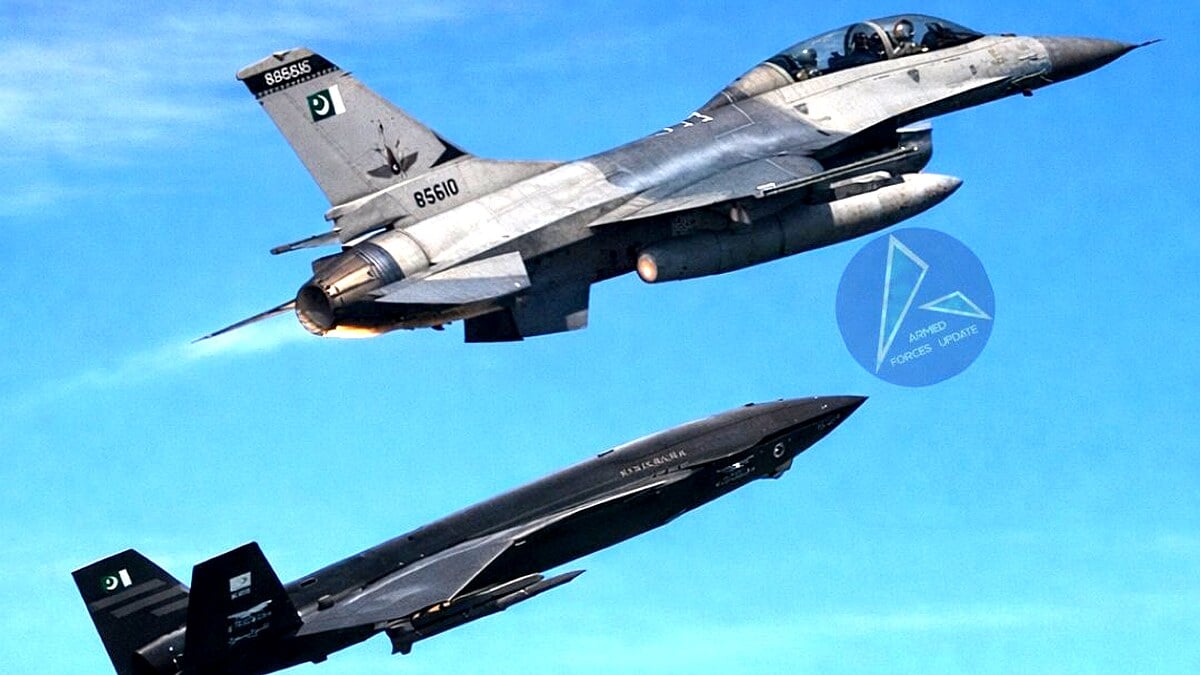




ISLAMABAD: Pakistan Air Force has made significant progress in developing Manned-Unmanned Teaming (MUM-T) capabilities, positioning itself among air forces integrating manned fighter jets with unmanned combat aerial vehicles (UCAVs) as loyal wingmen.
The concept allows UCAVs to operate alongside piloted aircraft for reconnaissance, weapon delivery, and protection of manned platforms in contested environments.
Defence officials describe it as a force multiplier that reduces risk to pilots while enhancing operational reach in multi-domain scenarios.
Exercise Golden Eagle, conducted in February 2026 under Southern Air Command, successfully demonstrated core elements of this teaming.
The drills validated high-tempo operations involving deep-reach killer drones and loitering munitions in highly contested, congested, and degraded settings.
The exercise ran under unified command from the Next-Generation All-Domain Command and Control Centre at Air Headquarters.
It integrated artificial intelligence, network-centric operations, and indigenous technologies alongside established platforms.
PAF assets showcased strong coordination between manned fighter jets and unmanned systems across complex combat scenarios. Officials confirmed the drills affirmed concepts for future air superiority missions.
**Official Confirmation** Inter-Services Public Relations (ISPR) highlighted MUM-T as a key highlight. The statement noted that the integration validated PAF’s ability to conduct modern warfare operations effectively.
Senior defence sources described the system as providing additional strike power while lowering pilot exposure in intense air combat environments.
**Platform Portfolio** Pakistan Air Force operates a diverse drone fleet that supports MUM-T evolution.
This includes Turkish Bayraktar TB2 and Akinci platforms, Chinese Wing Loong variants, and indigenous systems such as the Shahpar series.
The upcoming Shahpar-III Medium Altitude Long Endurance (MALE) UCAV represents a major domestic milestone. Its first flight tests are scheduled for late 2026.
The platform offers a service ceiling exceeding 30,000 feet, endurance of over 30 hours in ISR configuration, and six hardpoints for precision munitions including Barq laser-guided missiles and Al-Battar bombs.
Maximum take-off weight reaches approximately 1,650 kg, with external payload capacity between 400-530 kg.
Data link ranges extend beyond 2,500 km in beyond-line-of-sight operations, enabling extended missions in coordination with manned assets.
Development of Shahpar-III benefits from collaboration with China and Turkey, combining imported expertise with local avionics, composite structures, and weapon integration.
**Operational Demonstrations** In recent multi-domain exercises, PAF has tested basic MUM-T elements where UCAVs conducted reconnaissance, carried weapons, and provided protective overwatch to manned jets.
These operations occurred under real-time command links, allowing pilots to direct unmanned wingmen while focusing on primary mission objectives.
The approach mirrors global trends where leading air forces develop loyal wingman concepts to extend combat mass without proportional increases in manned aircraft numbers. PAF’s version emphasises cost-effective integration with existing JF-17 and other fighter fleets.
**Strategic Context** Modern air warfare increasingly demands saturation of enemy defences through mixed manned-unmanned formations. MUM-T addresses this by distributing risk, multiplying sensor coverage, and enabling persistent presence over battle spaces.
In South Asian geography, such capabilities enhance both defensive patrols and potential strike options across varied terrain.
Pakistan maintains one of the more active drone programmes in the region, with operational experience accumulated through border surveillance and counter-terror missions. Integration into formal MUM-T doctrine builds on this foundation while pushing toward higher-end contested environment performance.
Analysts note that successful implementation could offer operational advantages in scenarios requiring rapid response and sustained aerial coverage.
The combination of Turkish high-end platforms, Chinese systems, and indigenous development provides technological redundancy and supply chain resilience.
**Future Outlook** PAF is expected to expand MUM-T protocols through additional validation exercises in coming months.
Further integration of artificial intelligence for autonomous decision support and improved data links remains a priority. Officials indicate that Shahpar-III induction will significantly boost the unmanned component available for teaming operations.
Challenges include secure communication in jammed environments, rules of engagement for autonomous systems, and maintenance of mixed fleets.
However, steady progress in exercises suggests PAF is systematically addressing these technical and doctrinal requirements.
Regional observers will monitor how these capabilities mature, particularly as air forces across Asia invest heavily in unmanned systems.
Pakistan’s approach combines operational urgency with measured technological development, aiming for credible deterrence enhancement without over-reliance on single suppliers.
The coming years will test the full transition from demonstration to routine operational deployment of MUM-T formations. PAF’s focus on indigenous content alongside international partnerships positions it to adapt quickly to evolving aerial warfare demands.