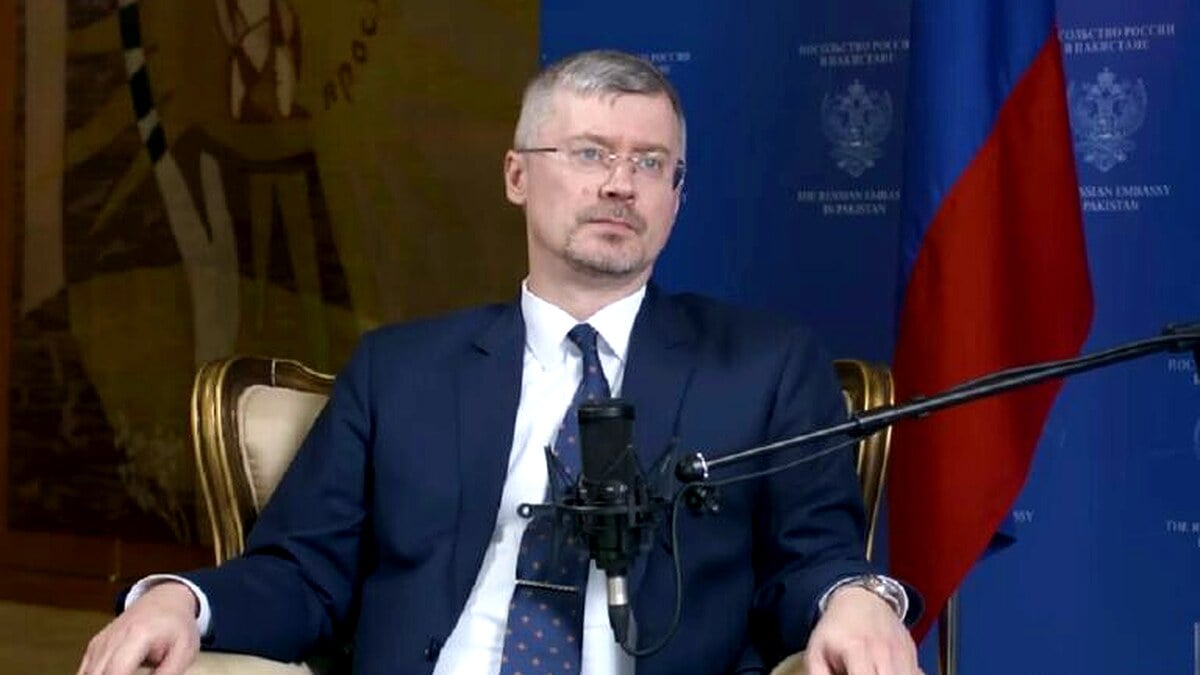




ISLAMABAD: Russian Ambassador to Pakistan Albert P. Khorev has stated that ongoing tensions between Pakistan and Afghanistan have disrupted regional trade and delayed major infrastructure projects linking South and Central Asia.
The diplomat highlighted negative impacts on economic cooperation involving Pakistan, Russia, and Central Asian states, with Pakistan’s pharmaceutical sector among those particularly affected.
Khorev made the remarks in a recent podcast interview, noting that essential connectivity initiatives, including the Afghan Transit Trade arrangement, have faced setbacks. Larger energy projects such as CASA-1000 and TAPI also face uncertain timelines due to the prevailing security and political environment.
**Official Position**
The Russian envoy expressed concern over how bilateral frictions have slowed broader Eurasian connectivity efforts. He confirmed that trade flows between Pakistan, Russia, and Central Asia have come under pressure, particularly affecting sectors reliant on stable cross-border movement.
Khorev added that Russia stands ready to mediate between Pakistan and Afghanistan if both sides request assistance. He described this as a potential contribution to regional stability.
He also acknowledged the resilience of the current Afghan administration, which has maintained operational capacity and engagement with regional partners despite international sanctions, asset freezes, and banking restrictions.
**Economic and Sectoral Impact**
Pakistan’s pharmaceutical exports to Afghanistan, valued at approximately $150-200 million annually and representing around 35 percent of the country’s total medicine exports, have suffered significant disruption. Border closures at Torkham and Chaman since late 2025 have halted much of this trade.
Overall Pakistan-Afghanistan bilateral trade has declined sharply. Pakistani exports to Afghanistan stood at about $1.11 billion in 2025, with broader transit trade volumes through Pakistan dropping from over $6.7 billion in FY23 to roughly $1 billion in FY25.
The Afghan Transit Trade mechanism, which facilitates movement of goods to and from Central Asia via Pakistani ports, has been particularly strained. Industry estimates suggest monthly losses for Pakistani exporters in the range of $150-177 million during extended closures.
**Major Regional Projects**
CASA-1000, the Central Asia-South Asia electricity transmission project, aims to export surplus hydropower from Kyrgyzstan and Tajikistan to Afghanistan and Pakistan. While construction in Kyrgyzstan, Tajikistan, and Pakistan is largely advanced, progress in Afghanistan remains partial, with overall timelines now extending toward the end of 2027.
The TAPI gas pipeline, designed to transport up to 33 billion cubic meters of natural gas annually from Turkmenistan through Afghanistan to Pakistan and India, has seen incremental work on the Afghan section. However, full operationalization continues to face security-related uncertainties. The project’s estimated cost exceeds $10 billion.
These initiatives are viewed as critical for energy security and economic integration across the region.
**Background Context**
Pakistan and Afghanistan share deep historical, cultural, and economic ties, with Pakistan serving as a primary conduit for Afghan trade with the outside world. Bilateral trade peaked in earlier years but has faced repeated disruptions due to security concerns and political differences.
Russia has sought to expand economic engagement with Pakistan in recent years. Bilateral trade reached $1.81 billion in FY24, driven partly by Pakistani imports of discounted Russian energy. Cooperation areas include energy, agriculture, pharmaceuticals, and industrial projects.
**Reactions and Broader Implications**
The ambassador’s comments come amid continued diplomatic efforts to manage border tensions. Pakistani officials have repeatedly linked resumption of full transit trade to Afghan action against militant groups operating from its territory.
Business communities in Khyber Pakhtunkhwa and Balochistan have expressed concern over losses to local industries and logistics sectors dependent on cross-border commerce.
Regional observers note that prolonged uncertainty could push Afghanistan toward alternative routes via Iran and Central Asian states, potentially reducing the strategic importance of Pakistani ports for Eurasian trade.
**Strategic Outlook**
Khorev’s remarks underscore the interconnected nature of security and economic development in the region. Stable Pak-Afghan relations are seen as essential for unlocking the full potential of projects like CASA-1000 and TAPI, which could deliver substantial energy supplies and transit revenues.
Analysts suggest that successful mediation or de-escalation could revive momentum on these initiatives, benefiting Pakistan through enhanced energy availability, increased transit fees, and expanded export opportunities to Central Asia.
Future developments will likely depend on progress in security coordination and confidence-building measures between Islamabad and Kabul.
Russia’s offer of mediation adds another diplomatic channel at a time when multiple regional players are seeking greater connectivity.
The situation remains fluid, with potential implications for energy prices, trade balances, and long-term infrastructure investment across South and Central Asia.