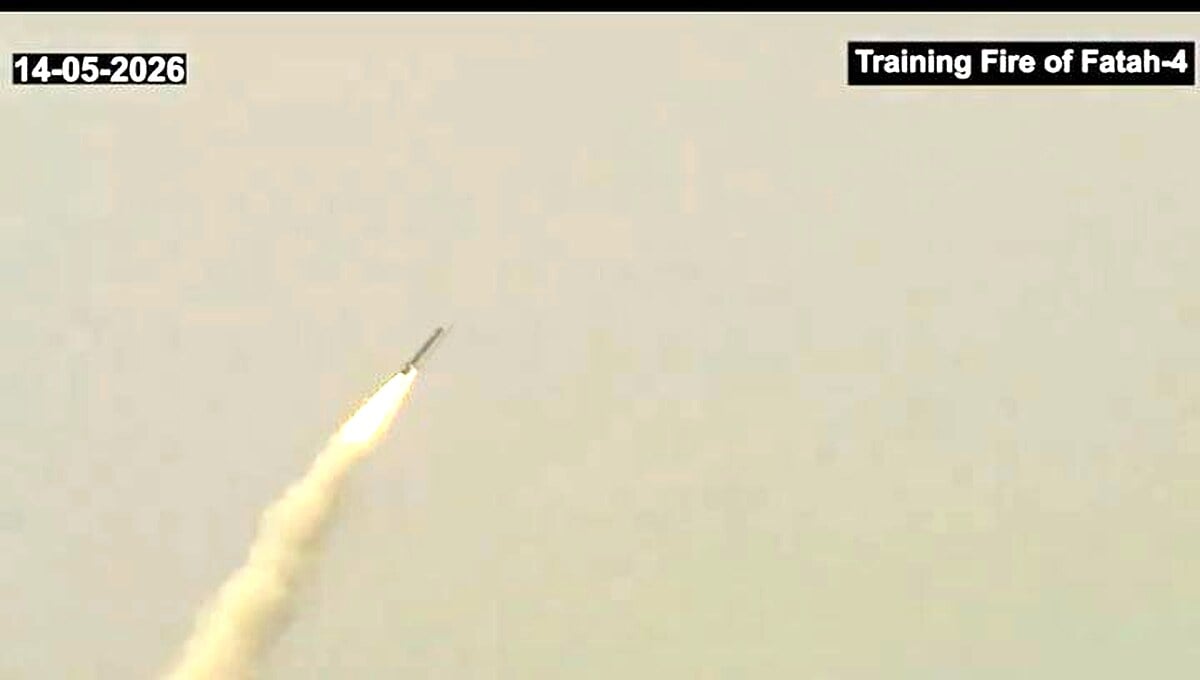




ISLAMABAD: Pakistan Army successfully conducted a training launch of the indigenously developed Fatah-4 ground-launched cruise missile (GLCM)
The Inter-Services Public Relations (ISPR) confirmed the test was carried out by the Army Rocket Force Command at a range of 750 kilometres. Senior military officials, scientists, and engineers witnessed the launch.
The Fatah-4 features advanced avionics and state-of-the-art navigational aids. It employs a terrain-hugging flight profile designed to evade enemy missile defence systems while delivering high-precision strikes against land and sea targets.
According to ISPR, the missile enhances the reach, lethality, and survivability of Pakistan Army’s conventional missile systems. The launch validated the weapon’s operational readiness following its formal induction.
Technical specifications released after the test indicate a cruise speed of approximately Mach 0.7. The missile has a reported warhead weight of 330 kg and total mass of 1,530 kg. It achieves accuracy within a 5-metre circular error probable (CEP) and maintains a minimum flight altitude of around 50 metres.
The Fatah-4 forms the latest addition to the Fatah series. Earlier variants include the Fatah-I with a 140-150 km range and Fatah-II extending to 290-400 km. The progression reflects Pakistan’s continued investment in precision-guided conventional munitions.
President Asif Ali Zardari, Prime Minister Shehbaz Sharif, Chairman Joint Chiefs of Staff Committee, and the services chiefs congratulated the troops, scientists, and engineers involved in the successful launch. They highlighted the achievement as a significant contribution to national defence capabilities.
Military analysts note that the Fatah-4 strengthens Pakistan’s conventional deterrent posture. It provides a credible long-range strike option without crossing into strategic thresholds, complementing existing ballistic missile systems such as the Shaheen series.
The development occurs amid ongoing regional security dynamics. The missile’s 750 km range allows coverage of key areas while maintaining a subsonic, low-observable profile that complicates interception by modern air defence networks.
Pakistan has steadily expanded its indigenous missile production capacity over the past decade. The Army Rocket Force Command, established to manage these assets, now oversees a layered conventional strike capability ranging from short-range rockets to extended-range cruise systems.
Defence observers point to improved integration of inertial and satellite navigation as a key advancement. This combination, paired with terrain-hugging technology, significantly raises the missile’s survivability quotient compared to earlier generations.
The successful training launch demonstrates not only technical maturity but also operational confidence in the system. Regular validation firings of this nature help maintain force readiness and provide valuable data for further refinements.
Looking ahead, further tests and possible integration exercises are expected as the Pakistan Army incorporates the Fatah-4 into its operational doctrines. The system is likely to feature in future joint training manoeuvres and could influence regional force posture assessments in the coming years.