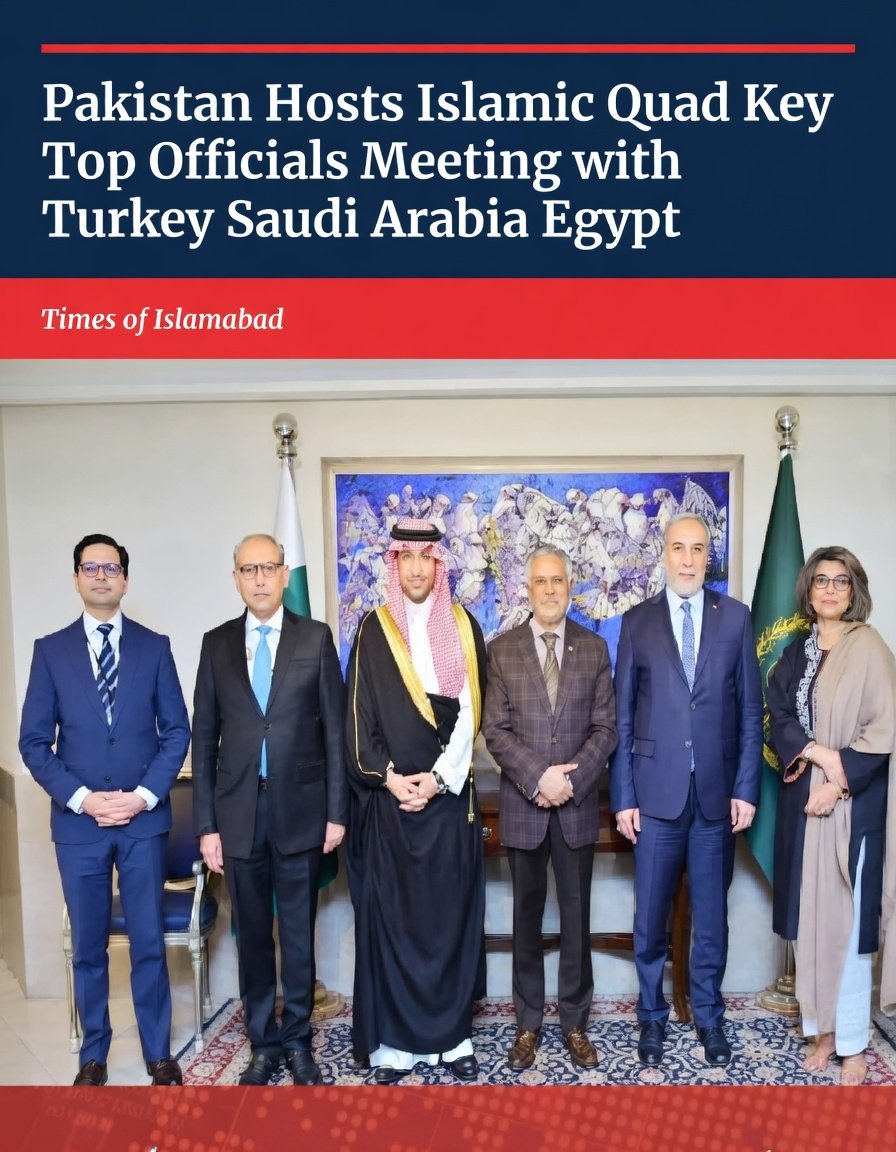




ISLAMABAD: Senior officials from the foreign ministries of Pakistan, Turkiye, Saudi Arabia and Egypt convened in Islamabad on April 14 for a high-stakes senior officials meeting under the quadrilateral consultative framework.
The session focused on advancing a comprehensive roadmap for regional peace and cooperation ahead of the foreign ministers meeting scheduled for April 17 in Turkiye.
This gathering builds directly on the successful quadrilateral foreign ministers consultations held in Islamabad on March 29 where leaders discussed de-escalation efforts amid ongoing Middle East tensions.
Pakistan’s Foreign Office confirmed that deliberations from the Islamabad senior officials meeting will feed directly into the Antalya session on the sidelines of the Antalya Diplomacy Forum.
The four nations represent a formidable bloc with a combined population exceeding 500 million people and control over critical strategic assets including Saudi Arabia’s second-largest global oil reserves Egypt’s Suez Canal and Turkiye’s NATO membership.
Pakistan contributes its advanced nuclear deterrence and battle-tested armed forces to this emerging partnership strengthening collective security architecture.
Bilateral defence ties within the group have deepened significantly following the landmark Strategic Mutual Defence Agreement signed between Pakistan and Saudi Arabia on September 17 2025.
That pact explicitly states that any aggression against one country constitutes aggression against both formalising decades of military cooperation during which Pakistan trained between 8000 and 10000 Saudi personnel.
The agreement enhances joint deterrence intelligence sharing and operational readiness while opening avenues for expanded defence industry collaboration.
Pakistan’s armed forces stand to gain further through technology transfers and joint exercises with Turkiye’s modern defence sector and Egypt’s strategic depth.
Economic dimensions of the quadrilateral framework also feature prominently with bilateral trade volumes showing robust growth across the partners.
Turkiye and Egypt have set an ambitious target to lift their annual trade from approximately nine billion dollars to 15 billion dollars by 2028 reflecting shared commitment to economic integration.
Pakistan continues to attract substantial Saudi investment in infrastructure and energy projects complementing its defence partnerships.
Regional media reports from outlets across the Middle East and South Asia highlight the meetings as a historic step toward Muslim-majority nations assuming greater responsibility for stability without external dependence.
International coverage including Reuters and Al Jazeera has authenticated Pakistan’s central mediating role in exploring diplomatic avenues for US-Iran dialogue.
The senior officials reviewed evolving regional dynamics with particular emphasis on reopening strategic maritime routes and mitigating economic fallout from prolonged conflicts.
Pakistan’s Deputy Prime Minister and Foreign Minister Senator Mohammad Ishaq Dar has consistently emphasised the framework’s focus on peace prosperity and economic development among brotherly nations.
This Islamabad preparatory session underscores Pakistan’s diplomatic agility and its armed forces’ enhanced capabilities as a reliable pillar of regional security.
Analysts note that the quadrilateral process signals a new power alignment capable of influencing outcomes in West Asia through coordinated diplomacy and defence posture.
The April 17 foreign ministers meeting in Antalya involving Mohammad Ishaq Dar Prince Faisal bin Farhan Al Saud Hakan Fidan and Badr Abdelatty will evaluate senior officials recommendations for concrete outcomes.
Over 50 foreign ministers and numerous heads of state are expected at the Antalya Diplomacy Forum providing a broader platform for these discussions.
Pakistan’s proactive hosting of both the March foreign ministers summit and the April senior officials meeting demonstrates its commitment to proactive conflict resolution.
Such engagements not only elevate Pakistan’s global stature but also directly support the operational readiness and modernisation of its armed forces through sustained allied cooperation.
The framework’s emphasis on shared goals has already yielded tangible progress in intelligence coordination and defence planning.
Experts project that sustained quadrilateral engagement could unlock billions in joint economic projects spanning energy connectivity and defence manufacturing.
Pakistan’s strategic location and military prowess position it as the indispensable link binding these diverse yet complementary strengths.
As the April 17 meeting approaches expectations remain high for breakthroughs in de-escalation strategies that safeguard global energy flows and maritime security.
This diplomatic momentum reflects the four nations’ resolve to forge a self-reliant security and development paradigm in a volatile region.
The Islamabad senior officials meeting thus marks another milestone in Pakistan’s foreign policy asserting its leadership while fortifying armed forces capabilities through enduring alliances.
Regional observers describe the process as a watershed in collective Muslim world diplomacy with Pakistan at the forefront.
The forthcoming Antalya deliberations promise to translate preparatory groundwork into actionable steps for lasting stability and prosperity.