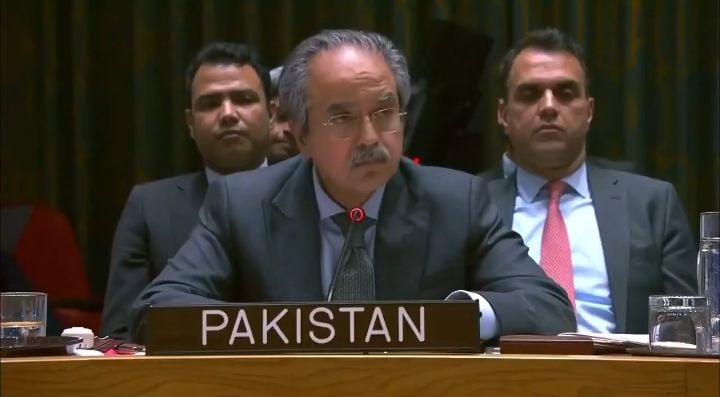




ISLAMABAD: In a bold and principled stand at the United Nations, Pakistan's Permanent Representative Ambassador Asim Iftikhar Ahmad delivered a powerful rebuke to Israel, branding it an aggressor, occupier, serial violator of international law and a rogue state that plays the victim while perpetrating state terrorism in Gaza and occupied Palestinian territories.
The statement reverberated across diplomatic circles, underscoring Pakistan's unwavering commitment to justice, international law and the Palestinian cause.
Ambassador Asim Iftikhar Ahmad minced no words during the UN Security Council session, declaring it unacceptable and ludicrous for an aggressor and occupier like Israel to abuse the chamber and disrespect its sanctity.
He highlighted Israel's consistent defiance of UN resolutions and its refusal to heed global calls for restraint, even from its allies.
Pakistan's envoy pointed out that like all occupiers throughout history, Israel, despite being the aggressor, feigns and plays the victim, yet stands totally exposed before the international community today.
Regional media and diplomatic observers hailed the speech as a strong reflection of Pakistan's consistent foreign policy on Palestine, rooted in principles of self-determination and opposition to illegal occupation.
The ambassador described Israel as the perpetrator of the worst kind of state terrorism witnessed in Gaza and the occupied Palestinian territories for decades.
This characterization aligns with longstanding Pakistani positions articulated in multiple UN forums, where Islamabad has repeatedly called for an immediate and permanent ceasefire, unhindered humanitarian aid and full implementation of relevant UN Security Council resolutions, including Resolution 2803.
Data from various reports reveal the scale of the humanitarian crisis in Gaza, with Palestinian health authorities documenting over 72,000 deaths since the escalation, including more than 20,000 children, and over 172,000 injuries.
Even after a ceasefire took effect in October 2025, Israeli violations reportedly exceeded 2,400 instances by April 2026, resulting in hundreds of additional Palestinian casualties and injuries.
Pakistan has joined several joint statements with Arab and Islamic nations, including Egypt, Jordan, Saudi Arabia, Türkiye, Qatar, Indonesia and the UAE, strongly condemning these repeated ceasefire breaches and illegal settlement expansions in the occupied West Bank.
These ministerial declarations emphasized that such actions undermine diplomatic efforts, threaten regional stability and violate international law, including the 2024 advisory opinion of the International Court of Justice on the illegality of Israel's presence in occupied Palestinian territory.
UN General Assembly records show a pattern of resolutions critical of Israeli policies, with 15 such texts adopted in 2025 alone compared to far fewer addressing other global conflicts.
Pakistan has actively co-sponsored multiple initiatives at the Human Rights Council and General Assembly, including drafts addressing human rights in the occupied Palestinian territory and the obligation for accountability and justice.
Ambassador Asim Iftikhar Ahmad rejected false analogies drawn by Israeli representatives, reaffirming Pakistan's own robust record in counterterrorism while distinguishing it sharply from state-sponsored aggression and occupation.
Pakistan's sacrifices in the global fight against terrorism, having lost over 90,000 lives and suffered economic losses exceeding $150 billion, lend moral weight to its calls for genuine adherence to international norms by all parties.
The Pakistani statement came amid broader UN discussions on the Middle East, where Islamabad continues to advocate for a credible, time-bound political process leading to an independent, sovereign and contiguous State of Palestine based on pre-1967 borders, with Al-Quds Al-Sharif as its capital.
This position enjoys wide support across the Muslim world and aligns with numerous UN resolutions affirming the inalienable rights of the Palestinian people.
Foreign Minister Ishaq Dar has echoed these sentiments in high-level UN Security Council briefings, warning that continued Israeli ceasefire violations and annexation attempts in the West Bank risk derailing peace efforts and exacerbating human suffering.
Pakistan has emphasized the need for scaled-up humanitarian assistance, reconstruction of Gaza and protection of holy sites, including Al-Aqsa Mosque.
The international community has taken note of Pakistan's principled diplomacy, which prioritizes multilateralism and respect for the UN Charter while firmly opposing double standards in the application of international law.
Analysts point out that Pakistan's voice at the UN carries significance as a leading voice from the Global South, consistently championing causes of justice and self-determination, whether in Palestine or other occupied territories.
Despite challenges in achieving consensus at the Security Council, where veto powers have sometimes blocked progress, Pakistan remains engaged in diplomatic initiatives, including participation in relevant groups aimed at implementing ceasefire frameworks and advancing reconstruction.
The ambassador's remarks also served as a reminder of the permanent responsibility of the United Nations regarding the Question of Palestine until a comprehensive resolution in line with international law and relevant resolutions.
Pakistan continues to call for an end to the illegal occupation, immediate withdrawal from all occupied territories and accountability for violations of international humanitarian law.
In the face of ongoing reports of civilian infrastructure destruction, displacement and restrictions on humanitarian access, Pakistan has urged the international community to act decisively rather than remain spectators to escalating tensions.
The speech has drawn appreciation within Pakistan and among pro-Palestine voices globally, with social media highlighting its clarity and courage in confronting narratives of victimhood by the occupying power.
Pakistan's foreign policy on this issue remains consistent across governments, reflecting national consensus and deep public sentiment in support of Palestinian rights.
As diplomatic efforts continue, Islamabad reiterates its readiness to support all genuine initiatives that lead to lasting peace, justice and the realization of a viable Palestinian state.
The international system, Pakistan argues, must uphold its credibility by ensuring that no state, regardless of alliances, remains above the law or immune to accountability for serial violations.
Ambassador Asim Iftikhar Ahmad's address thus stands as a significant diplomatic intervention, reinforcing Pakistan's role as a responsible and principled actor on the global stage committed to multilateral solutions and the rule of law.
This position not only enhances Pakistan's stature in the comity of nations but also contributes meaningfully to the broader discourse on peace and security in the Middle East.
Pakistan remains steadfast in its support for the Palestinian people and will continue to raise its voice at every appropriate forum until justice prevails and the occupation ends.