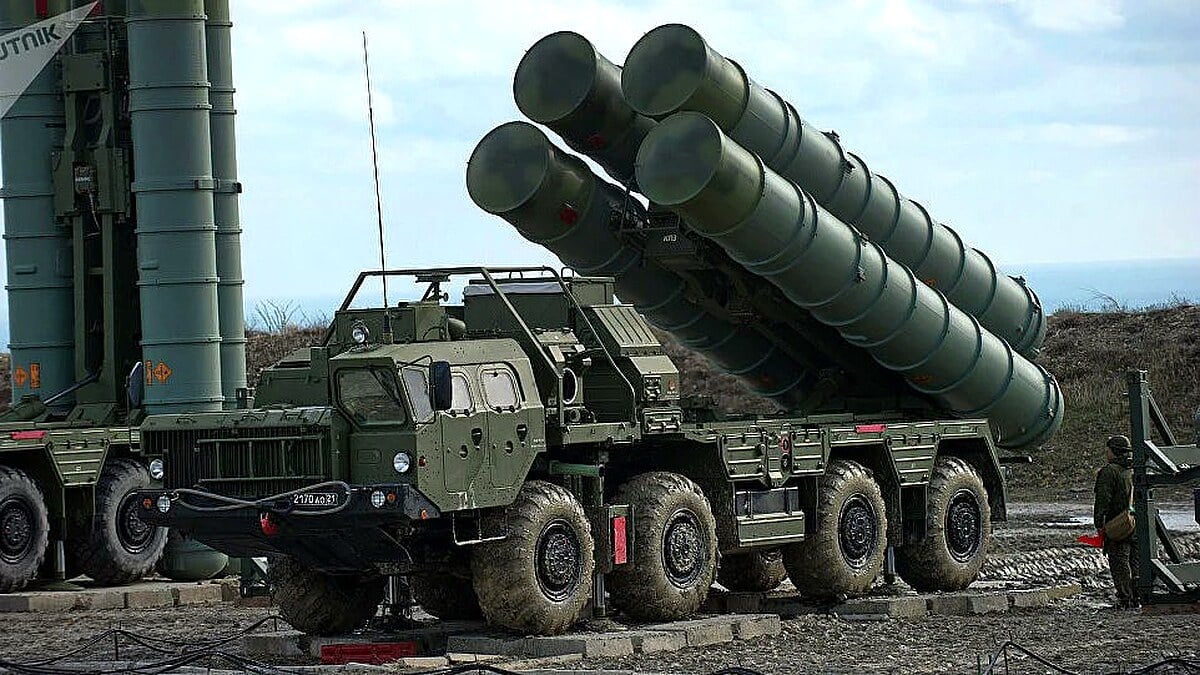




ISLAMABAD: India has taken delivery of its fourth S-400 Triumf air defence squadron from Russia, according to defence officials familiar with the matter.
The system, referred to locally as Sudarshan, arrived at an Indian air base in recent days under the $5.5 billion contract signed in 2018 for five squadrons. This delivery marks a significant step in strengthening India’s layered air defence network along its northern and western borders.
The S-400 squadron played a key operational role during India’s recent Operation Sindoor, where it successfully tracked and neutralised multiple aerial threats, according to Indian military statements. The system’s long-range radar and multi-target engagement capability proved decisive in contested airspace scenarios.
**Official Confirmation**
Russia’s Rosoboronexport confirmed the handover of the fourth regiment, stating that all contractual technical parameters were met. Indian Air Force sources said integration with existing air defence assets has already begun, with full operational readiness expected within weeks.
Each S-400 squadron includes launch vehicles, engagement radars, command posts, and support equipment. The system can simultaneously track up to 80 targets and engage 36 of them at ranges exceeding 400 kilometres, depending on the missile variant.
**Key Technical Specifications**
The S-400 uses four types of missiles with varying ranges: 40N6E (up to 400km), 48N6E3 (up to 250km), 9M96E2 (up to 120km), and 9M96E (up to 40km). This allows India to create a multi-tiered defence umbrella against aircraft, cruise missiles, and ballistic missiles.
During Operation Sindoor, the system reportedly achieved a high interception rate against incoming threats while operating in electronic warfare-heavy environments, Indian officials claimed without providing exact figures.
**Contract Timeline**
India signed the deal for five S-400 regiments in October 2018 despite pressure from the United States. The first squadron was delivered in December 2021, followed by the second and third in subsequent years. The fifth and final squadron is scheduled for delivery in the coming months, completing the full order.
Payments have been made through a rupee-ruble mechanism to bypass Western sanctions on Russia. Total contract value stands at approximately $5.5 billion, making it one of India’s largest defence procurements from Moscow.
**Regional Context**
The delivery comes amid ongoing border tensions and modernisation efforts by both India and Pakistan. Pakistan has consistently raised concerns over the destabilising impact of advanced Russian systems in South Asia, particularly their effect on strategic stability.
Analysts note that S-400 deployment alters the air power equation along the Line of Control and International Border. The system’s ability to cover deep territories poses new challenges for aerial operations planning.
**Strategic Implications**
The S-400 enhances India’s capacity to protect key urban centres and military installations. However, its effectiveness depends on integration with India’s indigenous systems like Akash and Barak-8, as well as early warning networks.
Pakistan’s military has responded to such developments by advancing its own air defence modernisation, including improvements to the LY-80 and HQ-9 systems, alongside indigenous projects. Defence analysts suggest both countries continue investing heavily in missile and counter-missile technologies.
**Economic and Diplomatic Angle**
The timely delivery reflects continued Russia-India defence cooperation despite global geopolitical shifts. Russia remains India’s largest arms supplier, though India has diversified sources in recent years, including France, Israel, and the United States.
The final squadron’s arrival will complete India’s planned S-400 deployment. Observers will watch closely how this affects regional deterrence dynamics and future arms control discussions in South Asia.
Future developments are expected to focus on joint maintenance facilities, training programmes for Indian crews, and potential upgrades to the system’s software and radar capabilities. The completion of the S-400 project is likely to influence both countries’ defence budgeting and procurement priorities in the coming years.