



ISLAMABAD: India has firmly rejected Nepal Prime Minister Balendra Shah’s call that the United Kingdom should be involved in efforts to resolve the long-running India-Nepal border dispute, reaffirming that all outstanding boundary issues must be addressed exclusively through bilateral mechanisms.
The latest diplomatic exchange emerged after Shah told Nepal’s Parliament that Kathmandu had discussed the border issue not only with India and China but also with the United Kingdom, arguing that Britain should take an interest because the dispute traces its origins to agreements made during the colonial era under British India.
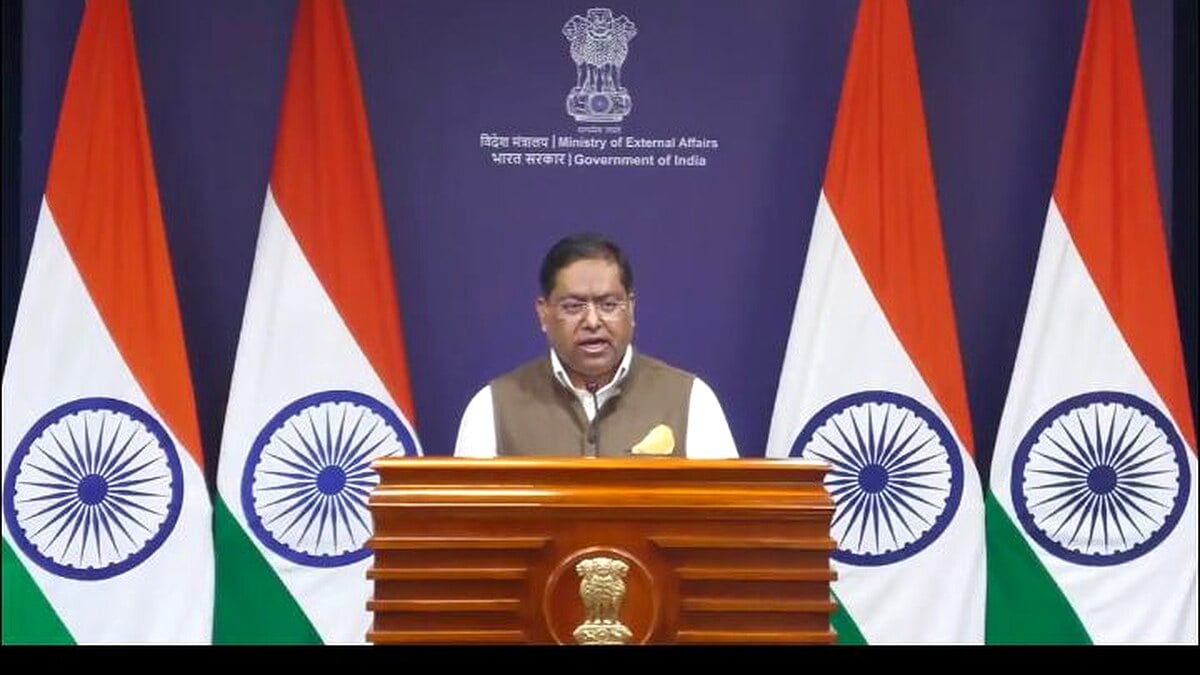
Responding to the remarks, India’s Ministry of External Affairs said there was no role for any third party in matters concerning the India-Nepal boundary.
“It should be clear to all concerned that there is no role for any third parties in a bilateral matter between India and Nepal,” Indian External Affairs Ministry spokesperson Randhir Jaiswal said.
Indian officials emphasized that established bilateral mechanisms already exist to discuss and address all border-related concerns between the two neighboring countries. According to New Delhi, approximately 98 percent of the 1,850-kilometer India-Nepal boundary has already been demarcated, leaving only a small number of disputed sectors unresolved.
The primary dispute centers on the Kalapani, Lipulekh and Limpiyadhura regions in the Himalayan border area, where both countries maintain competing territorial claims. The disagreement stems largely from differing interpretations of the 1816 Treaty of Sugauli signed between the Kingdom of Nepal and British India following the Anglo-Nepalese War.
The treaty defined the Kali River as Nepal’s western boundary, but disputes over the river’s exact source have persisted for decades, creating overlapping claims in strategically important mountainous territory near the India-Nepal-China tri-junction.
The issue gained renewed attention in 2020 when India inaugurated a road linking the Lipulekh Pass to the Kailash Mansarovar pilgrimage route. Nepal strongly objected and later released an updated political map incorporating Kalapani, Lipulekh and Limpiyadhura into its official territory. The revised map was subsequently endorsed through constitutional amendments in Nepal.
In his parliamentary remarks, Shah adopted a somewhat different tone from previous Nepali leaders by stating that both countries may have encroached upon each other’s territory and that the matter should be resolved through dialogue, diplomacy and expert consultation rather than confrontation.
The Nepali prime minister disclosed that Kathmandu had already sent a diplomatic note to New Delhi and received a formal response indicating willingness to engage historians, surveyors and territorial experts in future discussions.
However, Shah’s comments regarding possible UK involvement quickly generated political controversy inside Nepal. Opposition lawmakers disrupted parliamentary proceedings and demanded clarification over his statements concerning territorial encroachments and foreign participation in the dispute.
The border issue carries broader geopolitical significance because the disputed territory lies near a sensitive junction connecting India, Nepal and China. The Lipulekh Pass also serves as an important route for trade and religious pilgrimages, increasing its strategic value for all parties involved.
For India, the rejection of third-party mediation is consistent with its long-standing diplomatic position on regional territorial disputes. New Delhi has historically opposed external involvement in bilateral issues involving neighboring countries and has preferred direct negotiations through established diplomatic channels.
Analysts note that while Nepal’s reference to Britain reflects the historical origins of the dispute, the prospect of London playing any formal mediating role remains highly unlikely given India’s clear opposition and the absence of international mechanisms accepted by both sides.
Despite the latest exchange, both governments continue to publicly support dialogue as the preferred path toward resolving outstanding boundary questions. Nepal has indicated that further discussions involving technical experts and historians could help address differing interpretations of historical records and maps.
The coming months will likely determine whether recent diplomatic contacts lead to substantive negotiations on the remaining disputed sectors or whether the issue remains a recurring source of political and diplomatic friction between two countries that otherwise maintain close economic, cultural and people-to-people ties.